
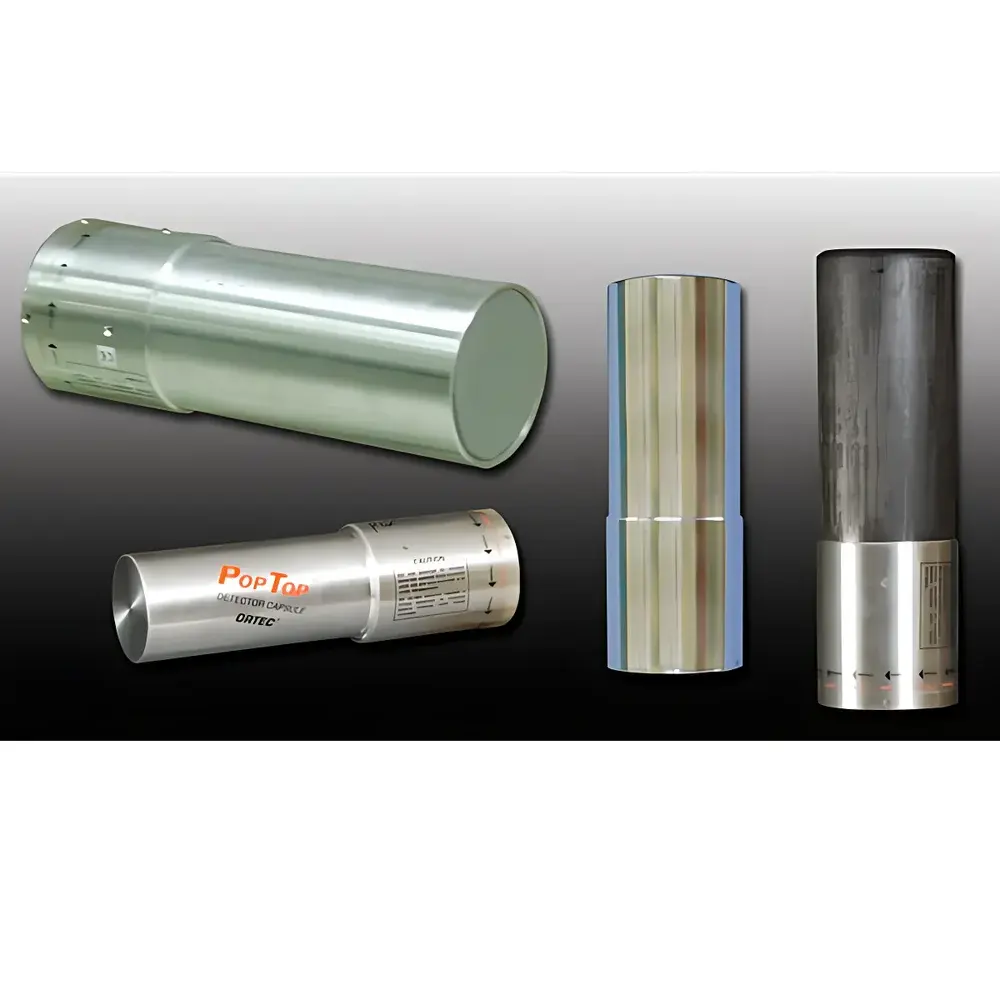
ORTEC PROFILE GEM-C / GEM-S / GEM-SP Series P-type Optimized All-in-One High-Purity Germanium (HPGe) Gamma Spectrometer
| Brand | ORTEC |
|---|---|
| Origin | USA |
| Model(s) | GEM-C, GEM-S, GEM-SP |
| Detector Type | P-type Coaxial Optimized All-in-One High-Purity Germanium (HPGe) Spectrometer |
| Radiation Type | Gamma (γ) Rays |
| Energy Range | 3 keV – 10 MeV |
| Energy Resolution | 1.8–2.3 keV FWHM at 1332 keV (varies by detector model and relative efficiency) |
| Application Class | Laboratory-Based Gamma Spectrometry |
| Compliance Context | ASTM E1452, ISO 8519, IEC 61452, ANSI N42.14, USP <1051>, FDA 21 CFR Part 11 (software-enabled), GLP/GMP-ready audit trail support |
Overview
The ORTEC PROFILE GEM-C, GEM-S, and GEM-SP Series represent a family of laboratory-grade, P-type coaxial high-purity germanium (HPGe) gamma spectrometers engineered for precision nuclear spectroscopy across environmental monitoring, health physics, safeguards verification, waste assay, and regulatory compliance applications. These detectors operate on the principle of gamma-ray photon interaction with crystalline germanium, generating electron-hole pairs proportional to incident photon energy—enabling high-fidelity energy-dispersive measurement via cryogenic semiconductor detection. Unlike conventional HPGe systems constrained by fixed geometry or compromised resolution-efficiency trade-offs, the PROFILE platform implements application-driven crystal optimization: each series (F, S, SP, M, C) is defined by distinct physical dimensions, contact architecture, and window composition to maximize absolute counting efficiency, low-energy response, or peak symmetry under specific sample geometries—whether point sources, Marinelli beakers, filter papers, or bulk containers. All models are manufactured in the United States and certified to IEEE Std. 325–2017 for relative efficiency calibration, with guaranteed crystal dimensions ensuring metrological traceability and inter-laboratory reproducibility.
Key Features
- P-type coaxial HPGe crystal architecture with ultra-stable, sub-100 nm dead layer front contact—prevents degradation during ambient storage (no room-temperature dead-layer growth in GEM-S, GEM-SP, and GEM-C models)
- Application-specific geometric optimization: F-series (“ultra-square”, diameter > length) maximizes efficiency for end-cap–mounted samples; S-series extends usable energy range down to 3 keV via proprietary thin entrance window; SP-series adds low-noise rear contact for enhanced resolution at low-to-mid energies (3–200 keV)
- C-series combines Marinelli-optimized geometry with S-series entrance window, enabling simultaneous high-efficiency measurement from 3 keV to >3 MeV in a single detector
- Integrated cryogenic infrastructure options: PopTop and Streamline dewars; optional Integrated Cryocooler System (-ICS-E) eliminates warm-up/cool-down downtime, enabling continuous operation without thermal cycling losses
- SMART-1 bias monitor (-SMP): embedded high-voltage regulation, tamper-evident checksum logging, and ABS-sealed connector housing for moisture resistance and long-term reliability
- Ultra-low-background construction options: carbon-fiber endcaps (-RB, -LB-C, -XLB-C) reduce intrinsic background by minimizing Z-dependent X-ray fluorescence; beryllium window (-B) further enhances transmission below 5 keV
Sample Compatibility & Compliance
The PROFILE GEM series supports standardized sample configurations aligned with international measurement protocols. F-, S-, and SP-series detectors are optimized for direct end-cap placement of point sources, air filters, planchets, and small-volume containers per ASTM D3648 and ISO 11929. M- and C-series detectors are dimensionally matched to standard Marinelli beakers (e.g., 400 mL, 1 L), achieving maximum solid-angle coverage and certified absolute efficiency per IEC 61452 Annex B. All configurations comply with EPA Method 901.1, DOE Order 440.1B, and EURATOM safeguards requirements for radionuclide quantification. Detector performance data—including measured relative efficiency, peak-to-Compton ratio, and resolution at 1332 keV—are traceable to NIST SRM 4355B and reported in accordance with ISO/IEC 17025:2017 calibration documentation. Optional SMART-1 and remote preamplifier (-HJ) configurations support 21 CFR Part 11-compliant electronic records with full audit trail, electronic signatures, and secure data integrity controls.
Software & Data Management
ORTEC’s GammaVision® v9.10+ software suite provides full spectral acquisition, nuclide identification (using ISO 11929–based decision thresholds), activity calculation (with self-absorption and geometry corrections), and uncertainty propagation per GUM (JCGM 100:2008). The system supports automated library matching against IAEA NuDat 3.0, ENDF/B-VIII.0, and EPDL97 databases. When configured with SMART-1 or ICS-E hardware, GammaVision logs real-time detector diagnostics—including bias voltage stability, cryostat temperature drift, and preamplifier gain consistency—enabling predictive maintenance and GLP audit readiness. Data export complies with ASTM E1399 for XML-based spectral interchange and supports CSV, SPE, and CNF formats for third-party analysis pipelines. Multi-user role-based access control, encrypted database storage, and configurable electronic signature workflows satisfy FDA 21 CFR Part 11 and EU Annex 11 requirements.
Applications
- Environmental radioactivity monitoring: soil, sediment, water, and air filter analysis for 137Cs, 40K, 210Pb, 241Am, and uranium/thorium series isotopes
- Health physics & internal dosimetry: lung counting, thyroid bioassay, and whole-body counter validation using low-energy emitters (239Pu, 241Am, 125I)
- Nuclear safeguards & non-proliferation: verification of spent fuel isotopic composition, enrichment determination, and fissile material assay
- Radioactive waste characterization: drum assay, MARSSIM-compliant surveying, and LLW/ILW classification per 10 CFR 61
- Reference material certification: NIST-traceable activity assignment for CRM production and inter-laboratory comparison studies
- Research spectroscopy: coincidence summing correction, cascade summing analysis, and low-background astrophysics experiments
FAQ
What distinguishes the GEM-S from the GEM-SP series?
The GEM-SP incorporates a proprietary low-noise rear contact in addition to the GEM-S’s ultra-thin front window, delivering improved energy resolution—particularly below 200 keV—without sacrificing low-energy efficiency or thermal stability.
Can the same detector be used for both environmental soil samples and Marinelli beaker assays?
No. F/S/SP-series detectors are optimized for end-cap geometry; M/C-series are dimensionally tuned for Marinelli beakers. Using an F-series detector in a Marinelli configuration reduces absolute efficiency by up to 40% compared to a matched M-series unit.
Is resolution guaranteed at time of delivery?
Yes. Each detector is individually characterized per IEEE Std. 325–2017. Measured resolution at 1332 keV, relative efficiency, and peak shape parameters are provided in the Certificate of Calibration shipped with the instrument.
How does the -ICS-E cooling system improve operational uptime?
Unlike liquid nitrogen dewars requiring 3-day re-cooling after warm-up, the ICS-E achieves full operating temperature (<77 K) within 4 hours post-power-on, eliminating scheduled downtime and supporting 24/7 unattended acquisition.
Are low-background options necessary for routine environmental lab work?
For MDA-sensitive applications—such as 210Pb or 40K in drinking water—the -XLB-C carbon fiber endcap reduces continuum background by 30–50%, directly lowering MDA by up to 2× at 46.5 keV without extending count time.







