
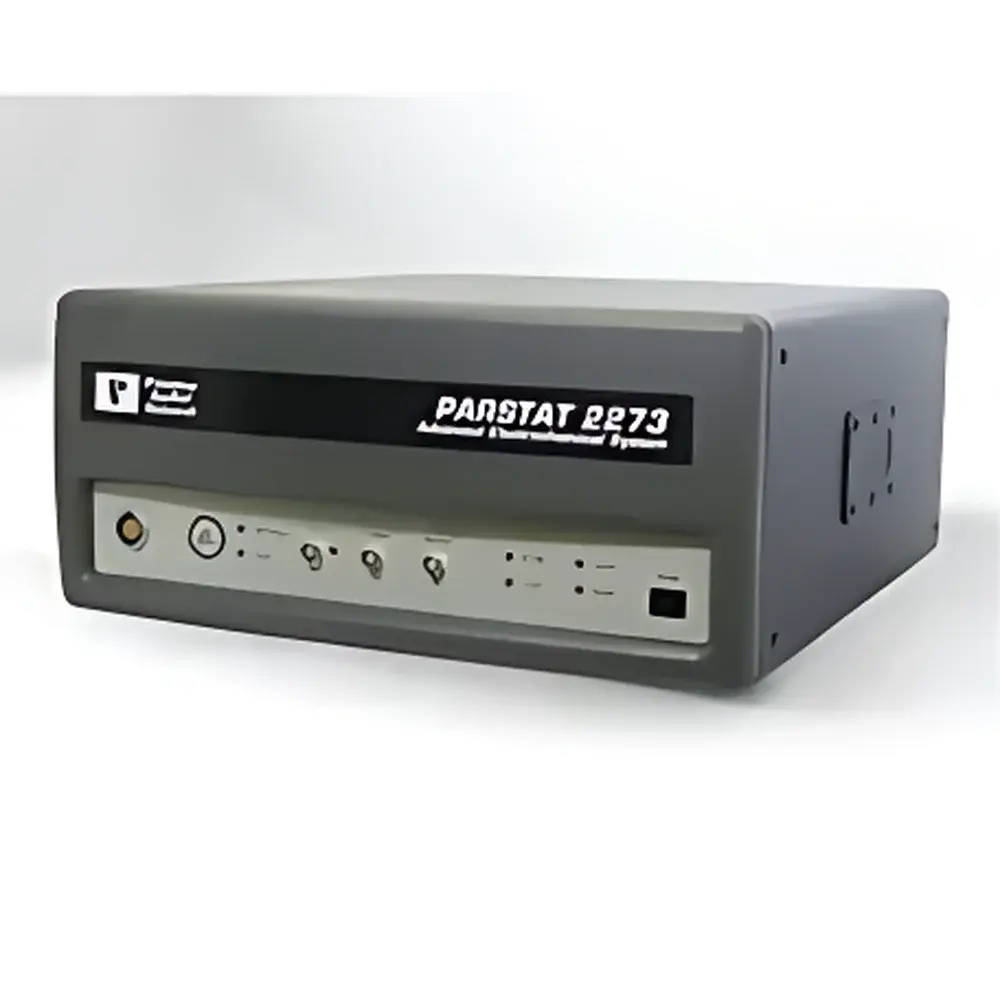
Princeton Applied Research PARSTAT 2273 Electrochemical Workstation
| Brand | Princeton Applied Research |
|---|---|
| Origin | USA |
| Model | PARSTAT 2273 |
| Maximum Output Voltage | ±100 V |
| Maximum Output Current | ±2 A (optional ±20 A) |
| Current Resolution | 1.2 fA |
| Input Impedance | >10¹³ Ω |
| Potentiostatic/Galvanostatic Bandwidth | >15 MHz (–3 dB) |
| EIS Frequency Range | 10 µHz to 1 MHz |
| Minimum Time Base | 20 µs |
| Minimum Potential Step | 2.5 µV |
| IR Compensation | Positive Feedback (2 Ω to 2000 MΩ) |
| Analog/Digital Conversion | 16-bit DAC for bias and modulation |
| Interface | USB |
| Weight | 31 kg |
| Dimensions | 50.8 cm W × 47.6 cm H × 22.9 cm D |
| Power Supply | 90–260 V AC, 50–60 Hz, ≤600 W |
Overview
The Princeton Applied Research PARSTAT 2273 Electrochemical Workstation is a high-performance, modular potentiostat/galvanostat/frequency response analyzer engineered for precision electrochemical characterization across academic, industrial, and regulatory environments. Built upon the proven architecture of the PARSTAT 273A platform, the 2273 integrates enhanced impedance measurement capability, ultra-low current resolution, extended voltage compliance, and real-time digital control—making it suitable for demanding applications including battery R&D, corrosion science, fuel cell diagnostics, biosensor development, and electrodeposition process optimization. Its core measurement principle relies on four-quadrant potentiostatic/galvanostatic control with analog feedback loops and high-fidelity signal conditioning, enabling stable polarization under highly resistive or capacitive conditions. The system operates via true analog control with digital supervision, ensuring minimal phase lag and high fidelity in dynamic measurements such as cyclic voltammetry at scan rates up to 10⁶ V/s (limited by cell configuration), transient chronoamperometry, and multi-frequency electrochemical impedance spectroscopy (EIS).
Key Features
- ±100 V compliance voltage and ±2 A maximum output current (expandable to ±20 A with external booster module)
- 1.2 fA current resolution—among the highest available in commercial potentiostats—enabling detection of sub-picoampere Faradaic processes
- Ultra-high input impedance (>10¹³ Ω in parallel with <5 pF) minimizes loading effects during high-impedance measurements (e.g., coated metals, biological membranes, solid-state electrolytes)
- Integrated EIS engine supporting frequency sweeps from 10 µHz to 1 MHz with single-sine, multi-sine, and Mott-Schottky analysis modes
- Dual 16-bit DAC architecture for independent control of DC bias and AC modulation signals, ensuring precise waveform synthesis and low harmonic distortion
- Sub-250 ns amplifier rise time and >15 MHz differential electrometer bandwidth support fast transient capture and high-speed pulse techniques
- Real-time positive-feedback iR compensation (2 Ω to 2000 MΩ range) with automatic amplitude-dependent adjustment
- USB 2.0 interface compliant with Windows-based host systems; driver-level compatibility with third-party LabVIEW and Python instrumentation libraries
Sample Compatibility & Compliance
The PARSTAT 2273 accommodates a broad range of electrochemical cells—from standard three-electrode aqueous configurations to high-voltage Li-ion half-cells, molten salt systems, and microfluidic sensor interfaces. Its wide voltage window supports aggressive anodic dissolution studies and cathodic protection validation per ASTM G5, G59, G102, and ISO 17475 standards. For regulated environments, the system supports audit-trail-capable operation when paired with PowerSuite software configured for 21 CFR Part 11 compliance (electronic signatures, user access controls, and immutable data logging). Input circuitry meets IEC 61010-1 safety requirements for laboratory equipment, and its low-noise design facilitates GLP/GMP-aligned battery cycling protocols requiring trace-level current stability over extended durations.
Software & Data Management
Controlled by the PowerSuite software suite, the PARSTAT 2273 provides intuitive experiment sequencing, real-time visualization, and post-acquisition modeling tools—including equivalent circuit fitting (ZView-compatible), derivative analysis, and automated parameter extraction. All raw data are stored in vendor-neutral ASCII formats (CSV, TXT) with embedded metadata (timestamp, instrument ID, calibration history, sequence log). The software architecture permits scripting via COM/ActiveX interfaces, enabling integration into automated test benches and LIMS environments. Version-controlled method templates ensure inter-laboratory reproducibility, while encrypted project files support secure collaboration across distributed research teams.
Applications
- Battery and energy storage: SEI formation kinetics, impedance evolution during cycling, lithium plating detection
- Corrosion science: Electrochemical noise analysis (ENA), critical pitting temperature determination, coating degradation monitoring
- Fuel cells and electrolyzers: Catalyst activity mapping, membrane resistance tracking, hydrogen crossover quantification
- Electrodeposition and surface finishing: Nucleation overpotential analysis, mass transport-limited deposition modeling
- Biosensors and bioelectrochemistry: Redox enzyme kinetics, DNA hybridization detection, impedance-based cell adhesion assays
- Materials science: Conducting polymer switching dynamics, semiconductor/electrolyte interface characterization (Mott-Schottky), dielectric spectroscopy of solid electrolytes
FAQ
What is the minimum measurable current with the PARSTAT 2273?
The system achieves a current resolution of 1.2 fA in its most sensitive range (40 pA full scale), validated per manufacturer specifications under shielded, low-noise bench conditions.
Can the PARSTAT 2273 perform EIS on high-impedance samples such as coated metals or biological tissues?
Yes—the combination of >10¹³ Ω input impedance, <5 pF cable capacitance, and active guarding enables reliable EIS down to 10 µHz on samples with impedances exceeding 10⁹ Ω.
Is the ±100 V compliance voltage available across all current ranges?
Voltage compliance remains ±100 V regardless of selected current range; however, power delivery is limited by the product of voltage and current (max 200 W continuous, 600 W peak).
How does the PARSTAT 2273 handle uncompensated solution resistance (Ru) during fast-scan experiments?
It employs both analog positive-feedback iR compensation and digital current-interrupt correction, with adjustable compensation bandwidth to avoid oscillation in high-Ru cells.
Does the system support automated long-term testing, such as 30-day battery cycling protocols?
Yes—PowerSuite supports unattended multi-step sequences with conditional branching, hardware-triggered interrupts, and periodic auto-calibration routines to maintain measurement integrity over extended durations.





