
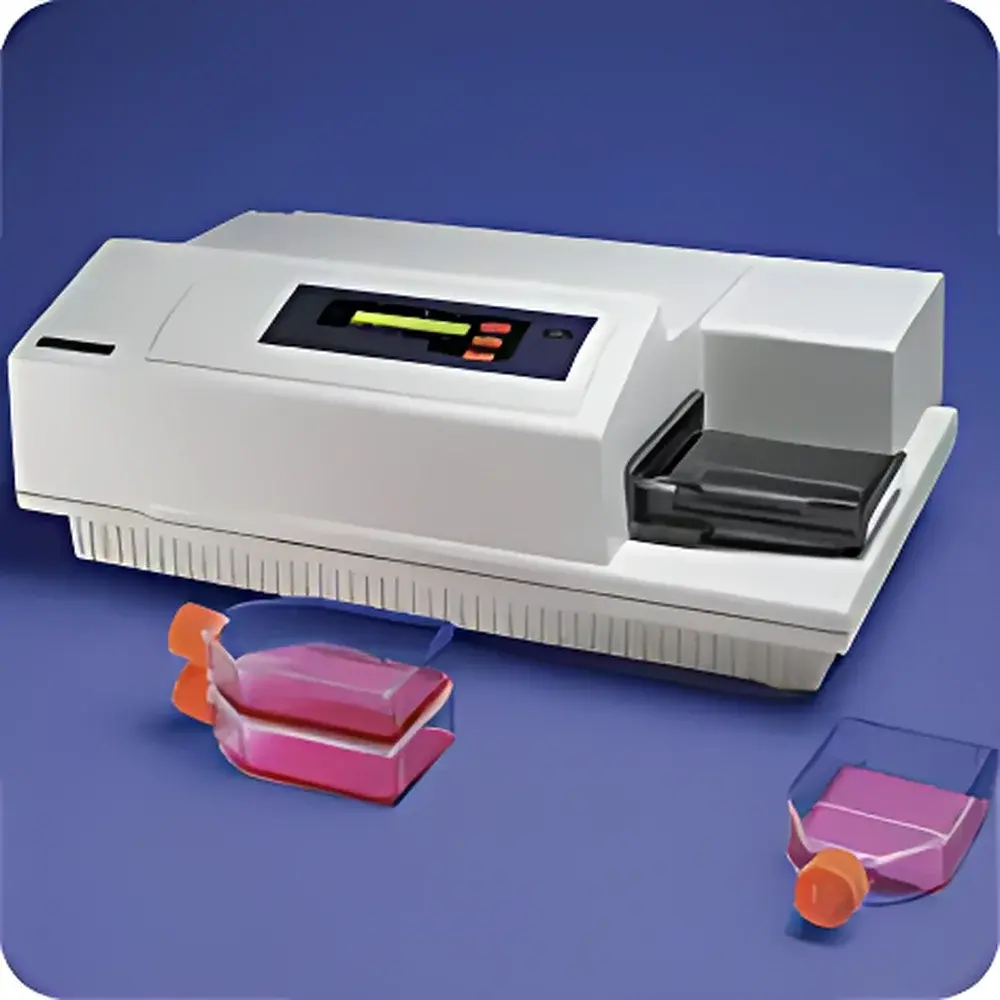
Molecular Devices SpectraMax Gemini EM Fluorescence Microplate Reader
| Brand | Molecular Devices |
|---|---|
| Origin | USA |
| Manufacturer Type | Manufacturer |
| Origin Category | Imported |
| Model | SpectraMax Gemini EM |
| Function Type | Dedicated Fluorescence Reader |
| Automation Level | Fully Automated |
| Assay Modes | Endpoint, Kinetic, Spectral Scan, Well-Scan |
| Curve Fitting | SoftMax Pro software supports 11 standard curve models (e.g., 4PL, 5PL, linear, exponential) |
| Detector Type | Photomultiplier Tube (PMT) |
| Excitation & Emission Wavelength Range | 250–850 nm |
| Wavelength Accuracy | < ±2 nm |
| Wavelength Scanning Speed | ≤15 sec per scan (full range) |
| Dual Monochromator Architecture | Independent excitation and emission grating monochromators |
| Reading Modes | Top-read and bottom-read fluorescence |
| Well-Scan Capability | Multi-point per well (up to 9×9 grid) |
| Plate Formats | 6–384-well microplates, including tissue-culture treated and membrane-based plates |
| Compliance | FDA 21 CFR Part 11 compliant with optional IQ/OQ/PQ documentation packages and SpectraTest™ FL1 Performance Verification Kit |
Overview
The Molecular Devices SpectraMax Gemini EM Fluorescence Microplate Reader is a dedicated, dual-monochromator-based instrument engineered for high-sensitivity, flexible fluorescence intensity measurements in life science research and quality control laboratories. Unlike filter-based readers, the Gemini EM employs two independent grating monochromators—one for excitation and one for emission—enabling precise, software-controlled selection of any wavelength between 250 nm and 850 nm without physical filter changes. This architecture supports method development for novel fluorophores, spectral characterization of probes, and optimization of assay conditions based on empirical excitation/emission profiling. The system is optimized for quantitative fluorescence detection in homogeneous solution assays, adherent and suspension cell-based assays, and membrane-permeability studies (e.g., chemotaxis, transwell migration), delivering reproducible data under GLP- and GMP-aligned workflows when paired with validated software and documentation packages.
Key Features
- Dual-grating monochromator design eliminates dependence on fixed-wavelength filters—enables full spectral scanning and rapid reconfiguration for new fluorophores.
- Top- and bottom-reading optical paths switch automatically via software command, supporting both solution-phase assays and cell-based fluorescence detection (e.g., GFP expression in monolayers or spheroids).
- Well-scan mode acquires up to 81 data points per well (9 × 9 grid), improving signal averaging and spatial resolution for heterogeneous samples such as adherent cells or gradient-based assays.
- Fully automated operation compatible with laboratory robotics; integrates natively with SoftMax Pro software for bidirectional communication with LIMS, Excel, and third-party automation platforms.
- High-precision wavelength control (< ±2 nm accuracy) across the full 250–850 nm range ensures reliable alignment with published excitation/emission maxima for dyes including FITC, TRITC, Cy3, Cy5, DAPI, Hoechst, and quantum dots.
- Supports endpoint, kinetic, spectral scan, and well-scan measurement modes across 6-, 24-, 96-, and 384-well plate formats—including TC-treated, black-walled, clear-bottom, and Transwell-compatible plates.
Sample Compatibility & Compliance
The SpectraMax Gemini EM accommodates diverse biological sample types: purified nucleic acids (e.g., PicoGreen DNA quantitation), proteins (NanoOrange assay), live/dead cell suspensions, adherent mammalian cultures (GFP reporter lines), and membrane-inserted systems (e.g., Boyden chamber assays). Its bottom-read capability enables robust detection in tissue-culture plates without interference from plastic autofluorescence. Regulatory compliance is supported through optional validation packages: SpectraTest™ FL1 provides automated performance verification per ASTM E2872 standards; IQ/OQ/PQ documentation kits satisfy equipment qualification requirements under ISO/IEC 17025, USP , and FDA 21 CFR Part 11. Audit trails, electronic signatures, and role-based access control are enabled within SoftMax Pro when configured for regulated environments.
Software & Data Management
SoftMax Pro software serves as the integrated platform for instrument control, protocol definition, real-time data visualization, and statistical analysis. It includes eleven built-in curve-fitting algorithms (4-parameter logistic, 5-parameter logistic, linear regression, sigmoidal dose-response, etc.), customizable data reduction formulas, and batch processing for multi-plate experiments. Raw fluorescence intensity values are exportable in CSV, XML, or Excel formats. The software supports automated plate mapping, background subtraction, Z’-factor calculation, and QC flagging based on user-defined thresholds. For regulated labs, optional 21 CFR Part 11 modules provide electronic signature enforcement, immutable audit logs, and secure user authentication—fully traceable to individual operators and timestamped actions.
Applications
- Nucleic acid quantification (PicoGreen, RiboGreen)
- Protein concentration determination (NanoOrange, Quant-iT)
- Cell viability and cytotoxicity (Live/Dead, Calcein AM/EthD-1)
- Gene expression monitoring (GFP, YFP, mCherry reporters)
- Second messenger assays (CatchPoint cAMP, calcium dyes)
- Enzymatic activity profiling (Caspase-3, protease, kinase assays)
- Molecular probe kinetics (FRET, quenching, anisotropy)
- Chemotaxis and transmigration assays using membrane inserts
FAQ
Does the SpectraMax Gemini EM support absorbance or luminescence measurements?
No—it is a dedicated fluorescence intensity reader. Absorbance and luminescence capabilities require separate instruments (e.g., SpectraMax M5/M5e or Paradigm Detection Platform).
Can I import literature-based excitation/emission wavelengths directly into the software?
Yes. SoftMax Pro allows manual entry of λex/λem values from published protocols or vendor datasheets, enabling immediate method deployment without prior spectral scanning.
Is bottom-reading performance equivalent to top-reading for cell-based assays?
Bottom-reading minimizes path-length variability and plastic interference in adherent cultures; sensitivity depends on plate transparency and cell monolayer uniformity—but typical CVs remain ≤5% across replicates.
What validation documentation is included by default?
The base system ships with factory calibration certificates. SpectraTest™ FL1, IQ/OQ/PQ kits, and 21 CFR Part 11 configuration services are available as optional add-ons.
How does the dual-monochromator design improve assay development efficiency?
It removes the need to procure, qualify, and inventory multiple filter sets—reducing method transfer time, minimizing cross-contamination risk from filter handling, and enabling retrospective spectral re-analysis of stored raw data.




