
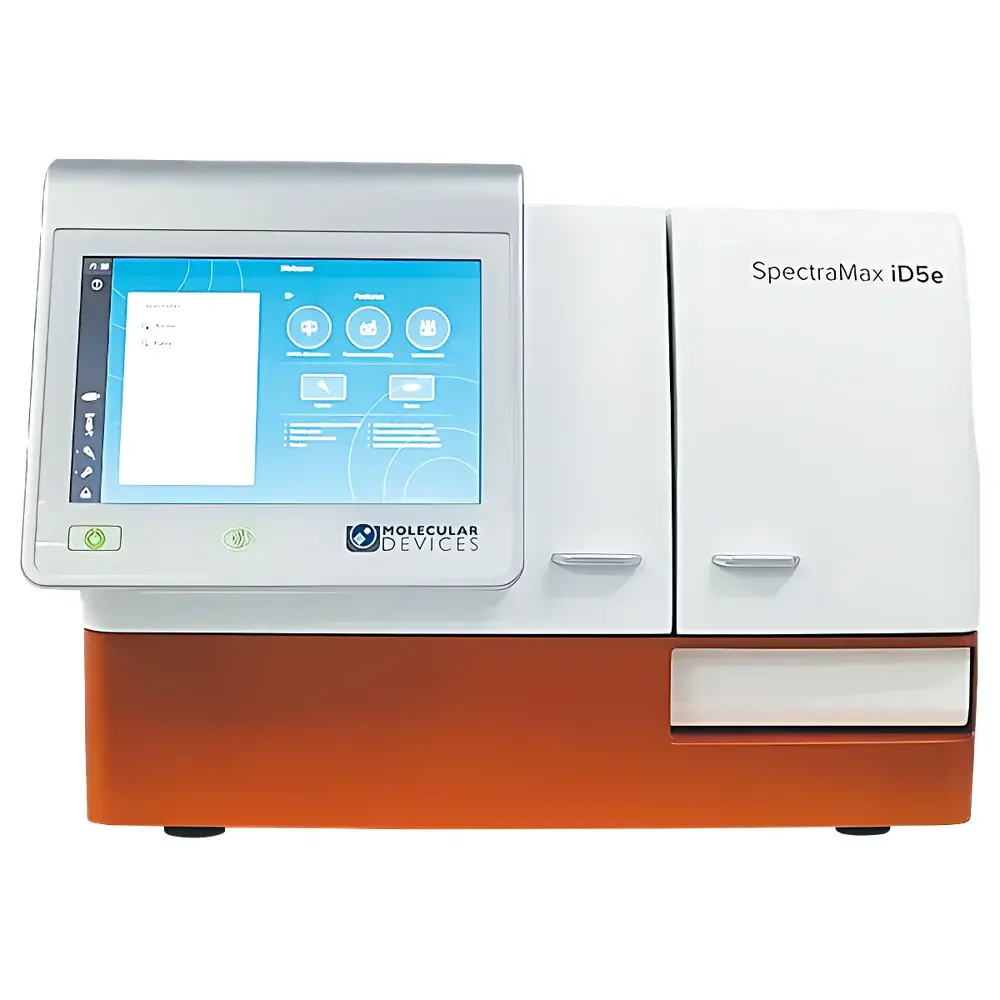
Molecular Devices SpectraMax iD5e Multimode Microplate Reader
| Brand | Molecular Devices |
|---|---|
| Origin | Shanghai, China |
| Manufacturer Type | Original Equipment Manufacturer (OEM) |
| Product Origin | Domestic (China) |
| Model | SpectraMax iD5e |
| Pricing | Available Upon Request |
Overview
The Molecular Devices SpectraMax iD5e is a high-performance multimode microplate reader engineered for precision, flexibility, and reproducibility in life science laboratories. It integrates five core detection modalities—absorbance, fluorescence intensity (FI), luminescence, time-resolved fluorescence (TRF), and wavelength-tunable fluorescence polarization (FP)—within a single compact platform. Its hybrid optical architecture combines a double-monochromator system (quad-grating) with a filter-based pathway, enabling unmatched spectral resolution, signal-to-noise ratio, and assay versatility. The instrument employs a high-energy xenon flash lamp as the excitation source and features dual detectors: a thermoelectrically cooled photomultiplier tube (PMT, operating at –5°C) for ultra-sensitive luminescent and fluorescent measurements, and a photodiode for robust absorbance quantification. Designed for rigorous academic, pharmaceutical, and biotechnology research environments, the iD5e supports GLP-compliant workflows through hardware-enforced protocol integrity, audit-trail-ready software, and full traceability of instrument configuration and calibration history.
Key Features
- Dual-Path Optical System: Simultaneous access to both monochromator- and filter-based optics ensures optimal performance across assay types—e.g., narrow-band TRF using Eu/Tb filters and broad-spectrum FP scanning via 1-nm incremental grating steps.
- Advanced Temperature Control: Precise on-plate heating from ambient to 66°C ±0.3°C, with ramp rate control and real-time monitoring, enabling kinetic assays requiring thermal stability (e.g., enzyme kinetics, protein denaturation studies).
- NFC-Based Filter Recognition: Automatic identification of installed filter sets via embedded NFC tags eliminates manual configuration errors and enforces assay-specific optical validation prior to data acquisition.
- Modular Expandability: Optional upgrades include bottom-read luminescence, TR-FRET (compatible with HTRF® and LanthaScreen™ reagents), Western blot detection module, CO₂/O₂ gas mixing (0.1–15% CO₂, 1–21% O₂, 0.1% resolution), and programmable orbital/linear shaking with variable amplitude and frequency.
- Microvolume Sample Handling: Integrated SpectraDrop™ microplate enables direct quantification of 2–4 µL nucleic acid or protein samples without dilution; SpectraCuvette™ adapter plate supports horizontal cuvette-based measurements (1 cm pathlength) without external hardware.
Sample Compatibility & Compliance
The SpectraMax iD5e accommodates standard microplate formats from 6- to 384-well, including opaque, clear, and white plates for absorbance, fluorescence, and luminescence applications respectively. It complies with ISO/IEC 17025 requirements for testing laboratories and supports FDA 21 CFR Part 11 compliance when used with SoftMax Pro GxP Software—including electronic signatures, role-based access control, and immutable audit trails. All optical calibrations are traceable to NIST-certified standards. The Western blot detection module meets sensitivity requirements outlined in USP for low-abundance protein quantification (down to sub-femtogram levels), while TRF and FP modes align with ASTM E2914–18 for homogeneous immunoassay validation.
Software & Data Management
SoftMax Pro 7 software provides an intuitive touchscreen interface with preconfigured assay templates (ELISA, BCA, Bradford, ATP, Caspase-3, β-galactosidase, etc.), real-time kinetic plotting, and multi-parameter data overlay. Raw data export is supported in CSV, XML, and SDMX formats for integration into LIMS or statistical platforms (e.g., GraphPad Prism, R). The software includes built-in QC tools: Z’-factor calculation, coefficient of variation (CV) reporting per well/column/plate, and auto-flagging of outliers based on user-defined thresholds. For regulated environments, SoftMax Pro GxP offers full 21 CFR Part 11 functionality, including secure login, session logging, and electronic record retention policies aligned with ALCOA+ principles.
Applications
The iD5e delivers validated performance across diverse life science workflows: quantitative ELISA and immunoassays; nucleic acid (A260/A280) and protein (BCA, Lowry, Bradford) concentration analysis; cell viability (MTT, resazurin), cytotoxicity (LDH), and apoptosis (caspase-3/7) assays; microbial growth kinetics under controlled O₂/CO₂ atmospheres; reporter gene assays (luciferase, GFP); enzymatic activity profiling (kinetic and endpoint); time-resolved FRET-based protein-protein interaction studies; and chemiluminescent Western blot densitometry with extended dynamic range (>4 logs). Its microvolume capability makes it ideal for precious clinical samples or CRISPR-edited cell lysates where material is limiting.
FAQ
Does the SpectraMax iD5e support bottom-read luminescence?
Yes—bottom-read luminescence is available as an optional upgrade kit, enabling enhanced sensitivity for cell-based luciferase assays in opaque plates.
Can the instrument perform TR-FRET assays such as HTRF®?
Yes—the iD5e’s TRF mode, combined with optional excitation/emission filters and delay/gate timing control, fully supports HTRF®, LanthaScreen™, and other commercial TR-FRET reagent systems.
Is CO₂/O₂ environmental control integrated or external?
Gas control is implemented via an internally mounted, user-installable gas mixer module that interfaces directly with the instrument’s environmental chamber—no external gas manifold required.
What is the minimum sample volume supported for absorbance measurements?
Using the SpectraDrop™ microplate, the iD5e measures absorbance from as little as 2 µL of undiluted sample, eliminating the need for serial dilution or transfer steps.
Does the Western blot detection module require additional hardware?
No—the module is a plug-in accessory that utilizes the existing optical train and PMT detector; no separate imager or scanner is needed.
Related Products





