
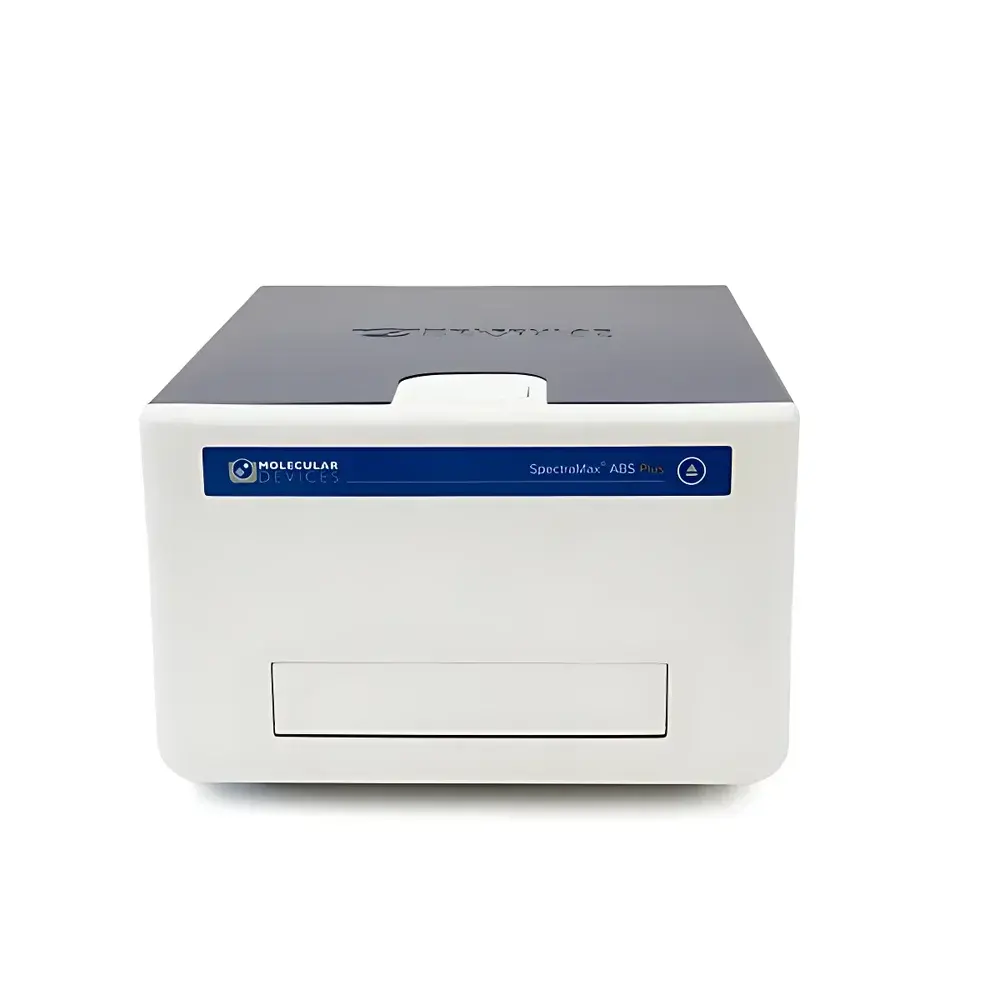
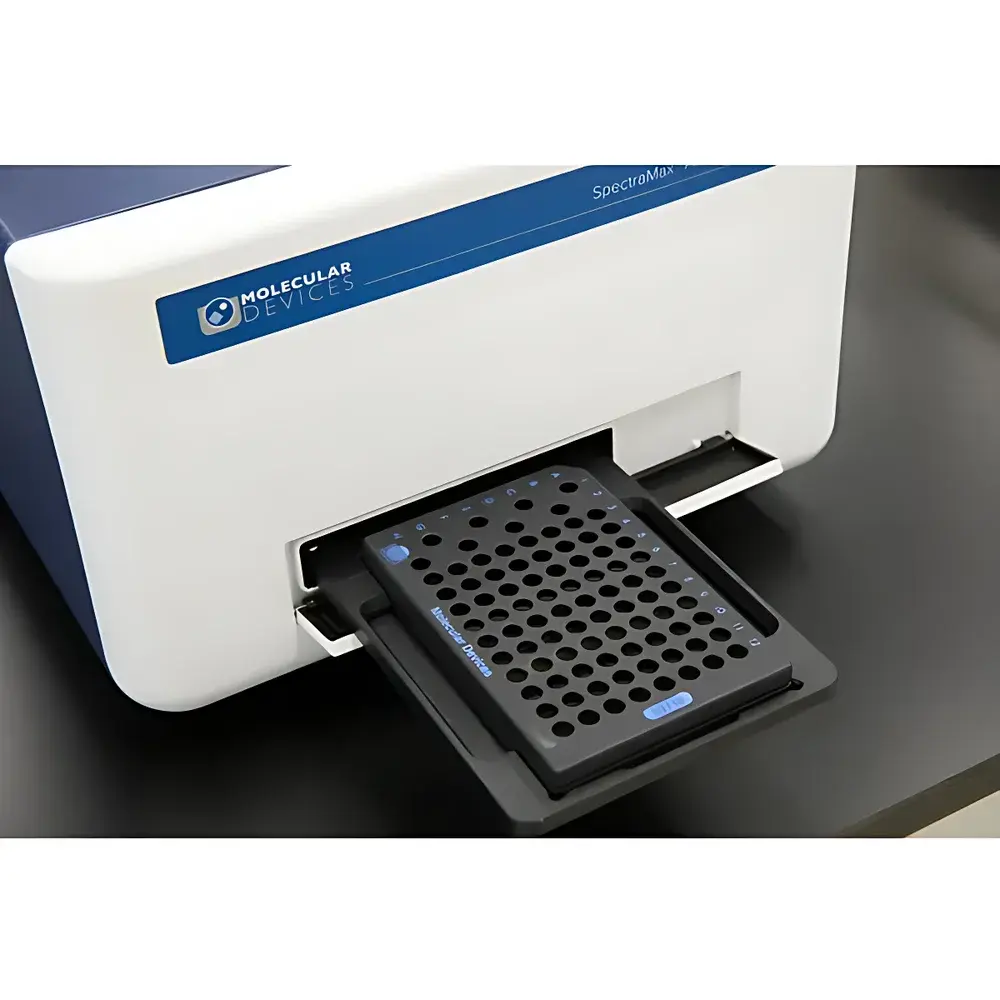
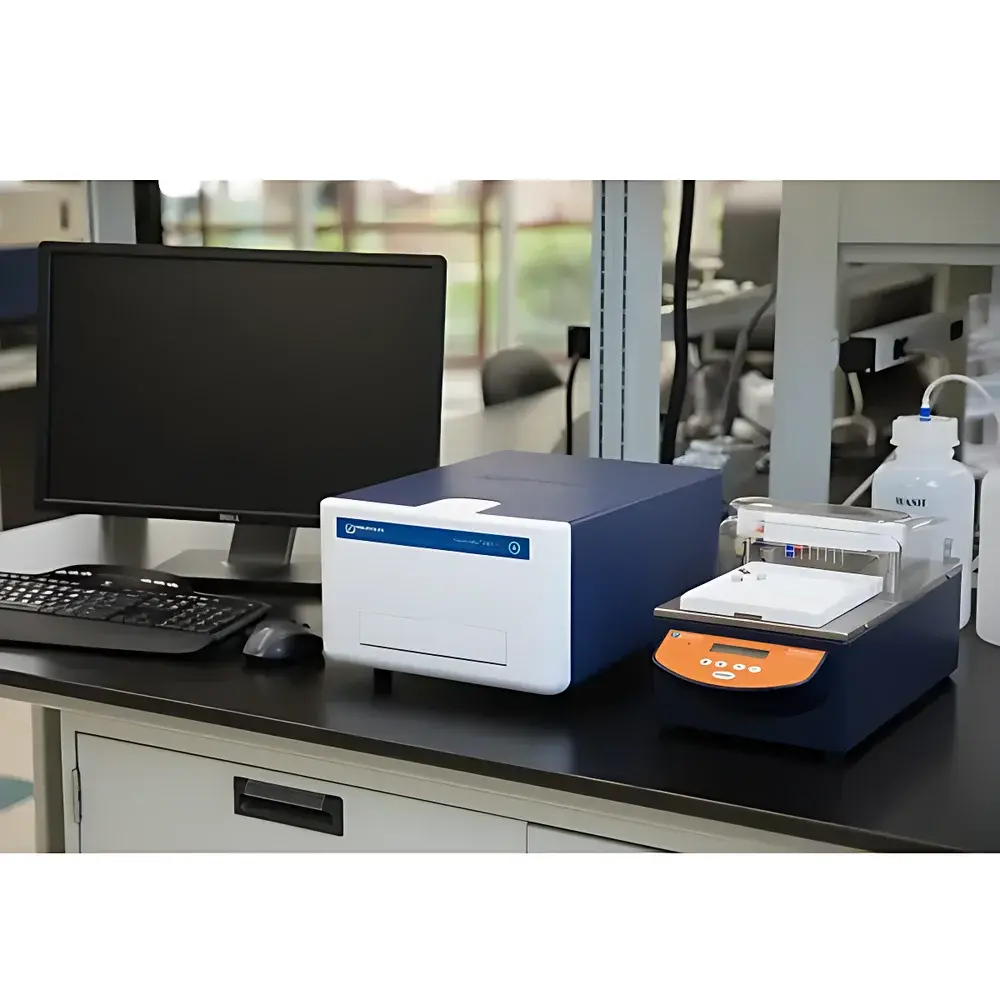
Molecular Devices SpectraMax ABS & ABS PLUS Absorbance Microplate Readers
| Brand | Molecular Devices |
|---|---|
| Origin | USA |
| Manufacturer Type | Manufacturer |
| Origin Category | Imported |
| Model | SpectraMax ABS & ABS PLUS |
| Function Type | Single-Mode Absorbance Detection |
| Automation Level | Fully Automated Microplate Reader |
| Assay Modes | Endpoint, Kinetic, Scanning |
| Detector Type | Grating Monochromator |
| Wavelength Range | ABS PLUS: 190–1000 nm |
| ABS | 340–850 nm |
| Absorbance Range | –0.000 to 4.000 OD |
| Absorbance Linearity | 0.000–4.000 OD |
| Read Speed | 96-well plate: 9 s |
| 384-well plate | 29 s |
| Accuracy | < ±0.003 OD ±1.0% (0–2 OD) |
Overview
The Molecular Devices SpectraMax ABS and ABS PLUS Absorbance Microplate Readers are precision-engineered instruments designed for high-fidelity UV-Vis absorbance measurements in life science laboratories. Based on grating-based monochromator technology, these readers eliminate the need for fixed optical filters while delivering full spectral flexibility across defined wavelength ranges—340–850 nm for the ABS model and an extended 190–1000 nm range for the ABS PLUS, enabling applications from nucleic acid quantification in the far-UV to near-infrared assays. Unlike traditional filter-based systems, the grating architecture allows continuous wavelength selection at 1 nm increments, supporting multi-wavelength acquisition within a single read cycle (up to six wavelengths per well). The optical path is optimized for microplate formats (96-, 384-, and half-area plates) with support for flat-bottom, round-bottom, and low-volume wells. Temperature control up to 45 °C enables reproducible kinetic assays under physiological or controlled thermal conditions. Critically, both models incorporate PathCheck™ Pathlength Correction—a proprietary sensor-based system that measures actual liquid height in each well and mathematically normalizes absorbance values to a standard 1 cm optical path length, effectively transforming the microplate into a parallelized cuvette array.
Key Features
- Grating monochromator with continuous wavelength selection (1 nm resolution) and no physical filter wheels—enabling rapid method development and assay flexibility.
- PathCheck™ Pathlength Correction technology: real-time measurement of sample depth per well and automatic conversion of raw OD values to 1 cm-equivalent absorbance, accommodating variable dispense volumes (e.g., 50–300 µL) without manual dilution or recalibration.
- Extended dynamic range: when combined with PathCheck™, effective absorbance detection extends beyond 4.000 OD—demonstrated correction from 2.8 OD at ~0.3 cm pathlength to ~9.2 OD equivalent—supporting high-concentration samples without pre-dilution.
- High-speed reading: 9 s for full 96-well plates and 29 s for 384-well plates, maintaining precision across throughput demands.
- Integrated temperature control (ambient to 45 °C) with uniform well-to-well thermal stability, essential for enzyme kinetics, cell-based assays, and microbial growth monitoring.
- Compact footprint and robust mechanical architecture designed for benchtop integration, stacker compatibility (e.g., StakMax), and seamless robotic interfacing via standardized automation protocols.
Sample Compatibility & Compliance
The SpectraMax ABS series supports standard polystyrene, clear-bottom, black, white, and UV-transparent microplates—including low-volume and half-area formats—as well as 1 cm pathlength cuvettes (ABS PLUS only). It complies with key regulatory expectations for analytical instrumentation in GLP and GMP environments: SoftMax Pro GxP software provides audit trails with time-stamped user actions, electronic signatures with role-based access control, and data integrity features aligned with FDA 21 CFR Part 11 requirements. Optical performance validation is supported using the SpectraTest ABS1 verification plate, traceable to NIST standards, allowing users to perform routine instrument qualification per internal SOPs or ISO/IEC 17025 guidelines. The system supports IQ/OQ/PQ documentation templates and integrates with LIMS and ELN platforms via secure API or file export (CSV, XML, SDMX).
Software & Data Management
SoftMax Pro 7.1 software serves as the unified interface for instrument control, protocol definition, real-time monitoring, and advanced analysis. It includes 21 built-in curve-fitting algorithms—including four-parameter logistic (4PL), Michaelis-Menten, exponential decay, and custom equation editors—for IC50, EC50, Km, Vmax, AUC, and slope analysis. Multi-plate data alignment enables cross-plate normalization, overlay of calibration curves, and composite plotting of unknowns against multiple reference standards—all within a single graphical workspace. Validation workflows include automated hardware self-tests (lamp intensity, wavelength accuracy, photometric linearity), password-protected method locking, and version-controlled protocol archiving. For enterprise deployment, SoftMax Pro GxP supports centralized database hosting, concurrent multi-user access, and synchronized user account management across geographically distributed labs.
Applications
These readers are routinely deployed in quantitative and kinetic assays requiring high photometric fidelity. Key use cases include: DNA/RNA quantification (260 nm) and purity assessment (260/280 ratio) — enabled by the ABS PLUS’s 190 nm lower limit; microbial growth and minimum inhibitory concentration (MIC) determination; endpoint and kinetic ELISA/EIA; colorimetric protein assays (e.g., BCA, Bradford); cell viability and cytotoxicity (e.g., MTT, WST-1); enzyme activity profiling (e.g., β-galactosidase, LDH, alkaline phosphatase); drug dissolution testing; and enzymatic parameter derivation (Ki, Km, kcat). The PathCheck™ capability ensures accurate concentration calculations directly from microplate data without cuvette transfer—critical for high-throughput screening and bioprocess monitoring where sample conservation and workflow continuity are paramount.
FAQ
What distinguishes the ABS PLUS from the ABS model?
The ABS PLUS extends the wavelength range to 190–1000 nm and adds cuvette compatibility, enabling far-UV nucleic acid analysis and near-IR applications not possible with the ABS (340–850 nm only).
Can PathCheck™ correct for evaporation during kinetic assays?
No—PathCheck™ measures initial liquid height at read time only. For long-duration kinetics, humidity control or sealed plates are recommended to minimize volume drift.
Is SoftMax Pro GxP required for 21 CFR Part 11 compliance?
Yes—only SoftMax Pro GxP provides the full suite of electronic signature, audit trail, and role-based access controls necessary for regulated environments.
How is optical performance verified between calibrations?
Users may run the SpectraTest ABS1 plate at any time to confirm wavelength accuracy, photometric linearity, and stray light performance against NIST-traceable references.
Can the reader be integrated into third-party robotic workcells?
Yes—Molecular Devices participates in the Automation Partner Program, offering documented, pre-tested integration kits for major robotics platforms (e.g., Hamilton, Tecan, Agilent), reducing validation effort and time-to-deployment.





