
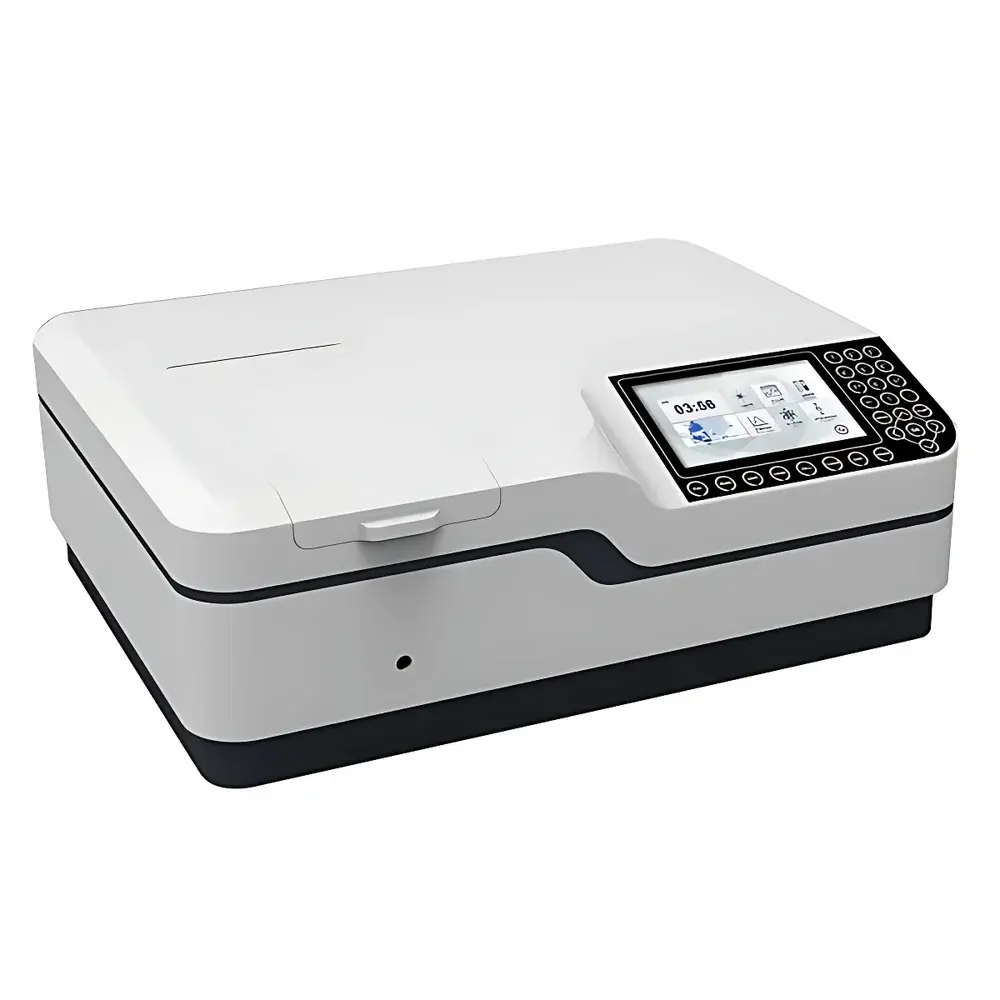
Yoke T2600 UV-Vis Spectrophotometer
| Brand | Yoke |
|---|---|
| Origin | Shanghai, China |
| Manufacturer Type | OEM/ODM Manufacturer |
| Product Category | Domestic |
| Model | T2600 |
| Price Range | USD 2,800–4,200 |
| Optical Design | Pseudo-Double-Beam |
| Detector | Photodiode Array (PDA) |
| Wavelength Range | 190–1100 nm |
| Wavelength Scanning | Motorized Auto-Scanning |
| Spectral Bandwidth | 2 nm |
| Wavelength Accuracy | ±0.3 nm |
| Stray Light | ≤0.05% at 220 nm |
Overview
The Yoke T2600 UV-Vis Spectrophotometer is a precision optical instrument engineered for quantitative and qualitative analysis across the ultraviolet, visible, and near-infrared spectral regions (190–1100 nm). It operates on a pseudo-double-beam optical architecture—combining the cost-efficiency of single-beam design with real-time reference compensation—ensuring high photometric stability and reduced baseline drift during extended measurements. The system employs a Czerny-Turner monochromator with a fixed 2 nm slit width, coupled with imported deuterium and tungsten-halogen lamps as dual broadband light sources. Detection is performed via a high-sensitivity, thermally stabilized photodiode array (PDA), enabling rapid spectral acquisition without mechanical scanning of the detector. This configuration delivers robust performance in routine QC labs, academic teaching environments, and R&D settings where reproducibility, ease of operation, and regulatory traceability are essential.
Key Features
- 7-inch full-color TFT-LCD touchscreen (1024 × 600 resolution) with intuitive graphical interface—enables standalone operation without external PC; all scan curves, calibration plots, and kinetic data visualized directly on-device.
- Industrial-grade Omron tactile switches rated for >1 million actuations—designed for long-term reliability in high-throughput laboratory environments.
- Embedded ARM11 microprocessor with 16 GB internal flash memory—stores up to 2,000 absorbance/transmittance measurements or 500 user-defined calibration curves.
- Suspended optical bench architecture mounted on reinforced aluminum baseplate—minimizes thermal drift and mechanical vibration impact on wavelength registration and photometric repeatability.
- Patented optoelectronic signal detection module (Chinese Patent No. ZL 2010 2 0562320.3)—enhances signal-to-noise ratio (SNR) by optimizing analog front-end gain staging and dark-current compensation.
- Dual-layer chassis design—physically isolates optical path from power supply and digital control circuits to suppress electromagnetic interference (EMI) and improve photometric linearity.
- Multi-interface connectivity: RS-232C (for thermal printer integration), USB Device (for PC tethering), and USB Host (for direct plug-and-play U-disk data export).
Sample Compatibility & Compliance
The T2600 accommodates standard 10 mm square cuvettes (glass, quartz, or plastic) and supports optional accessories including an 8-position rotating automatic cuvette changer (patented centering mechanism ensures consistent beam alignment) and a built-in flow cell module for continuous monitoring applications. Its optical performance complies with key international specifications for UV-Vis instrumentation, including ASTM E275–22 (Standard Practices for Describing and Measuring Performance of UV-Vis Spectrophotometers) and ISO 9001-aligned manufacturing controls. While not pre-certified for FDA 21 CFR Part 11, the firmware architecture supports audit-trail-ready data logging when deployed with validated third-party LIMS or ELN systems—making it suitable for GLP-compliant workflows in pharmaceutical QA/QC, environmental testing, and food safety laboratories.
Software & Data Management
All measurement data—including spectra (.qua), kinetic time-series (.csv), concentration reports (.txt), and bitmap overlays (.bmp)—are exportable directly to USB storage devices without proprietary software dependencies. Files conform to open formats compatible with Microsoft Excel, OriginLab, GraphPad Prism, and Python-based analysis pipelines (e.g., NumPy/Pandas). Internal data management includes timestamped metadata (operator ID, date/time, instrument serial number, lamp hours), configurable auto-save intervals, and password-protected method recall. Firmware updates are delivered via USB stick and include version-controlled changelogs compliant with ICH Q5A change control principles.
Applications
- Quantitative determination of nucleic acids and proteins (e.g., A260/A280 ratio analysis per USP & EP guidelines)
- Pharmaceutical assay validation—including dissolution testing, excipient compatibility studies, and stability-indicating methods
- Environmental water quality monitoring (e.g., nitrate, phosphate, COD estimation per APHA Standard Methods)
- Food and beverage colorimetric analysis (e.g., anthocyanin content in juices, chlorophyll in oils)
- Enzyme kinetics (initial rate determination under controlled temperature conditions using optional Peltier cuvette holders)
- Material science characterization—thin-film transmittance/absorbance profiling and bandgap estimation via Tauc plot derivation
FAQ
Does the T2600 support GLP-compliant electronic records?
Yes—when integrated with validated laboratory informatics systems, its timestamped, operator-tagged data export and firmware update logs meet core ALCOA+ (Attributable, Legible, Contemporaneous, Original, Accurate) requirements.
Is the 2 nm spectral bandwidth adjustable?
No—the T2600 features a fixed 2 nm bandwidth. For variable resolution, consider the T2600S variant with selectable 0.5/1/2/4/5 nm slits.
What is the typical lamp lifetime under normal usage?
Deuterium lamp: ≥1,500 hours; Tungsten-halogen lamp: ≥2,000 hours. Automatic lamp switching and runtime tracking are embedded in firmware.
Can the instrument perform kinetic measurements?
Yes—supports time-scan mode with user-defined interval (0.1–600 s) and up to 10,000 data points per run, stored internally or exported in CSV format.
Is quartz cuvette compatibility confirmed across the full 190–1100 nm range?
Yes—standard 1 cm quartz cells transmit effectively down to 190 nm; below 220 nm, oxygen absorption in air may require purging or nitrogen flush for optimal S/N in deep-UV applications.





