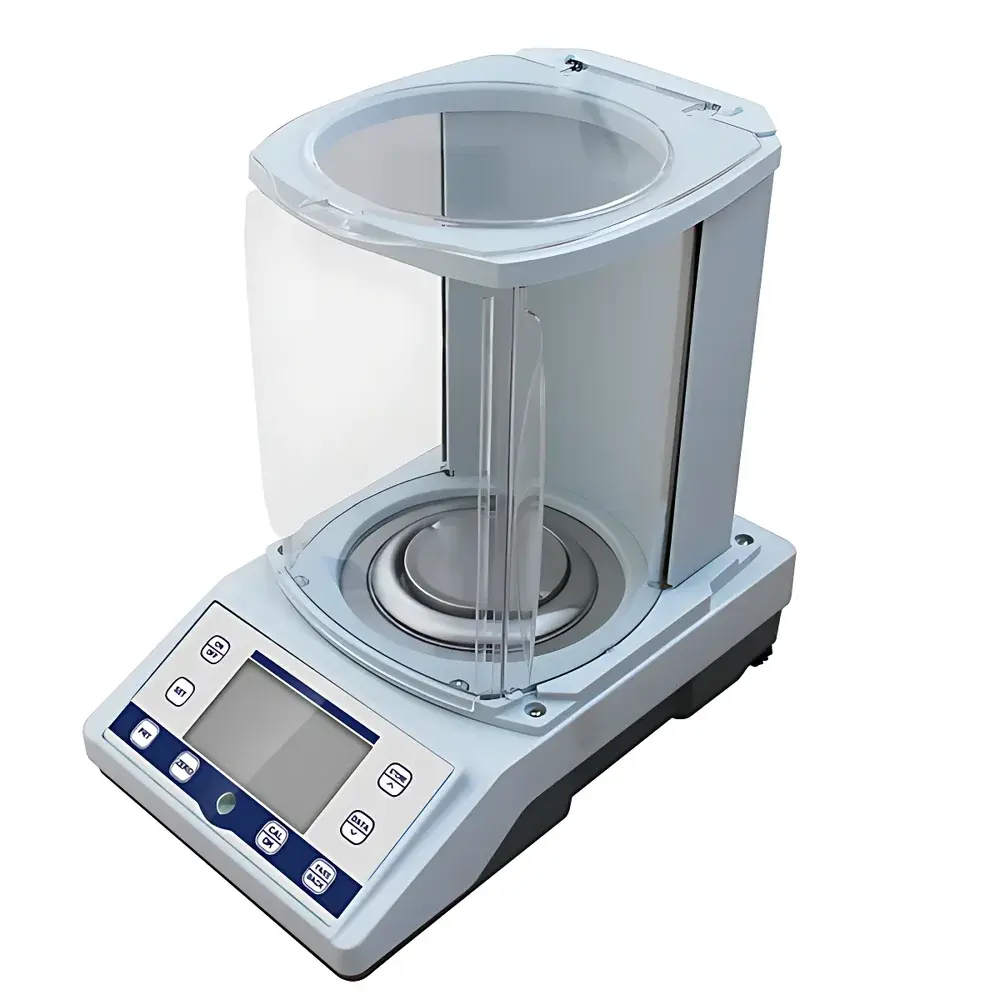
Yoke GC Series Analytical Balance (0.1 mg Readability)
| Brand | Yoke |
|---|---|
| Origin | Shanghai, China |
| Manufacturer | Yoke Instrument Co., Ltd. |
| Model | GC Series |
| Maximum Capacity | 220 g |
| Readability | 0.1 mg |
| Accuracy Class | Class I (OIML R76) |
| Calibration | External |
| Repeatability | ±0.1 mg |
| Weighing Pan Diameter | 90 mm |
| Dimensions (W×D×H) | 360 × 220 × 350 mm |
| Net Weight (incl. packaging) | 7.5 kg |
| Power Supply | DC 9 V / 1 A |
Overview
The Yoke GC Series Analytical Balance is a high-precision Class I laboratory balance engineered for routine and regulated weighing tasks in quality control laboratories, academic research facilities, and pharmaceutical production environments. Designed to meet OIML R76 metrological requirements for analytical balances, the GC Series delivers 0.1 mg readability across its full capacity range (100 g to 220 g), ensuring traceable, reproducible mass measurements under controlled ambient conditions. Its electromagnetic force compensation (EMFC) sensor architecture—fabricated using CNC-machined high-stability components—provides long-term linearity and minimal drift over time. The balance operates on a dedicated ARM32 microprocessor platform, enabling real-time digital filtering, adaptive response optimization, and robust noise suppression—critical for stable readings in non-ideal lab environments with air currents or mechanical vibration.
Key Features
- Electromagnetic force compensation (EMFC) transducer with CNC-precision sensor housing for enhanced thermal stability and mechanical repeatability
- ARM32-based embedded control system supporting dynamic digital filtering algorithms to optimize settling time without compromising accuracy
- Integrated draft shield enclosure with ergonomic sliding doors and seamless acrylic construction—designed to minimize airflow interference while maintaining operator accessibility
- Multi-function weighing modes: piece counting, percentage weighing, checkweighing, density determination (with optional density kit), and animal/dynamic weighing
- SMT-assembled PCBs with conformal coating for improved moisture resistance and long-term reliability in humid laboratory settings
- Backlit monochrome LCD display (BTN black-on-white membrane type) with 18-mm character height for legibility under varied lighting conditions
- Class I accuracy certification per OIML R76; compliant with ISO/IEC 17025 calibration traceability requirements when used with certified external weights
Sample Compatibility & Compliance
The GC Series accommodates standard laboratory samples—including powders, granules, small solid components, and pre-weighed vials—within its 90 mm diameter stainless-steel weighing pan. Its sealed enclosure design meets basic environmental protection requirements for ISO 14644-1 Class 8 cleanroom-adjacent use. While not rated for hazardous or corrosive substances without accessory protection (e.g., anti-static or chemical-resistant pans), the balance supports GLP-compliant workflows through user-accessible calibration logs and manual entry of calibration weight IDs. It satisfies fundamental regulatory expectations for analytical balance qualification under USP , EP 2.1.3, and ASTM E898–22, provided that installation, operational, and performance qualification (IQ/OQ/PQ) protocols are executed per site-specific SOPs. External calibration with class E2 or better weights (e.g., 100 g or 200 g certified砝码) is required to maintain metrological integrity between accredited calibrations.
Software & Data Management
The GC Series features a built-in RS232 interface (standard) for direct connection to PCs, printers, or LIMS systems. ASCII-formatted data output includes timestamp, net weight, tare value, unit identifier, and operation mode—enabling automated record capture without proprietary software dependencies. While no native PC application is bundled, the device supports standard terminal emulation (e.g., Tera Term, PuTTY) and integrates seamlessly with third-party laboratory informatics platforms via configurable data framing. Audit trail functionality is limited to manual logbook entries; for full 21 CFR Part 11 compliance—including electronic signatures, user access controls, and immutable audit trails—integration with validated middleware or LIMS is recommended. Firmware updates are performed via serial interface using manufacturer-provided utilities and require authorized service personnel.
Applications
- Pharmaceutical formulation: active pharmaceutical ingredient (API) dispensing, excipient ratio verification, and batch release testing per pharmacopeial methods
- Chemical synthesis: stoichiometric reagent weighing, catalyst dosing, and reaction yield calculation
- Materials science: powder density characterization, thin-film mass loading, and nanoparticle dispersion quantification
- Food & beverage QC: nutritional label verification, additive dosage control, and moisture content determination (via loss-on-drying protocols)
- Academic teaching labs: fundamental metrology instruction, uncertainty budgeting exercises, and gravimetric titration preparation
- Environmental testing: filter mass gain analysis for particulate matter (PM2.5/PM10) monitoring programs
FAQ
What calibration weights are required for the GC Series?
External calibration requires certified weights traceable to national standards: 100 g weights for models up to GC124, and 200 g weights for GC204, GC214, and GC224. Class E2 tolerance weights are recommended for optimal verification of 0.1 mg readability.
Is internal calibration available on this model?
No—the GC Series supports external calibration only. An internal motorized calibration mechanism is not integrated; all calibration procedures must be performed manually using certified reference masses.
Can the balance be connected to a networked LIMS system?
Yes—via RS232-to-Ethernet or USB-serial adapters, provided the host system accepts ASCII stream input with configurable delimiters and timing parameters. No native Ethernet or Wi-Fi interface is included.
What is the warm-up time before achieving specified repeatability?
A minimum 30-minute stabilization period at constant ambient temperature (20 ± 2 °C) is recommended prior to critical measurements to ensure thermal equilibrium of the EMFC sensor and internal electronics.
Does the balance support automatic tare or auto-zero functions?
Auto-zero is enabled by default upon power-up and after extended idle periods. Automatic tare must be initiated manually; no programmable auto-tare-on-stabilization feature is implemented.