
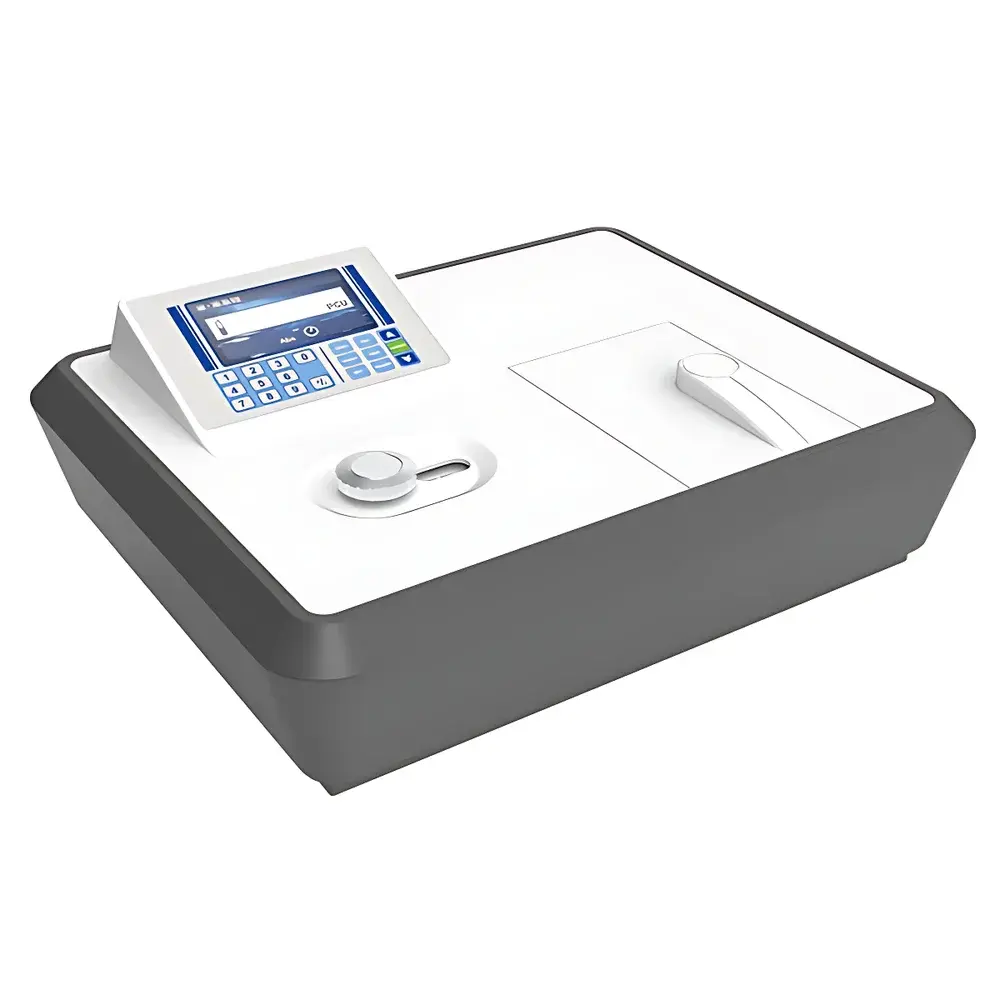
Yoke YKG-C1 10th-Generation Single-Parameter Water Quality Analyzer
| Brand | Yoke |
|---|---|
| Origin | Shanghai, China |
| Manufacturer | Yoke Instrument Co., Ltd. |
| Model | YKG-C1 |
| Instrument Type | Laboratory Water Quality Analyzer |
| Measurable Parameters | COD / Ammonia Nitrogen / Total Phosphorus (select one per operation) |
| Detection Range (COD) | High Range 15–8000 mg/L, Low Range 5–160 mg/L |
| Detection Range (Ammonia Nitrogen) | 0.01–100 mg/L |
| Detection Range (Total Phosphorus) | 0.002–20 mg/L |
| Chloride Interference Tolerance | [Cl⁻] < 1000 mg/L (no interference) |
| optional high-tolerance module | [Cl⁻] < 8000 mg/L |
| Accuracy | ≤5% |
| Repeatability | ≤±5% |
| Measurement Time | 10–20 min per sample |
| Optical Stability | ≤0.001 A/10 min |
| Light Source | Imported tungsten halogen lamp |
| Photometric Method | Fixed-wavelength spectrophotometry using standardized cuvette-based colorimetry |
| Wavelength Filtering | Precision interference filter system |
| Data Storage Capacity | ≥5000 measurement records (date, time, parameter ID, result, curve ID) |
| Calibration Curves | 200 programmable curves (5 factory-default + 195 user-expandable), including segmented calibration support with concentration-dependent slope coefficients (K) |
| Display | 4.3-inch TFT color touchscreen |
| Interface Options | USB Device (PC connection), USB Host (U-disk import/export), RS-232C (printer interface), Bluetooth (optional) |
| Operating System Language | Switchable Chinese/English UI |
| Batch Processing | Up to 20 samples per session |
| Memory | 512 MB internal NAND flash |
| Processor | ARM9 embedded microcontroller |
Overview
The Yoke YKG-C1 is a 10th-generation single-parameter laboratory water quality analyzer engineered for precise, trace-level quantification of critical water contaminants—specifically chemical oxygen demand (COD), ammonia nitrogen (NH₃-N), or total phosphorus (TP)—in accordance with national and internationally harmonized standard methods (e.g., HJ/T 399–2007 for COD, HJ 535–2009 for NH₃-N, and GB/T 11893–1989 for TP). It operates on fixed-wavelength spectrophotometry: after sample digestion and chromogenic reaction, absorbance is measured at pre-optimized wavelengths (e.g., 610 nm for COD, 420 nm for NH₃-N, 700 nm for TP) using a thermally stabilized tungsten-halogen light source and a high-fidelity interference filter optical path. The instrument’s photometric stability (<0.001 A/10 min) and low stray light design ensure reproducible transmittance measurements across extended operational cycles—essential for compliance with GLP and routine QC/QA protocols in municipal labs, environmental monitoring stations, and industrial wastewater treatment facilities.
Key Features
- 4.3-inch capacitive TFT color touchscreen with intuitive rotary encoder navigation—enabling one-handed, menu-free selection of analytical parameters without tactile key presses.
- Dual-mode data storage: internal non-volatile memory (≥5000 records) plus direct U-disk export via USB Host port—supporting audit-ready traceability without PC dependency.
- Flexible calibration architecture: 200 programmable curves—including 5 factory-loaded reference curves and 195 user-definable slots—with full support for segmented linear/nonlinear calibration (variable K-coefficients per concentration range) to minimize systematic error across wide dynamic ranges.
- ARM9-based embedded control system with 512 MB NAND flash memory ensures responsive UI rendering, rapid spectral acquisition, and robust multi-task handling during concurrent data logging and curve management.
- Optimized optical train featuring imported interference filters and precision-matched cuvette geometry—validated against NIST-traceable standards—to deliver improved photometric accuracy and long-term wavelength fidelity versus conventional broadband systems.
- Pre-formulated, lot-certified liquid reagents included—eliminating manual powder dissolution, reducing analyst exposure, and minimizing inter-batch variability in color development kinetics.
Sample Compatibility & Compliance
The YKG-C1 accepts standard 10 mm or 30 mm pathlength glass or quartz cuvettes (compliant with ISO 7027 and ASTM D1253), supporting both tube-based and cuvette-based digestion workflows. Its chloride tolerance profile ([Cl⁻] < 1000 mg/L baseline; optional high-salinity module up to 8000 mg/L) enables reliable COD analysis in coastal wastewater, landfill leachate, and industrial effluents where halide interference commonly compromises dichromate-based oxidation. All measurement protocols align with Chinese EPA method equivalencies and are compatible with ISO/IEC 17025 documentation requirements. Data integrity safeguards include timestamped records, operator ID tagging (via optional login), and immutable storage—facilitating alignment with FDA 21 CFR Part 11 principles when paired with validated software configurations.
Software & Data Management
Raw absorbance values, calibration coefficients, and final concentration results are stored with full metadata (date, time, parameter ID, curve version, operator code if enabled). USB Device mode enables direct transfer to Windows/Linux PCs using standard CDC ACM drivers—no proprietary software required. Exported CSV files contain column headers compliant with LIMS ingestion schemas (e.g., “Sample_ID,DateTime,Parameter,Result_mg_L,Method_ID,Curve_ID”). Bluetooth 4.2 (optional) supports secure point-to-point transmission to on-site tablets running validated data aggregation tools. Internal firmware supports over-the-air updates via U-disk—ensuring continued alignment with evolving regulatory test criteria without hardware replacement.
Applications
- Routine compliance monitoring of municipal wastewater discharge (COD, NH₃-N, TP) per GB 18918–2002 Class I-A limits.
- Process control in pharmaceutical and food/beverage manufacturing—tracking phosphorus removal efficiency in tertiary treatment stages.
- Environmental field lab deployment for river basin surveys, where ruggedized cuvette handling and offline data archiving reduce reliance on network infrastructure.
- Educational laboratories requiring pedagogically transparent spectrophotometric principles—complete with visible light-path optics and editable calibration logic.
- Third-party testing labs performing accredited analyses under CNAS accreditation scopes referencing HJ and GB standards.
FAQ
Does the YKG-C1 support simultaneous multi-parameter measurement?
No—the YKG-C1 is a dedicated single-parameter platform. Each analysis cycle measures only one analyte (COD, NH₃-N, or TP), selected prior to reagent addition. This design prioritizes optical path optimization and method-specific digestion protocol fidelity over multiplexing.
Can users modify or delete factory-loaded calibration curves?
Yes—factory curves (5 total) are read-only by default but may be duplicated and edited as new user curves. Originals remain intact for method verification and revalidation purposes.
Is the instrument compatible with external barcode scanners for sample ID input?
Not natively—but RS-232C serial output supports integration with third-party peripherals via custom ASCII command protocols; integration requires site-specific validation.
What is the recommended maintenance interval for optical alignment verification?
Optical alignment is factory-sealed and does not require periodic realignment. Users should perform daily blank verification and quarterly absorbance linearity checks using certified neutral density filters (NIST SRM 2031 recommended).
How is data security managed during USB export?
U-disk transfers generate timestamped, read-only CSV files. No executable code or configuration files are written to the drive—preventing cross-contamination between instruments or unauthorized firmware injection.
Related Products







