
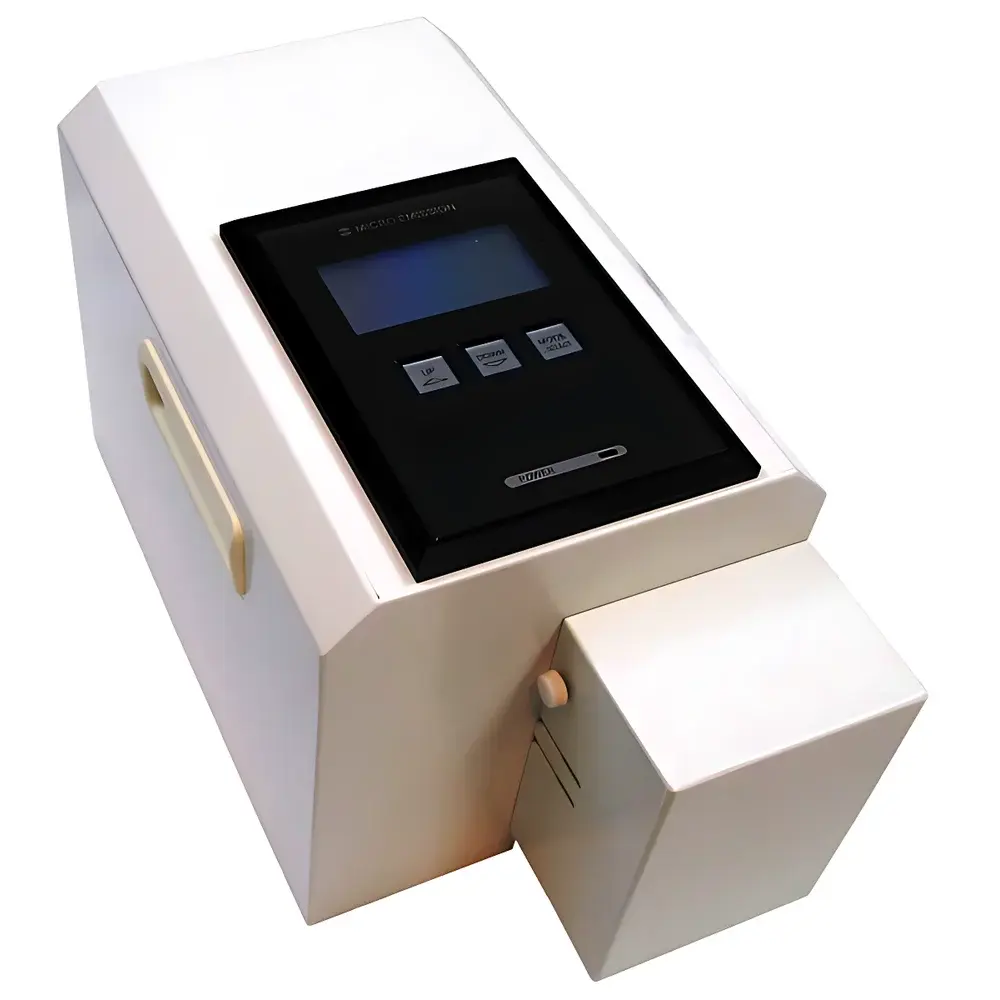
Micro Emission MH-6000A Portable Liquid Electrode Capillary Plasma Optical Emission Spectrometer (LECP-OES)
| Brand | Micro Emission |
|---|---|
| Origin | Japan |
| Model | MH-6000A |
| Instrument Type | Portable |
| Detection Principle | Optical Emission Spectrometry (OES) with Liquid Electrode Capillary Plasma (LECP) Excitation |
| Target Analytes | Multi-element (≥40 metals, including As, Cd, Cr, Cu, Fe, Pb, Zn, Ni, Mn, Al, Si, etc.) |
| Analysis Time | ≤5 s per sample |
| Detection Limit | Sub-ppm to ppm range |
| Power Requirement | 100 W AC/DC |
| Weight | 4.4 kg |
| Dimensions | 31 × 16 × 20 cm |
| Gas-Free Operation | Yes |
| Cooling System | None required |
| Exhaust Ventilation | Not required |
| Sample Introduction | Peristaltic pump |
| Detector Configuration | Dual-detector array (UV–Vis–NIR extended range) |
| Optional Accessory | Sapphire flow cell (for alkaline and high-silica matrices) |
Overview
The Micro Emission MH-6000A is a field-deployable Liquid Electrode Capillary Plasma Optical Emission Spectrometer (LECP-OES), engineered for rapid, multi-element quantification in uncontrolled or resource-limited environments. Unlike conventional ICP-OES systems that rely on high-power RF generators, argon plasma torches, and complex cooling and exhaust infrastructure, the MH-6000A employs a patented liquid electrode capillary plasma excitation source—where a stable, low-energy microplasma is generated directly within a flowing aqueous sample stream using a conductive liquid electrode configuration. This principle eliminates dependency on compressed gas, high-voltage RF matching networks, and water-cooled components, while retaining spectral resolution sufficient for qualitative identification and quantitative determination of over 40 metallic elements—including regulated heavy metals such as As, Cd, Cr(VI), Cu, Pb, Hg, Ni, and Zn—in water, soil extracts, food digests, and industrial process streams. Its compact architecture (31 × 16 × 20 cm; 4.4 kg), integrated battery-compatible power supply (100 W max), and fully self-contained optical path make it suitable for real-time decision support during environmental emergency response, regulatory field audits, and decentralized water quality surveillance programs.
Key Features
- Gas-free operation: No requirement for high-purity argon, nitrogen, or other carrier gases—reducing logistical burden and operational cost.
- Ultra-low power consumption: Operates at ≤100 W, compatible with portable power stations, vehicle inverters, or solar-charged battery packs.
- Dual-detector spectral acquisition: Simultaneous UV–Vis–NIR coverage (190–900 nm) enables broad elemental coverage without mechanical grating scanning.
- Peristaltic pump-based liquid handling: Supports direct aspiration from bottles, field vials, or inline sampling manifolds; no nebulizer, spray chamber, or torch alignment needed.
- Sapphire flow cell option: Chemically inert, thermally stable sample interface for analysis of high-pH, fluoride-rich, or silica-containing matrices without signal drift or corrosion.
- Robust optical design: Sealed, temperature-stabilized spectrometer housing with solid-state detectors ensures reproducible performance across ambient temperatures from 5 °C to 40 °C.
- Minimal consumables: No torches, injector tubes, RF coils, or vacuum pumps—only disposable tubing and optional sapphire cells require periodic replacement.
Sample Compatibility & Compliance
The MH-6000A accepts clarified aqueous samples with total dissolved solids (TDS) ≤ 2,000 mg/L and suspended solids < 10 mg/L. It supports direct analysis of EPA Method 200.7– and ISO 11885-compliant acid-digested water, wastewater, and leachate samples. For soil and sediment applications, it is validated for use with EPA Method 3050B/3051A and ISO 11466 extracts. The instrument meets functional equivalence criteria for field screening under US EPA Region 10 Field Screening Guidance and EU Water Framework Directive Annex V monitoring protocols. Data integrity is maintained through built-in audit trail logging compliant with GLP and ISO/IEC 17025 requirements. While not certified for 21 CFR Part 11 out-of-the-box, its software architecture supports configurable electronic signatures and user access control when deployed in regulated QA/QC workflows.
Software & Data Management
The MH-6000A operates via embedded Linux-based firmware with touchscreen GUI or remote control through Windows/macOS desktop software (MH-Analyzer Suite v3.2+). All spectral acquisitions are time-stamped, geotagged (via optional Bluetooth GPS), and stored in vendor-neutral .csv and .spc formats. Calibration curves support single-point, multi-point, and standard-addition methods with automatic matrix-matched correction. The software includes EPA-defined reporting templates (e.g., for Lead and Copper Rule compliance), customizable pass/fail thresholds, and export-ready PDF reports with full metadata (operator ID, location, date/time, calibration status, raw spectra). Raw spectral data can be reprocessed offline using open-source chemometric tools (e.g., Python-based PyMca or R’s hyperSpec), ensuring long-term analytical traceability independent of proprietary platforms.
Applications
- Field-based drinking water safety verification—rapid screening for lead, arsenic, and cadmium at distribution points or private wells.
- Industrial effluent monitoring—real-time tracking of metal discharge limits in electroplating, mining, and semiconductor fabrication facilities.
- Environmental site assessment—on-site triage of contaminated soils and groundwater plumes during Phase II investigations.
- Food safety field labs—quantitative detection of toxic metals in rice, seafood, and infant formula digestates.
- Educational and training deployments—hands-on OES instruction without need for dedicated lab infrastructure or hazardous gas handling.
- Emergency response—immediate elemental profiling during chemical spills, floodwater contamination events, or post-disaster water supply evaluation.
FAQ
Does the MH-6000A require external gas supply or ventilation?
No. It operates without argon, nitrogen, or any compressed gas. No fume hood or dedicated exhaust system is necessary.
What sample preparation is required for water analysis?
Filtered (0.45 µm) and acidified (1% v/v HNO₃) samples are recommended. Direct analysis of tap water, surface water, and treated wastewater is possible after filtration.
Can the MH-6000A analyze solid samples?
Not directly. Solids must first undergo standardized acid digestion (e.g., EPA 3050B, ISO 11466) to produce aqueous extracts compatible with peristaltic aspiration.
Is method validation support available?
Yes. Micro Emission provides application notes, spike recovery data, and interlaboratory comparison reports aligned with ISO 17025 method validation parameters (linearity, LOD/LOQ, precision, trueness).
How is calibration maintained during extended field use?
The instrument features internal wavelength reference lines (e.g., Hg and Ar emission peaks) for automated spectral recalibration before each batch. NIST-traceable multi-element standards are supplied for routine calibration verification.
Related Products







