
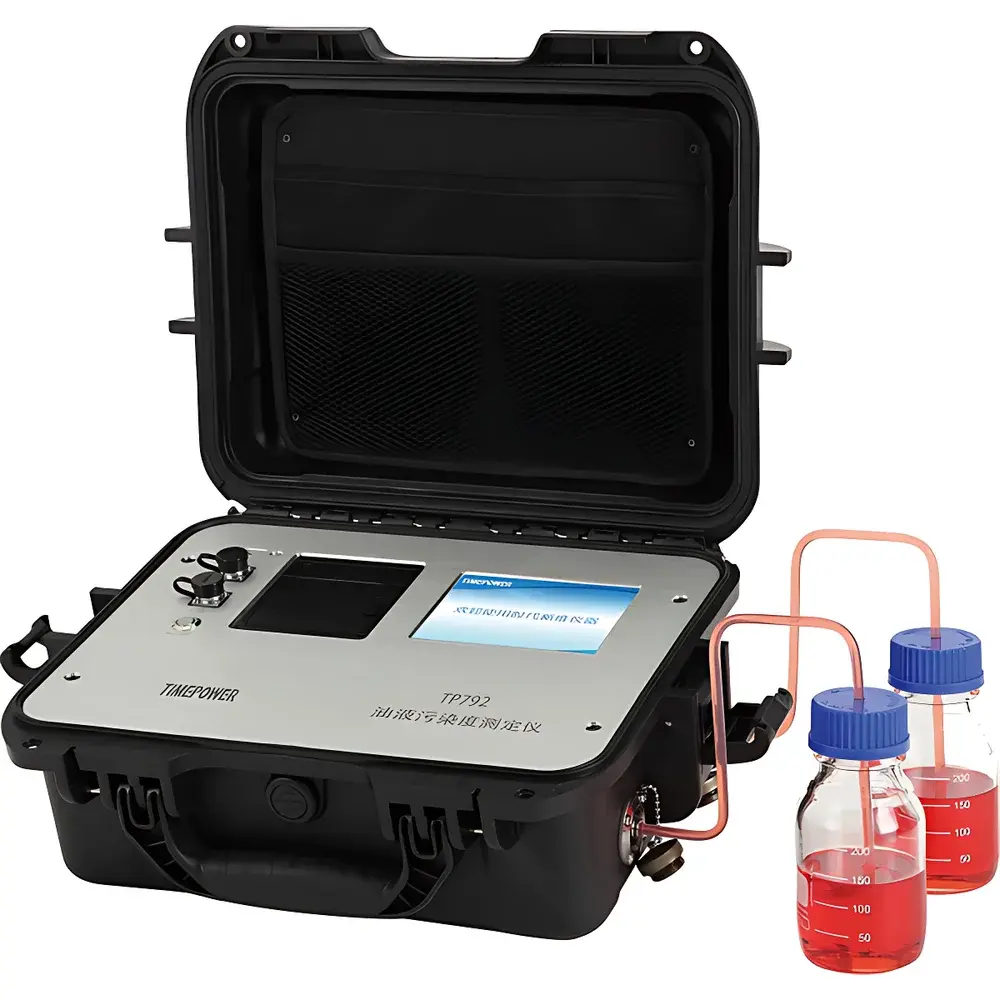
Timepower TP691 Portable Oil Particle Contamination Analyzer
| Brand | Timepower |
|---|---|
| Origin | Beijing, China |
| Manufacturer Type | Direct Manufacturer |
| Country of Origin | China |
| Model | TP 691 |
| Pricing | Upon Request |
| Measurement Principle | Microscopic Filtration & Manual Particle Counting |
| Detection Threshold | ≥5 µm (maximum dimension) |
| Microscope Magnification | 100× with Integrated Illumination |
| Contamination Rating Range | NAS 1638 Classes 4–12 |
| Dimensions | 410 mm × 310 mm × 230 mm |
| Weight | 6.4 kg |
| Compliance Standards | DL/T 432, GB/T 20082, ISO 4406, NAS 1638, GB/T 18854, ISO 11171, GJB 420B, GJB 380.4A |
Overview
The Timepower TP691 Portable Oil Particle Contamination Analyzer is a field-deployable, microscope-based instrument engineered for quantitative assessment of solid particulate contamination in industrial lubricants and hydraulic fluids. It operates on the standardized membrane filtration principle: a defined volume of oil sample is vacuum-filtered through a polycarbonate or mixed-cellulose ester (MCE) microporous membrane; retained particles are then visually enumerated and sized under incident-light optical microscopy at 100× magnification. The reported particle size corresponds to the maximum linear dimension of each particle—consistent with the metrological definitions in ISO 4406 and NAS 1638. Designed specifically for challenging matrices—including highly viscous turbine oils, phosphate ester fire-resistant fluids, and emulsified transformer oils—the TP691 delivers reproducible contamination grading without reliance on automated imaging or laser scattering, making it especially suitable for environments where electrical interference, ambient light variability, or fluid opacity preclude optical particle counters.
Key Features
- Integrated vacuum-assisted filtration system for accelerated sample processing—reducing filtration time by up to 40% compared to gravity-only methods
- Dedicated incident-illumination microscope (100× fixed magnification) with adjustable brightness and glare-free optics optimized for high-contrast particle visualization on membrane surfaces
- Comprehensive standard template set aligned with NAS 1638, ISO 4406, and GJB 420B contamination codes—enabling rapid visual comparison and grade assignment
- Compact, ruggedized chassis (410 × 310 × 230 mm; 6.4 kg) with shock-absorbing housing and sealed electronics—certified for operation in industrial plant floors, substations, and mobile laboratory vehicles
- No software dependency for core analysis—ensures compliance with GLP/GMP workflows requiring manual audit trails and operator accountability
- Modular accessory kit including calibrated sampling bottles, conical funnels, rinse flasks, glass slides, and certified 5 µm-rated track-etched membranes (pore size validated per ISO 11171)
Sample Compatibility & Compliance
The TP691 accommodates a broad spectrum of petroleum- and synthetic-based fluids used across power generation, petrochemical refining, aerospace hydraulics, and marine propulsion systems. It has been validated for use with ASTM D2276-grade aviation fuels, ISO VG 32–100 turbine oils, phosphate ester anti-wear fluids (e.g., Fyrquel, Skydrol), and inhibited mineral insulating oils meeting IEC 60296 specifications. All measurement procedures adhere strictly to the sampling, filtration, and counting protocols defined in DL/T 432 (China Electric Power Industry Standard), GB/T 20082 (Chinese national standard for hydraulic fluid cleanliness), and ISO 4406:2021. The instrument’s manual counting methodology satisfies regulatory requirements for traceability in FDA-regulated facilities where 21 CFR Part 11-compliant electronic data capture is not mandated—and remains fully auditable under ISO/IEC 17025 accreditation frameworks.
Software & Data Management
The TP691 operates as a standalone hardware platform with no embedded firmware or proprietary software. All data recording—including sample ID, volume filtered, observed particle counts per size bin (≥5 µm, ≥15 µm, ≥25 µm), assigned contamination class, operator initials, and date/time stamp—is documented manually in laboratory notebooks or facility-specific LIMS templates. This design eliminates cybersecurity vulnerabilities associated with network-connected analyzers and supports full compliance with ITAR-controlled environments and air-gapped QC laboratories. Optional digital documentation kits (sold separately) include ISO 17025-traceable calibration certificates for supplied microscopes and certified reference membranes, along with printable NAS/ISO comparison charts compliant with ASME Y14.5 geometric tolerancing conventions.
Applications
- Routine in-service oil monitoring at coal-, gas-, and nuclear-powered generating stations per IEEE C57.106 and DL/T 571 guidelines
- Pre-commissioning verification of hydraulic system cleanliness prior to turbine startup (per ISO 4406 Class 14/12/9 acceptance criteria)
- Root-cause analysis of servo-valve failures in aerospace ground support equipment using GJB 420B severity classification
- Third-party certification testing for lubricant blenders supplying NAS Class 5–7 fluids to defense contractors
- Research-grade particle morphology studies in tribology labs investigating wear debris evolution under controlled shear stress
FAQ
What sample volume is recommended for reliable NAS classification?
A minimum of 10 mL is required for statistically representative results when assessing NAS classes 4–12; volumes up to 100 mL may be processed using optional large-capacity filter holders.
Can the TP691 be used with water-contaminated or severely emulsified oils?
Yes—its vacuum-driven filtration architecture and compatibility with hydrophobic membrane chemistries enable consistent particle retention even in samples with >1,000 ppm water content or macro-emulsion stability.
Is operator training required for ISO 4406 compliance?
Yes—users must complete documented competency assessments covering membrane handling, illumination alignment, particle discrimination criteria (per ISO 11171 Annex B), and inter-laboratory counting reproducibility (target CV ≤15% for duplicate 20 mL runs).
How often must the microscope be recalibrated?
Annual verification against NIST-traceable stage micrometers is recommended; calibration records must include magnification verification at both eyepiece and objective levels per ISO 10993-12.
Are replacement membranes supplied with certified pore size distribution data?
Yes—all included MCE membranes are supplied with batch-specific test reports confirming mean pore diameter (5.0 ± 0.3 µm), bubble point pressure (≥20 psi), and extractables profile per USP <661.1>.





