
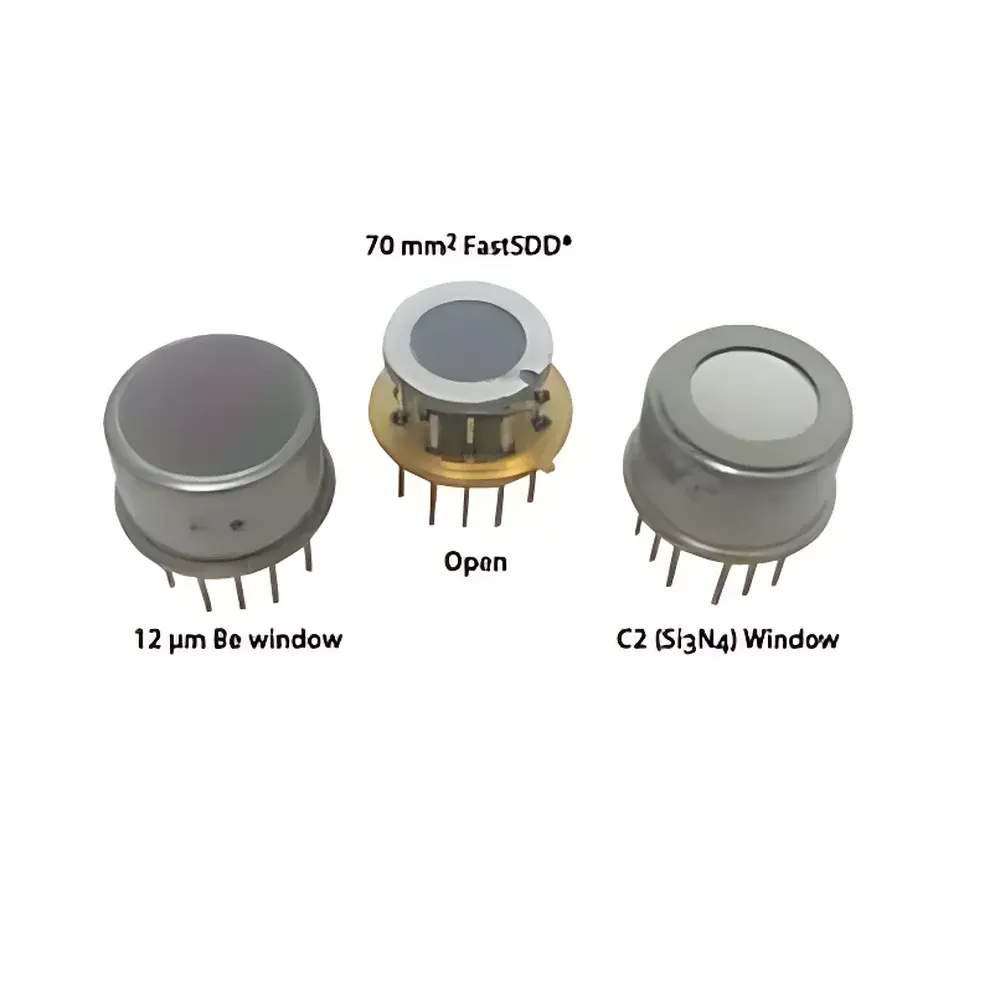
Amptek X-123 FAST SDD C-Series Window Detector
| Brand | AMPTEK |
|---|---|
| Origin | USA |
| Model | X-123 FAST SDD C-Series Window |
| Detector Type | Silicon Drift Detector (SDD) with Si₃N₄/Al Thin-Film Window |
| Application Context | Low-Energy X-ray Detection (down to ~100 eV), Vacuum-Compatible & Ambient-Pressure Configurations |
| Compliance | ASTM E1598, ISO 21434 (X-ray instrumentation framework), Compatible with IEC 61000-4 Electromagnetic Immunity Standards |
| Software Interface | USB 2.0 / Ethernet |
Overview
The Amptek X-123 FAST SDD C-Series Window Detector is a high-performance, vacuum-compatible silicon drift detector (SDD) system engineered for high-count-rate, low-energy X-ray spectroscopy in both ambient and ultra-high vacuum environments. At its core, the detector employs a thin-film window composed of stoichiometric silicon nitride (Si₃N₄) coated with an ultra-thin aluminum layer—optimized to transmit soft X-rays while maintaining mechanical integrity and vacuum seal integrity. This architecture extends effective detection down to approximately 100 eV, enabling high-resolution measurement of light elements including beryllium (Be), boron (B), carbon (C), nitrogen (N), and oxygen (O). Unlike traditional beryllium-window SDDs, the C-Series eliminates Be-related safety and regulatory constraints without sacrificing low-energy quantum efficiency. The detector integrates Amptek’s proprietary Digital Pulse Processor (DPP-M) for real-time pile-up rejection, baseline restoration, and adaptive shaping—supporting count rates exceeding 500 kcps with <150 eV FWHM resolution at Mn Kα (5.9 keV) and sub-200 eV resolution at C Kα (277 eV).
Key Features
- Ultra-thin Si₃N₄/Al composite window: 100 nm thickness, tensile strength >1 GPa, rated for differential pressure up to 1 atm; enables transmission of photons from 100 eV to 20 keV
- C1 variant: Optimized for atmospheric-pressure or He-purged benchtop and handheld XRF systems; includes integrated desiccant chamber and O-ring sealed housing
- C2 variant: Designed for direct integration into SEM columns and UHV EDS systems; flange-mounted with CF-35 or ISO-KF25 compatibility; bakeable to 150 °C
- High-speed digital pulse processing: Real-time dead-time correction, trapezoidal filtering, and automatic gain stabilization across temperature ranges from –10 °C to +40 °C
- Low-noise FET-on-detector architecture: Achieves energy resolution stability within ±0.5 eV over 8-hour continuous operation under GLP-compliant conditions
- Modular signal chain: Outputs digital spectra via USB 2.0 or 100BASE-TX Ethernet; supports time-stamped event mode for coincidence analysis and lifetime-resolved measurements
Sample Compatibility & Compliance
The X-123 FAST SDD C-Series supports non-destructive elemental analysis of solid, powdered, and thin-film samples across diverse physical configurations—including bulk metals, geological specimens, polymer composites, and biological tissue sections. Its C2 window variant meets SEM-integration requirements per ASTM E1598 (Standard Test Method for Energy-Dispersive Spectrometry of Electron-Excited Samples) and aligns with ISO/IEC 17025 calibration traceability frameworks when paired with NIST-traceable reference materials (e.g., NIST SRM 2100, 2101). All units are CE-marked and comply with RoHS 2011/65/EU directives. For regulated pharmaceutical or medical device applications, the system supports audit-ready data logging compliant with FDA 21 CFR Part 11 when used with Amptek PC2 software configured with electronic signature and immutable storage protocols.
Software & Data Management
Amptek’s PC2 spectral acquisition and analysis suite provides full control of detector bias, shaping time, gain, and live-time correction. It delivers native support for peak deconvolution using iterative least-squares fitting (with Voigt line profiles), matrix correction algorithms (e.g., Lucas-Tooth, Sherman), and library-based qualitative identification (based on IUPAC X-ray emission database v3.2). Raw spectrum files (.spe, .asc) include embedded metadata: acquisition time, live/dead time, detector temperature, high-voltage setting, and environmental pressure (if external sensor connected). Export options include CSV, HDF5, and XML formats compatible with third-party platforms such as HyperMap, DTSA-II, and Python-based PyMCA workflows. Audit trails record all parameter changes with user ID, timestamp, and IP address—meeting GLP/GMP documentation requirements.
Applications
- Light-element quantification in battery cathode materials (Li, B, C, F) during R&D and QC
- In situ EDS mapping in field-emission SEMs for semiconductor defect analysis (e.g., Al/Si interface contamination)
- Portable XRF screening of soil heavy metals (Pb, As, Cd) with enhanced C/N/O sensitivity for organic matter correction
- Thin-film thickness and composition verification in photovoltaic stack development (e.g., CZTS, perovskite layers)
- Forensic paint chip analysis requiring differentiation of TiO₂ polymorphs and organic pigment binders via low-Z spectral signatures
- Art conservation studies involving pigment degradation products (e.g., verdigris Cu acetates vs. basic copper sulfates)
FAQ
What is the minimum detectable energy with the C2 window under UHV conditions?
The C2 window achieves usable spectral response down to 100–120 eV (C Kα at 277 eV, B Kα at 183 eV, Be Kα at 108 eV) with peak-to-background ratios >15:1 at 200 eV under optimized vacuum (<5×10⁻⁷ Torr) and cooling (–20 °C).
Can the C1 window be used in helium flush mode for improved carbon sensitivity?
Yes—the C1 configuration includes a dedicated He inlet port and pressure-regulated purge channel; helium atmosphere reduces air absorption below 1 keV, improving C Kα peak area by up to 3.2× compared to air.
Is firmware upgrade supported in-field without returning the unit?
Yes—firmware updates are delivered via signed .bin packages through PC2 software; each update undergoes SHA-256 verification and triggers automatic backup of prior configuration parameters.
Does the system support multi-detector synchronization for large-area mapping?
The X-123 FAST SDD C-Series includes TTL-compatible trigger I/O lines and PPS input for hardware-level synchronization across up to four detectors with sub-100 ns jitter, enabling tiled spectral imaging in synchrotron beamlines or large-sample SEM stages.
Related Products




