
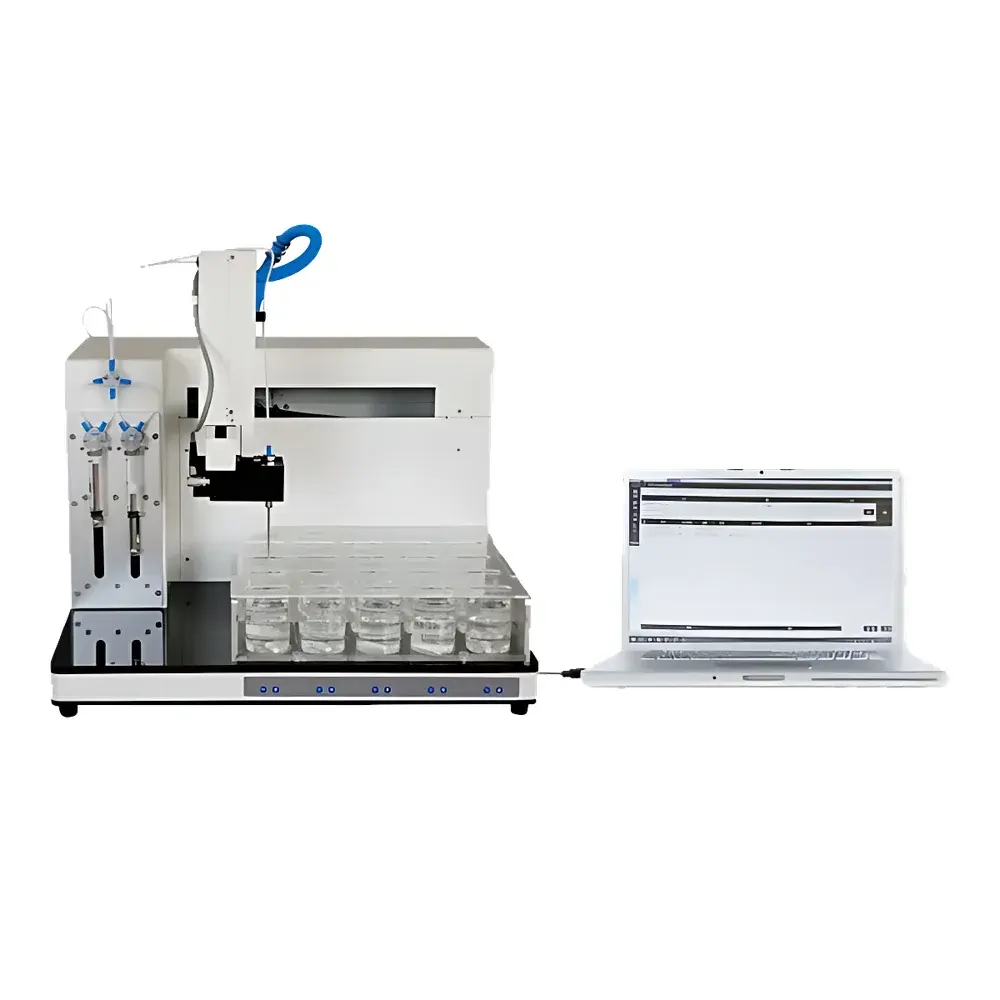
Tianhe GWF-9DW Insoluble Particle Analyzer
| Brand | Tianhe |
|---|---|
| Origin | Tianjin, China |
| Manufacturer Type | Authorized Distributor |
| Country of Origin | China |
| Model | GWF-9DW |
| Pricing | Available Upon Request |
Overview
The Tianhe GWF-9DW Insoluble Particle Analyzer is a fully automated, laser-based light obscuration instrument engineered for quantitative detection and size-resolved counting of insoluble particulate matter in parenteral pharmaceuticals, injectables, ophthalmic solutions, and medical device eluates. It operates on the principle of light extinction (ISO 21501-4:2018), where particles suspended in a liquid medium pass through a precisely defined sensing zone illuminated by a stable, temperature-compensated semiconductor laser. Each particle causes a transient reduction in detected light intensity proportional to its cross-sectional area—enabling classification into user-defined size bins (e.g., ≥10 µm, ≥25 µm) per pharmacopoeial requirements. Designed specifically for compliance-driven quality control laboratories, the GWF-9DW meets the analytical rigor mandated by the 2025 edition of the Chinese Pharmacopoeia (ChP), United States Pharmacopeia (USP <788> and <789>), European Pharmacopoeia (Ph. Eur. 2.9.19), Japanese Pharmacopoeia (JP XVII), British Pharmacopoeia (BP), and ISO 21501-4 for calibration and measurement uncertainty control.
Key Features
- Fully automated sample handling with precision 3-axis robotic arm capable of unattended analysis of up to 9 vials per run, minimizing operator intervention and inter-run variability.
- Dual-channel sampling system ensures continuous flow, high repeatability (RSD <3% for particle counts across replicate injections), and reduced carryover risk between samples.
- Optimized optical path featuring a high-stability 650 nm laser source with real-time photodiode feedback and dynamic power compensation—maintaining consistent signal-to-noise ratio across colorless, amber, or lightly tinted formulations.
- Chemically inert fluidic pathway constructed from electropolished ASTM F138-grade 316L stainless steel and PTFE-lined tubing—validated for compatibility with organic solvents (e.g., ethanol, propylene glycol), oil-based vehicles, and weakly acidic/alkaline preparations (pH 3–10).
- Integrated automatic cleaning cycle using programmable rinse sequences (water, isopropanol, or custom solvent), eliminating manual line purging and supporting multi-product lab environments.
- Onboard calibration verification with NIST-traceable polystyrene latex (PSL) reference standards; supports automated alignment and zero-check routines prior to each analytical session.
- Role-based user access control (RBAC) with audit trail logging compliant with FDA 21 CFR Part 11 requirements—including electronic signatures, session time stamps, and immutable record retention.
Sample Compatibility & Compliance
The GWF-9DW accommodates standard USP/ChP-compliant containers (e.g., 2–10 mL glass vials, syringes, IV bags via adapter kits) and supports direct injection of low-viscosity liquids (≤20 cP). It is validated for use with aqueous buffers, saline, dextrose solutions, lipid emulsions, and small-molecule APIs dissolved in ethanol or PEG-400. Regulatory alignment includes full traceability to ChP 2025 General Chapter 0903, USP <788>, Ph. Eur. 2.9.19, ISO 21501-4:2018 Annex B (calibration protocol), and GB 8368–2018 for infusion device extractables testing. Instrument qualification documentation (IQ/OQ/PQ templates) and raw data export formats (CSV, PDF, XML) are provided to support GLP and GMP audit readiness.
Software & Data Management
The embedded Windows-based analytical software features intuitive workflow navigation, configurable reporting templates (including ChP/USP summary tables), and batch-level statistical evaluation (mean, SD, CV%, pass/fail status per limit). All measurement data—including raw pulse height histograms, timestamped event logs, calibration history, and maintenance records—are stored in an encrypted local database with optional network backup. Audit trails capture every user action (login, parameter change, result override, report generation) with immutable timestamps and operator ID linkage. Export options include PDF reports with digital signatures, CSV for LIMS integration, and XML files compatible with enterprise data management systems adhering to ASTM E2500-14 guidelines.
Applications
- Final container testing of sterile injectables (e.g., monoclonal antibodies, vaccines, small-molecule IV formulations)
- Extractables and leachables assessment of polymeric medical devices (IV sets, syringes, stoppers) per ISO 10993-12
- In-process monitoring during filtration validation and formulation development
- Stability-indicating particle profiling across accelerated and long-term storage conditions
- Comparative analysis of generic vs. innovator products under regulatory submission protocols
FAQ
Does the GWF-9DW comply with FDA 21 CFR Part 11 requirements for electronic records?
Yes—the system implements role-based authentication, electronic signatures, and tamper-evident audit trails meeting all technical and procedural criteria for Part 11 compliance.
Can it analyze viscous or protein-rich biologics without clogging?
It is optimized for low-to-moderate viscosity samples (≤20 cP); for higher-viscosity or aggregation-prone biologics, optional dilution modules and pre-filtration adapters are available.
Is NIST-traceable calibration supported out-of-the-box?
Yes—factory-installed calibration verification routines accept certified PSL standards (e.g., 10 µm ±3%, 25 µm ±3%) with automated size bin adjustment and uncertainty reporting per ISO 21501-4.
What sample volume is required per test?
Standard assay uses 1–5 mL per vial; minimum detectable volume is 0.5 mL with optional micro-sampling kit.
How frequently must the optical sensor be cleaned or recalibrated?
Automatic cleaning executes before/after each sample; full optical alignment and calibration verification are recommended daily or per shift, with documented intervals aligned to internal SOPs.




