
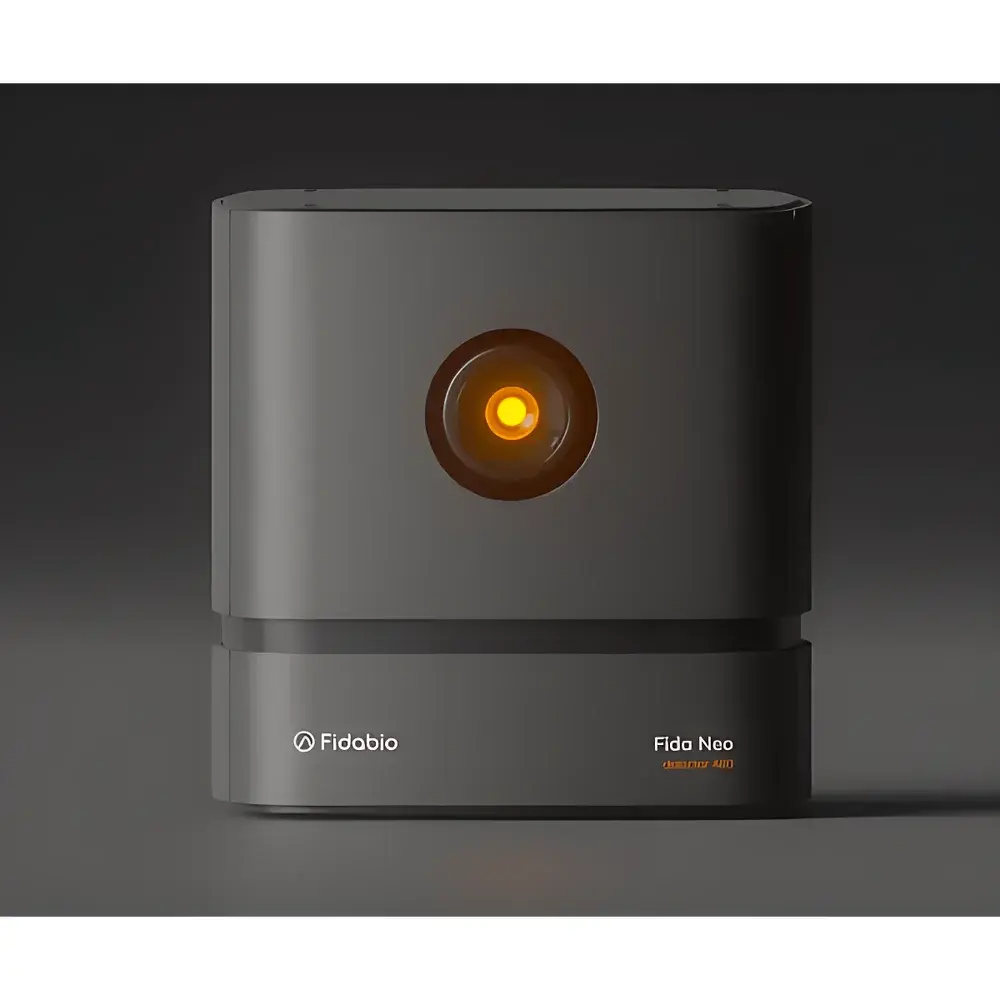
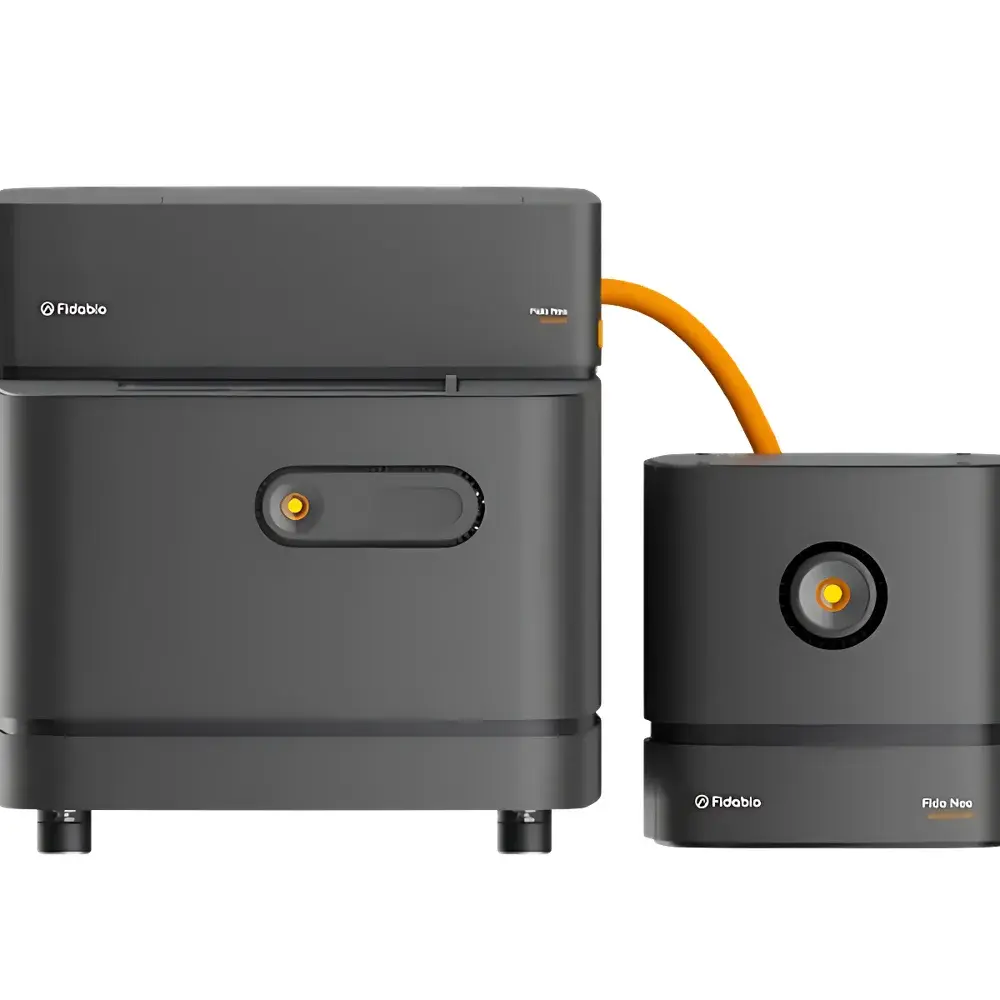
FIDA NEO Molecular Interaction and Stability Analyzer
| Brand | FIDA |
|---|---|
| Origin | Denmark |
| Model | NEO |
| Sample Capacity | 2 × 96-well plates or 2 × 50 vials |
| Temperature Control Range | 15–55 °C |
Overview
The FIDA NEO Molecular Interaction and Stability Analyzer is a next-generation biophysical platform developed by FIDA Biosystems (Denmark), engineered for label-free, solution-phase characterization of biomolecular interactions and structural stability. Unlike conventional surface-based or fluorescence-intensity-dependent techniques, FIDA leverages first-principles fluid dynamics—specifically Taylor dispersion in laminar flow—to directly quantify the hydrodynamic radius (Rh) of molecules in native buffer conditions. This physics-driven approach eliminates reliance on immobilization, labeling, or empirical calibration, enabling absolute, reproducible measurements of Rh with ≤5% resolution across a broad size range (0.5–500 nm). The system simultaneously delivers affinity parameters (KD, kon, koff), conformational metrics (e.g., BRIC index), aggregation state, viscosity, polydispersity (PDI), and fluorescence labeling efficiency—all from a single, unprocessed sample injection. Its design supports high-fidelity data acquisition under physiologically relevant conditions, making it particularly suited for early-stage biopharmaceutical development, QC release testing, and mechanistic studies of phase separation (LLPS), amyloid formation, and multivalent complexes.
Key Features
- Label-free, immobilization-free molecular interaction analysis in native solution—no surface tethering, heating, or covalent modification required
- Simultaneous multi-parameter output per run: KD, kon/koff (with optional kinetics module), Rh, PDI, aggregation index, intrinsic viscosity, fluorescence labeling efficiency, and sample loss quantification
- Three independent temperature-controlled zones: autosampler (4–55 °C), capillary chamber (15–45 °C), and detection cell (15–55 °C), each stabilized to ±0.1 °C
- High-sensitivity dual-color fluorescence detection (blue & red channels; sub-pM sensitivity), upgradable to UV
- Autosampler supporting two 96-well plates or 100 vials with full walk-away operation and post-run sample recovery into collection tubes
- Capillary reuse ≥400 times with automated cleaning protocol; no instrument flush required between runs
- Native buffer compatibility—including all detergents, chaotropes, and viscous formulations—without signal interference or calibration drift
- Integrated LLPS (liquid–liquid phase separation) analysis mode with time-resolved droplet sizing and partition coefficient calculation
- Tripartite interaction modeling: simultaneous determination of binary and ternary complex affinities plus cooperativity coefficients from one gradient experiment
- Real-time structural correlation via Rh mapping against PDB, AlphaFold2, and PyMOL databases using built-in BRIC (Binding-Induced Radius Change) algorithms
Sample Compatibility & Compliance
The FIDA NEO accommodates diverse analytes without purification or formulation adjustment: proteins (monomers to megadalton complexes), nucleic acids, peptides, small molecules (<500 Da), liposomes, exosomes, AAVs, amyloid fibrils, condensates, and even inorganic ions. It operates under full GLP-compliant data integrity frameworks, supporting 21 CFR Part 11–enabled audit trails, electronic signatures, and role-based access control when deployed with validated software configurations. All raw data files retain traceable metadata—including pressure profiles (1–3500 mBar), thermal logs, capillary usage counters, and real-time QC flags—ensuring full regulatory traceability for submissions to FDA, EMA, and PMDA. Method validation packages align with ICH Q5E and USP guidelines for comparability and higher-order structure assessment.
Software & Data Management
FIDA Control Suite provides intuitive workflow-driven experiment setup, automated multi-dimensional fitting (global KD/Rh/viscosity co-fitting), and batch processing with customizable reporting templates. Raw fluorescence decay curves are stored in vendor-neutral HDF5 format; export options include CSV (for kinetic modeling in Prism or KinTek), PDF (QC-certified reports), and TXT (machine-readable metadata). The software embeds built-in statistical process control (SPC) charts for longitudinal monitoring of assay robustness and integrates with LIMS via RESTful API. All computational models—whether monovalent binding, avidity-driven clustering, or cooperative ternary assembly—are transparently documented with open-source fitting equations and Jacobian diagnostics, facilitating internal model verification and external peer review.
Applications
- Early-stage antibody–antigen affinity maturation and epitope binning without immobilization artifacts
- Stability profiling of biosimilars under stress conditions (pH, temperature, excipients) via real-time Rh and PDI tracking
- Quantitative assessment of protein aggregation kinetics in formulation development
- Mechanistic investigation of intrinsically disordered proteins (IDPs) and phase-separated condensates
- Small-molecule fragment screening with direct stoichiometry and conformational response readouts
- AAV capsid–ligand interaction analysis in gene therapy vector characterization
- Viscosity prediction of high-concentration mAb formulations without dilution or rheometer calibration
- Comparability studies across manufacturing batches using orthogonal Rh-based fingerprinting
FAQ
Does FIDA require fluorescent labeling?
No—FIDA works with intrinsic tryptophan fluorescence or optional extrinsic dyes. Label-free operation is standard; labeling is only used when signal enhancement is needed for low-abundance targets.
Can FIDA distinguish soluble vs. insoluble aggregates?
Yes—the system resolves sub-populations based on diffusion coefficient distribution and provides separate quantification of reversible oligomers, amorphous aggregates, and sedimenting particles via time-resolved dispersion profiling.
Is kinetic analysis (kon/koff) included by default?
Kinetic parameter extraction requires activation of the optional Kinetics Module, which enables stopped-flow–equivalent transient dispersion analysis within the same capillary geometry.
How does FIDA handle highly viscous samples?
The instrument measures absolute viscosity in situ and applies real-time hydrodynamic correction to Rh calculations, eliminating need for reference standards or dilution.
What is the minimum sample consumption per analysis?
As low as 40 nL of analyte and ≤4 µL total volume per well—ideal for precious clinical or CRISPR-edited cell lysate samples.





