
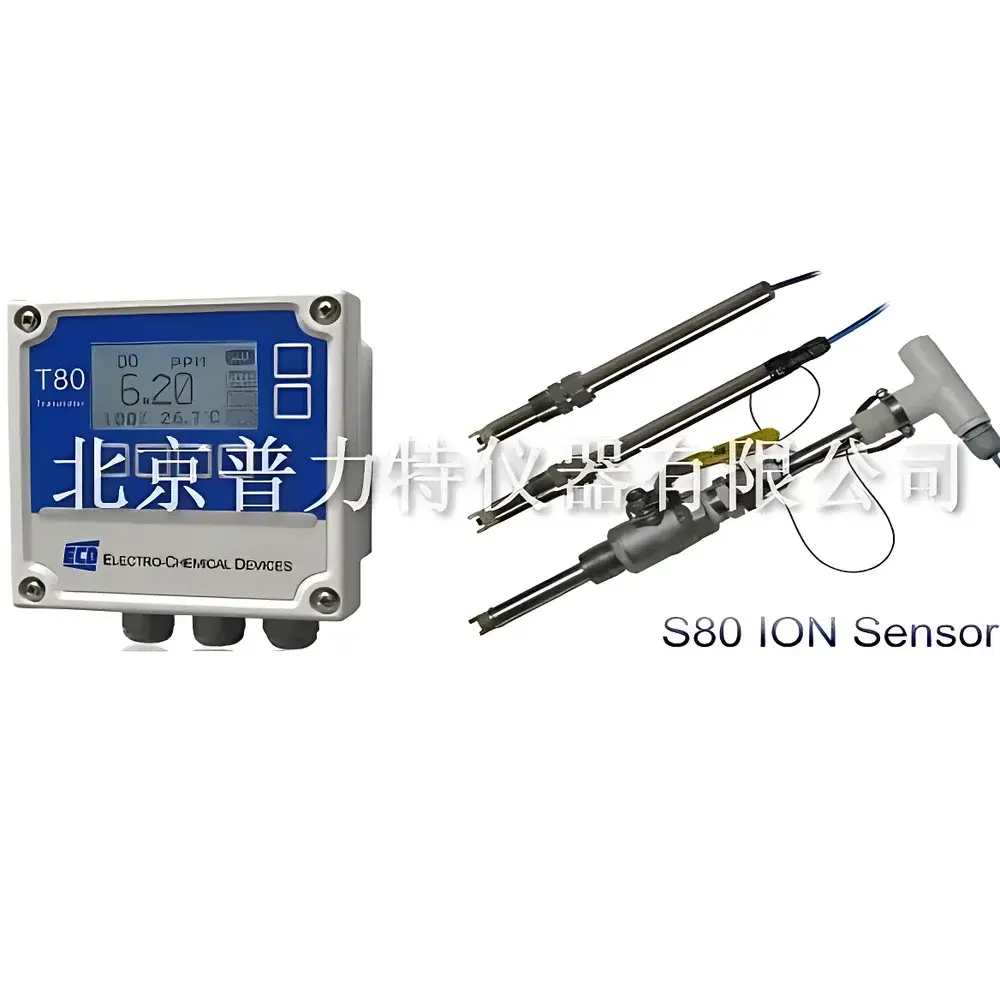
S80 Online Ion Analyzer
| Origin | USA |
|---|---|
| Manufacturer Type | Authorized Distributor |
| Origin Category | Imported |
| Model | S80 |
| Price Range | USD 2,800–7,000 (FOB) |
| Instrument Type | Online Multi-Ion Analyzer |
| Measurement Range | 0.01–32,000 ppm |
| Detection Limit | 0.01 ppm |
| Response Time | ≤1 s |
| Accuracy | ±10% of reading |
| Operating Temperature | −20 °C to +70 °C |
Overview
The S80 Online Ion Analyzer is a field-deployable, industrial-grade ion-selective electrode (ISE)-based continuous monitoring system engineered for real-time, multi-parameter water quality assessment in demanding environmental and process applications. Designed around the potentiometric principle—where ion activity in solution generates a Nernstian voltage potential across a selective membrane—the S80 delivers rapid, stable electrochemical measurements without sample dilution or reagent addition. Its architecture integrates a rugged, replaceable ISE sensor with the T80 intelligent transmitter/data logger, enabling autonomous operation in wastewater treatment plants, drinking water distribution networks, industrial effluent streams, and natural surface water bodies. The system complies with fundamental electrochemical measurement standards under ISO 10523 (water quality — determination of pH) and supports traceability-aligned calibration practices required by EPA Method 300.1 and ASTM D1129 for ion-specific analysis.
Key Features
- Smart Sensor Architecture: Embedded microcontroller stores factory pre-calibration coefficients, electrode type, serial number, and calibration history—enabling plug-and-play recognition by the T80 transmitter without manual configuration.
- Dual-Mount Flexibility: Available in two mechanically optimized configurations: insertion-type (for pipe spool or flow cell integration) and valve-retractable type (for hot-tap installation and maintenance without process shutdown).
- Industrial-Grade Enclosure: IP68-rated stainless steel (316 SS) housing standard; optional materials include titanium, Hastelloy® C-22, PVDF, and polypropylene—selected per chemical compatibility and corrosion resistance requirements per NACE MR0175/ISO 15156.
- Modular Cable Interface: Waterproof, detachable cable assembly with industry-standard M12 or PG13.5 connectors simplifies field replacement and reduces downtime during sensor servicing.
- Long-Life Replaceable Electrodes: All ISE elements are user-swappable; no need to discard the entire sensor assembly—significantly lowering total cost of ownership over multi-year deployments.
- T80 Transmitter Intelligence: Auto-detects connected S80 sensor type, displays real-time concentration and temperature-corrected mV output, supports dual-channel expansion, and provides configurable alarm relays compliant with IEC 61508 SIL 2 functional safety guidelines.
Sample Compatibility & Compliance
The S80 platform supports 14 distinct ion-selective electrodes—including chloride (Cl⁻), fluoride (F⁻), nitrate (NO₃⁻), ammonium (NH₄⁺), sodium (Na⁺), potassium (K⁺), calcium (Ca²⁺), copper (Cu²⁺), lead (Pb²⁺), cadmium (Cd²⁺), silver (Ag⁺), cyanide (CN⁻), sulfide (S²⁻), and bromide (Br⁻)—each validated across defined pH and temperature windows (e.g., F⁻: pH 5–8, 0–80 °C; CN⁻: pH 11–13, 0–80 °C). All sensors operate within aqueous matrices meeting EPA-defined turbidity limits (<10 NTU) and suspended solids thresholds (<50 mg/L). The system meets NEMA 4X ingress protection for outdoor enclosures and conforms to electromagnetic compatibility (EMC) per EN 61326-1:2013. Calibration verification follows GLP-aligned protocols with documented audit trails stored in non-volatile memory.
Software & Data Management
The T80 transmitter features an embedded data logger capable of storing up to 16,000 timestamped readings (concentration, temperature, mV, status flags) at user-defined intervals (1 s to 24 h). Data export is supported via Modbus RTU over RS-485 (ASCII or RTU mode), enabling seamless integration into SCADA, DCS, or cloud-based IIoT platforms such as Ignition, Siemens Desigo, or AWS IoT Core. The 128 × 64 pixel LCD display presents trend graphs, numeric values, and diagnostic icons—including electrode impedance diagnostics and temperature drift alerts. All configuration changes, calibration events, and alarm triggers are logged with date/time stamps and user IDs—ensuring compliance with FDA 21 CFR Part 11 when paired with validated third-party software for electronic record retention.
Applications
- Continuous monitoring of chloride ingress in desalination plant permeate lines
- Real-time tracking of nitrate and ammonium levels in municipal wastewater bioreactors
- Corrosion control via sulfate and chloride ratio monitoring in cooling tower circuits
- Regulatory compliance reporting for fluoride in drinking water distribution systems (per WHO Guideline Values)
- Leachate monitoring in landfill containment basins for heavy metals (Pb²⁺, Cd²⁺, Cu²⁺)
- Process optimization in electroplating rinse baths using real-time cyanide and silver concentration feedback
- Early-warning detection of sulfide breakthrough in anaerobic digesters
FAQ
What ion-selective electrodes are compatible with the S80 platform?
The S80 supports 14 certified ISE modules—including Cl⁻, F⁻, NO₃⁻, NH₄⁺, Na⁺, K⁺, Ca²⁺, Cu²⁺, Pb²⁺, Cd²⁺, Ag⁺, CN⁻, S²⁻, and Br⁻—each supplied with individual calibration certificates and pH/temperature operating envelopes.
Does the system support automatic temperature compensation?
Yes. The integrated Pt1000 RTD sensor enables real-time temperature measurement and automatic Nernst slope correction per ISO 7888, with compensation applied directly in the T80 firmware prior to concentration calculation.
Can the S80 be deployed in seawater or high-salinity brines?
Standard S80 configurations are rated for conductivity up to 20 mS/cm. For seawater (≈50 mS/cm), optional titanium or Hastelloy C-22 housings and specialized reference electrode electrolytes are recommended to mitigate junction potential drift.
Is the calibration data traceable to NIST standards?
Factory calibrations are performed using NIST-traceable ionic standard solutions (e.g., NIST SRM 3198 for chloride); users receive calibration reports with uncertainty budgets per ISO/IEC 17025 requirements.
How often does the sensor require recalibration in continuous operation?
Typical recalibration intervals range from 7 to 30 days depending on matrix fouling risk and regulatory requirements; the T80 logs electrode impedance and drift rate to assist predictive maintenance scheduling.
Related Products







