
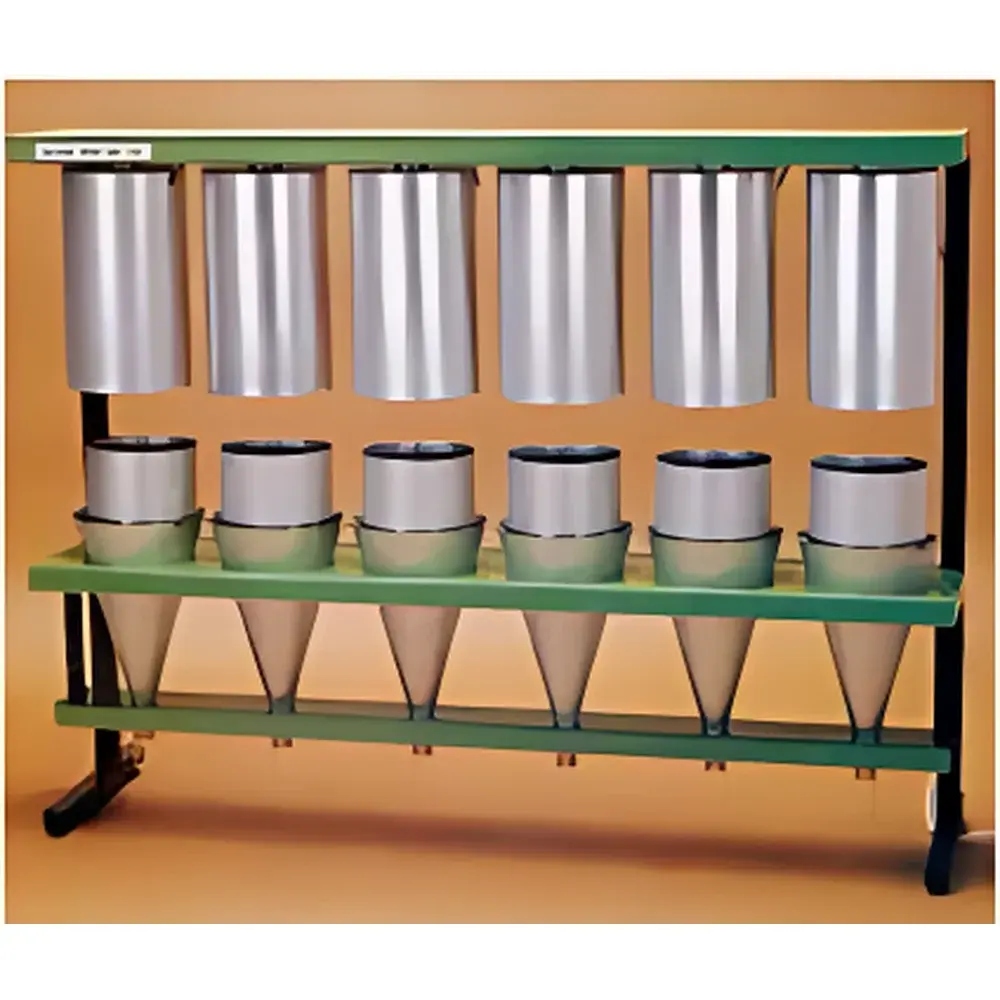
Burkard TULLGREN Soil Microfauna Extraction Funnel
| Brand | Burkard |
|---|---|
| Origin | United Kingdom |
| Model | TULLGREN |
| Instrument Type | Soil Microfauna Separation System |
| Power Supply | 110–240 V, 50/60 Hz |
| Weight | 2.5 kg |
| Configuration Options | Single-funnel, 6-funnel, or 12-funnel modular setup |
| Accessories Included | Stainless steel mesh screen, soil cylinder, calibrated rubber tubing, adjustable lamp housing with heat source, collection vial holder, and operational manual |
| Compliance | Designed in accordance with ISO 23611-4 (Soil quality — Sampling of soil invertebrates — Part 4: Extraction of microarthropods using the Tullgren funnel method) |
Overview
The Burkard TULLGREN Soil Microfauna Extraction Funnel is a precision-engineered apparatus for the standardized isolation and recovery of soil-dwelling microarthropods (e.g., collembolans, oribatid mites, pseudoscorpions) and nematodes from bulk soil or litter samples. Based on the classical dry-extraction principle first described by F. Tullgren in 1918, this system exploits vertical thermal and hygric gradients to induce behavioral descent in thermophobic and desiccation-avoiding organisms. The device operates without chemical solvents or mechanical disruption, preserving specimen viability and morphological integrity for subsequent taxonomic identification, biodiversity assessment, or ecotoxicological bioassay. Its design adheres to internationally recognized protocols—specifically ISO 23611-4—which defines procedural parameters for reproducible extraction efficiency across laboratories and long-term monitoring programs.
Key Features
- Adjustable radiant heat source: Integrated lamp housing with height-adjustable mounting allows precise control over thermal gradient development (typically ~14 °C differential across sample depth), minimizing thermal shock and preventing entrapment of slow-moving fauna in desiccated upper layers.
- Dual-mode operation: Supports both dry-extraction (for mesofauna) and wet-extraction (for nematodes and aquatic microfauna); in wet mode, the funnel chamber is filled with water and a fine-mesh gauze supports the sample, enabling passive buoyancy-driven separation.
- Modular scalability: Available as single-funnel, 6-funnel, or 12-funnel configurations—enabling parallel processing of replicate samples or multi-site comparative studies under identical environmental conditions.
- Corrosion-resistant construction: All contact surfaces—including stainless steel mesh screen, galvanized soil cylinder, and silicone-rubber tubing—are chemically inert and compliant with long-term exposure to organic-rich, acidic, or saline soil matrices.
- Integrated sample containment: Removable upper soil cylinder permits rapid loading/unloading while maintaining consistent sample geometry (standardized height-to-diameter ratio per ISO 23611-4).
- Universal power compatibility: Operates across global mains voltages (110–240 V AC, 50/60 Hz), eliminating need for external transformers in international field deployments or multi-country laboratory networks.
Sample Compatibility & Compliance
The Burkard TULLGREN funnel accommodates a broad range of natural substrates, including mineral soils (sandy, loamy, clayey), organic horizons (Oi, Oe, Oa), leaf litter, moss cushions, compost, and rhizosphere cores. It is validated for use with samples up to 50 mm diameter × 150 mm depth (compatible with standard Burkard soil corers). Extraction efficiency has been benchmarked against reference methods per ISO/IEC 17025-accredited interlaboratory trials. The system supports GLP-compliant workflows when paired with audit-trail-enabled data loggers (e.g., temperature and duration tracking), and its procedural consistency satisfies requirements for regulatory submissions under EU Soil Thematic Strategy reporting frameworks and US EPA Region 10 ecological risk assessment guidelines.
Software & Data Management
While the TULLGREN funnel is an analog, non-electronic instrument, its operation integrates seamlessly into digital lab ecosystems. Optional accessories include calibrated digital thermocouple probes (±0.3 °C accuracy) and time-stamped video recording rigs for behavioral validation. Raw extraction data—species counts, extraction duration, ambient RH/temperature, and sample metadata—are structured for import into biodiversity informatics platforms such as OBIS, GBIF, or custom LIMS via CSV or Darwin Core Archive templates. Full traceability is maintained through serialized instrument identifiers and batch-specific calibration records provided with each unit.
Applications
- Long-term soil biodiversity monitoring in protected areas and agricultural landscapes
- Ecotoxicological screening of pesticide or heavy metal impacts on microarthropod community structure
- Validation of metagenomic sequencing results via morphological ground-truthing
- Isolation of live nematodes (e.g., Globodera pallida, Rotylenchulus reniformis) for pathogenicity assays and resistance testing
- Standardized sampling for ISO 23611-4–compliant national soil health assessments
- Training modules in soil ecology, entomology, and environmental science curricula
FAQ
Is the lamp required during wet-extraction mode?
No. In wet-extraction, organisms are mobilized by hydrostatic pressure and buoyancy—not thermal gradient—so the lamp may be omitted or deactivated.
What is the recommended extraction duration for temperate forest litter?
ISO 23611-4 specifies 7 days at 20–25 °C ambient; however, optimal duration varies with fauna composition and moisture content—pilot trials are advised for novel substrates.
Can the funnel be used for extraction from peat or highly organic soils?
Yes, though extended pre-drying (to ~30% gravimetric moisture) is recommended to prevent clogging of the mesh and ensure uniform gradient formation.
Does Burkard provide calibration documentation?
Each unit ships with a Certificate of Conformance referencing ISO 23611-4 and a dimensional verification report; NIST-traceable thermometer calibration certificates are available upon request.
Are replacement parts available separately?
Yes—stainless steel mesh screens (100 µm and 40 µm variants), soil cylinders (40 mm × 50 mm and 50 mm × 150 mm), and lamp assemblies are stocked and orderable with lead times under 5 business days.







