
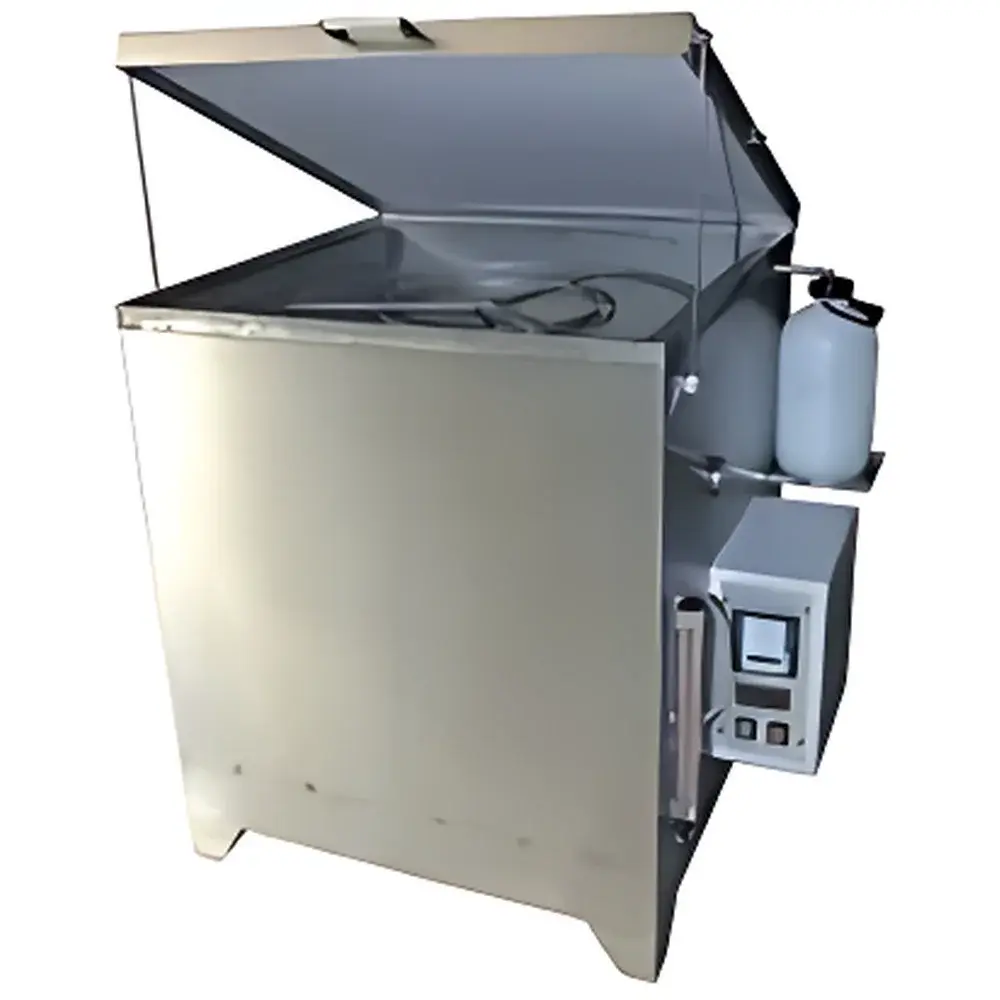
SDM 2500 Constant-Humidity Rust Characterization Chamber
| Brand | SDM |
|---|---|
| Origin | Italy |
| Model | 2500 |
| Compliance | ASTM D1748, IP 366 |
| Temperature Range | Ambient to 50 °C |
| Stability | ±1.1 °C |
| Power Supply | 220 V, 50 Hz |
| Heating Power | 1000 W |
| Chamber Dimensions | 100 × 80 × 98 cm (W × D × H) |
| Net Weight | 95 kg |
| Rotational Speed | 1/3 rpm |
| Sample Capacity | 33 steel panels |
| Air Distribution | 20 porous glass diffusers at tank base |
| Control System | Microprocessor-based PID temperature controller with digital display and over-temperature alarm |
| Humidity Maintenance | Automatic water-level regulation system |
| Construction | Dual-wall 18/8 stainless steel chamber with insulated jacket |
Overview
The SDM 2500 Constant-Humidity Rust Characterization Chamber is a precision-engineered instrument designed for standardized evaluation of rust-inhibiting properties of petroleum-based lubricants and corrosion inhibitors under controlled humid conditions. It operates on the principle of accelerated atmospheric corrosion testing—specifically replicating the ASTM D1748 and IP 366 protocols—where test specimens (typically polished steel panels) are exposed to a saturated humid environment while undergoing slow rotational motion to ensure uniform exposure and simulate real-world condensation dynamics. The chamber’s dual-wall 18/8 stainless steel construction provides thermal stability and long-term resistance to chloride-induced pitting, critical for reproducible multi-day corrosion trials. Its integrated microprocessor PID controller maintains temperature within ±1.1 °C across the operational range (ambient to 50 °C), while the automatic water-level regulation system ensures consistent relative humidity without manual intervention—eliminating drift in test boundary conditions that could compromise inter-laboratory comparability.
Key Features
- Dual-wall 18/8 stainless steel chamber with insulated jacket for minimized thermal gradient and enhanced humidity retention
- Stainless steel bath reservoir with integral faucet, isolation valve, and submerged heating element with dedicated auxiliary switch for rapid thermal recovery
- Hinged aluminum-framed lid fitted with desized cotton cloth—standard per ASTM D1748 for controlled vapor diffusion and condensate formation
- Calibrated air supply subsystem comprising particulate filter, pressure regulator, analog pressure gauge, high-accuracy rotameter, glass scrubber column, and flow-control valves
- Uniform air distribution via 20 borosilicate glass porous diffusers mounted flush at the chamber floor—ensuring laminar, low-velocity airflow across all specimen surfaces
- Low-speed stainless steel rotating platform (1/3 rpm) accommodating up to 33 standardized steel test panels (e.g., ASTM A240 Type 304)
- Integrated drip collection tray beneath the rotation stage to isolate oil runoff and condensed moisture—preventing cross-contamination and enabling quantitative residue analysis
- Digital PID temperature controller with real-time display, programmable setpoint, and independent over-temperature cut-off circuitry compliant with IEC 61000-6-2 EMC requirements
- Redundant temperature monitoring using two calibrated liquid-in-glass thermometers traceable to NIST standards
Sample Compatibility & Compliance
The SDM 2500 is validated for use with standard ferrous substrates specified in ASTM D1748 (e.g., polished cold-rolled steel panels, 76 × 127 × 0.8 mm) and IP 366 (similar dimensions, surface roughness Ra ≤ 0.4 µm). Panel mounting fixtures are non-reactive and prevent galvanic coupling. All wetted components—including bath, diffusers, drip tray, and cloth support frame—are fabricated from corrosion-resistant austenitic stainless steel (EN 1.4301 / AISI 304), eliminating metal ion leaching that could falsely accelerate rust formation. The system supports full audit readiness for GLP and GMP environments: temperature logs are time-stamped and stored internally; alarm events (e.g., over-temp, low-water) generate non-volatile flags; and hardware design permits third-party validation per ISO/IEC 17025 calibration protocols. No software-based data manipulation is performed—the instrument functions as a physical test platform, aligning with regulatory expectations for method-defined equipment in refinery QC labs.
Software & Data Management
The SDM 2500 operates as a stand-alone electromechanical test platform with no embedded operating system or network interface. Temperature setpoints, runtime duration, and alarm thresholds are configured via front-panel membrane switches and confirmed on a 4-digit LED display. All operational parameters—including real-time temperature, elapsed test time, and status indicators (heating active, water level OK, rotation engaged)—are visible without external software. For laboratories requiring electronic recordkeeping, optional RS-232 or 4–20 mA analog outputs (available upon request) enable integration with LIMS or SCADA systems. Raw temperature data can be logged externally using a Class A platinum RTD probe (calibration certificate provided). The absence of proprietary firmware eliminates cybersecurity concerns and ensures compatibility with FDA 21 CFR Part 11-compliant validation packages when paired with qualified data acquisition hardware.
Applications
- Evaluation of rust-preventive additives in turbine oils, hydraulic fluids, and gear lubricants per ASTM D1748 pass/fail criteria (e.g., “no rust observed after 24 h”)
- Comparative screening of corrosion inhibitor formulations during R&D of pipeline protection fluids
- Quality control release testing for military-specification lubricants (MIL-PRF-17331, MIL-PRF-2104G)
- Accelerated aging studies of greases and solid film lubricants under cyclic humidity exposure
- Supporting ASTM D665 (turbine oil rust testing) methodology development where constant-humidity preconditioning is required
- Academic research into electrochemical corrosion kinetics under controlled RH and thermal gradients
FAQ
What standards does the SDM 2500 explicitly support?
ASTM D1748 and IP 366 are fully implemented in mechanical design, airflow configuration, panel geometry, and cloth specification—no adapter kits or procedural deviations are required.
Can the chamber accommodate non-standard specimen sizes?
Yes—custom panel racks (subject to mechanical clearance verification) may be supplied; however, deviation from ASTM-specified dimensions voids conformance claims for standardized reporting.
Is the air flow rate adjustable and traceable?
The rotameter is factory-calibrated to ±2% FS with NIST-traceable documentation; flow is manually adjusted via needle valve and verified against the glass scale before each test series.
How is water purity maintained during extended tests?
Operators must use deionized water (resistivity ≥ 1 MΩ·cm); the system includes no built-in purification—this is a user responsibility aligned with ASTM D1748 Section 7.2.
Does the instrument include calibration certification?
Each unit ships with a Factory Calibration Report covering temperature uniformity mapping (9-point grid), rotational speed verification, and water-level sensor linearity—valid for 12 months from date of shipment.
Related Products







