
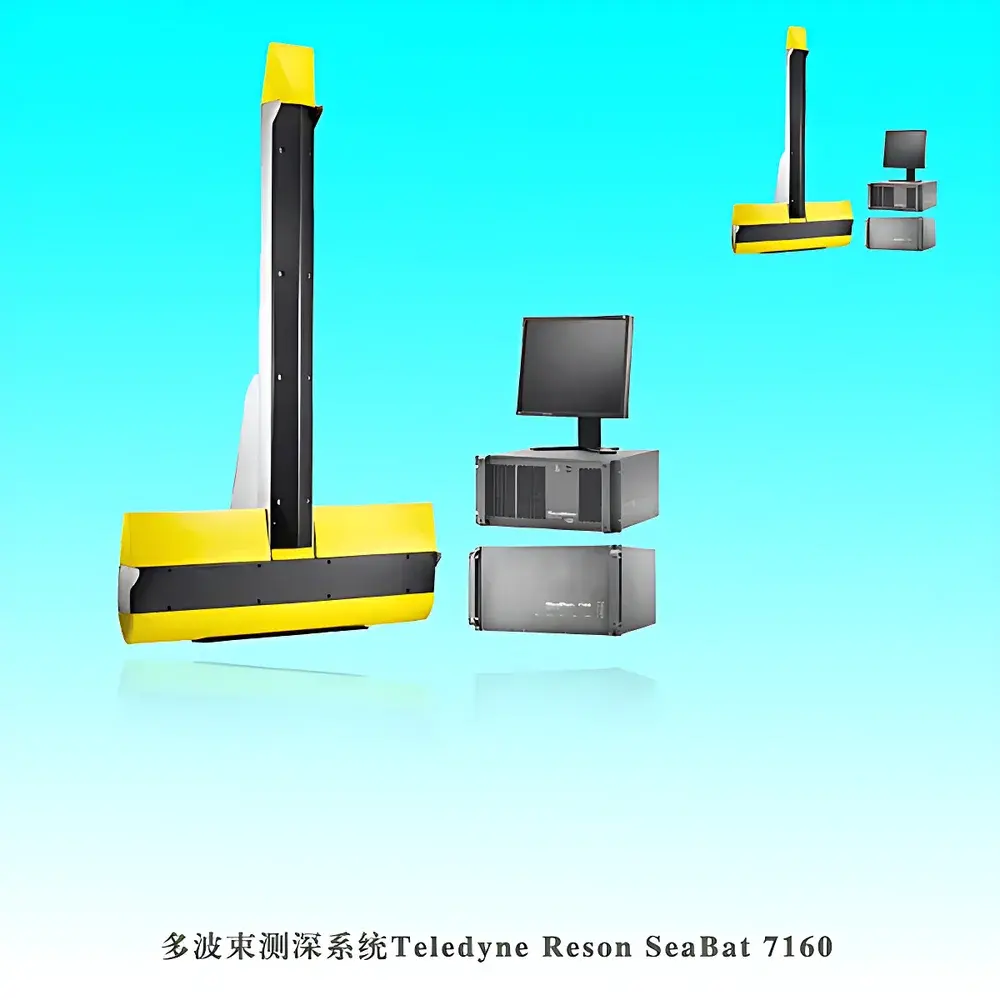
Teledyne Reson SeaBat 7160 Multibeam Echo Sounder System
| Origin | Denmark |
|---|---|
| Manufacturer Type | Authorized Distributor |
| Origin Category | Imported |
| Model | SeaBat 7160 |
| Price | USD 100,000 (FOB Copenhagen) |
| Operating Frequency | 44 kHz |
| Beam Count | 512 (equidistant) / 150 (equiangular) |
| Swath Width | ≥4× water depth |
| Depth Range | 3–3000 m |
| Ping Rate | 50 Hz |
| Beamwidth | 2.0° × 1.5° |
| Pitch Stabilization | ±10° |
| Transducer Dimensions | 1477 mm × 1100 mm × 100 mm |
| Transceiver Unit Dimensions | 265 mm × 483 mm × 469 mm |
| Transducer Pressure Rating | 60 m |
| In-Air Weight (Transducer + 15 m cable) | 34 kg |
| In-Water Weight (Transducer + 15 m cable) | 14.6 kg |
| In-Air Weight (Transceiver + 15 m cable) | 42 kg |
| In-Water Weight (Transceiver + 15 m cable) | 17.5 kg |
| Depth Resolution | 12 cm |
Overview
The Teledyne Reson SeaBat 7160 is a high-performance, dual-mode multibeam echo sounder system engineered for continental shelf mapping, hydrographic surveying, and offshore infrastructure inspection. Based on coherent broadband pulse compression technology and real-time beamforming, the SeaBat 7160 operates at a nominal center frequency of 44 kHz—optimized for balanced penetration, resolution, and signal-to-noise ratio in medium- to deep-water environments. Its T-shaped transducer array integrates a linear transmit array and a separate linear receive array, enabling precise spatial separation of emission and reception paths to minimize cross-talk and improve angular discrimination. The system supports both equidistant (512 beams) and equiangular (150 beams) beam configurations, allowing users to select acquisition geometry based on bathymetric fidelity requirements or operational constraints. With a maximum swath width exceeding four times the water depth and a certified operational range from 3 m to 3000 m, the SeaBat 7160 delivers consistent performance across coastal, shelf, and upper-slope regimes. Pitch stabilization (±10°) and roll compensation algorithms are embedded within the real-time processing firmware, ensuring geometric integrity of bathymetric point clouds even under dynamic vessel motion.
Key Features
- Coherent broadband transmission with adaptive pulse compression for enhanced signal discrimination and noise rejection
- T-shaped transducer architecture enabling independent optimization of transmit/receive directivity and reduced mutual coupling
- Real-time pitch stabilization and roll-compensated beam steering, compliant with IHO S-44 Special Order accuracy standards
- Dual-beam configuration mode: 512 equidistant beams for high-density coverage or 150 equiangular beams for uniform angular sampling
- 50 Hz ping rate supporting high-speed survey operations up to 12 knots without data gap or beam smearing
- 12 cm depth resolution at full range, traceable to NIST-traceable calibration procedures
- Integrated pressure-rated housing rated to 60 m depth for transducer unit; compatible with hull-mounted, pole-mounted, or portable deployment frames
- Modular transceiver unit (265 × 483 × 469 mm) designed for rapid integration into existing survey platforms including AUVs, USVs, and research vessels
Sample Compatibility & Compliance
The SeaBat 7160 is designed for deployment in marine environments ranging from sheltered harbors to open-ocean continental margins. It complies with IEC 62238-2 (hydrographic echosounders), meets IHO S-44 Special Order specifications for vertical uncertainty (<0.25 m + 0.0075 × depth), and supports GLP-aligned metadata tagging per ISO 8582:2022. All firmware and data logging modules are validated against DO-178C Level C for deterministic real-time behavior. The system’s raw data format (R2Sonic .s7k-compatible binary) ensures interoperability with CARIS HIPS & SIPS, QPS Qimera, and EIVA NaviModel processing suites. No proprietary lock-in: all processed and raw datasets retain full georeferenced timestamps, attitude inputs (via integrated or external IMU), and two-way travel time metadata required for post-processed kinematic (PPK) correction workflows.
Software & Data Management
The SeaBat 7160 operates with Reson’s SIS (Seafloor Information System) v5.x software suite, which provides real-time visualization, automatic surface detection, adaptive filtering, and QA/QC dashboards aligned with NOAA Hydrographic Survey Specifications. SIS includes built-in support for NMEA 0183/2000, PTPv2 time synchronization, and IEEE 1588-2019-compliant clock discipline. Raw data is stored in a self-describing binary format with embedded XML metadata headers, enabling automated ingestion into enterprise geospatial databases (e.g., PostgreSQL/PostGIS). Audit trails—including operator logins, parameter changes, and sensor health status—are retained for ≥18 months and exportable in CSV/JSON for regulatory review. The system fully supports FDA 21 CFR Part 11-compliant electronic signatures when deployed in offshore environmental monitoring contexts requiring ALARP-compliant data governance.
Applications
- High-resolution seafloor mapping for offshore wind farm site characterization and cable route surveys
- Subsea pipeline and cable burial assessment with sub-meter positional repeatability
- Geohazard identification (e.g., slope failures, pockmarks, fluid expulsion features) in continental margin studies
- Baseline and change-detection bathymetry for marine protected area (MPA) management
- Support for autonomous underwater vehicle (AUV) navigation and terrain-relative positioning
- Integration with side-scan sonar and sub-bottom profiler systems in multi-sensor towed arrays
FAQ
Is the SeaBat 7160 suitable for shallow-water (<10 m) surveys?
Yes—the system’s near-field correction algorithms and variable pulse length control enable stable bottom detection down to 3 m depth, provided vessel speed is reduced to ≤5 knots and motion compensation is active.
Can the SeaBat 7160 be interfaced with third-party inertial navigation systems (INS)?
Yes—it accepts industry-standard NMEA 0183/2000, STN-2000, and Ethernet-based UDP/GNSS+IMU streams (e.g., Applanix POS MV, iXblue PHINS) with configurable latency compensation.
What calibration protocols does Reson recommend for annual verification?
Reson recommends factory recalibration every 24 months or after any impact event exceeding 5 g; field verification using calibrated acoustic targets (e.g., tungsten carbide sphere) per ISO 17025-accredited procedures is advised quarterly.
Does the system support real-time water column backscatter analysis?
Yes—SIS v5.4+ provides calibrated volume scattering strength (Sv) computation using split-beam intensity normalization and absorption correction per Mackenzie (1981) equations.
Is hull integration engineering support included with purchase?
Yes—Teledyne Reson provides full mechanical, acoustic, and electrical integration support, including finite-element modeling of hull-induced noise coupling and flow-induced vibration mitigation strategies.





