
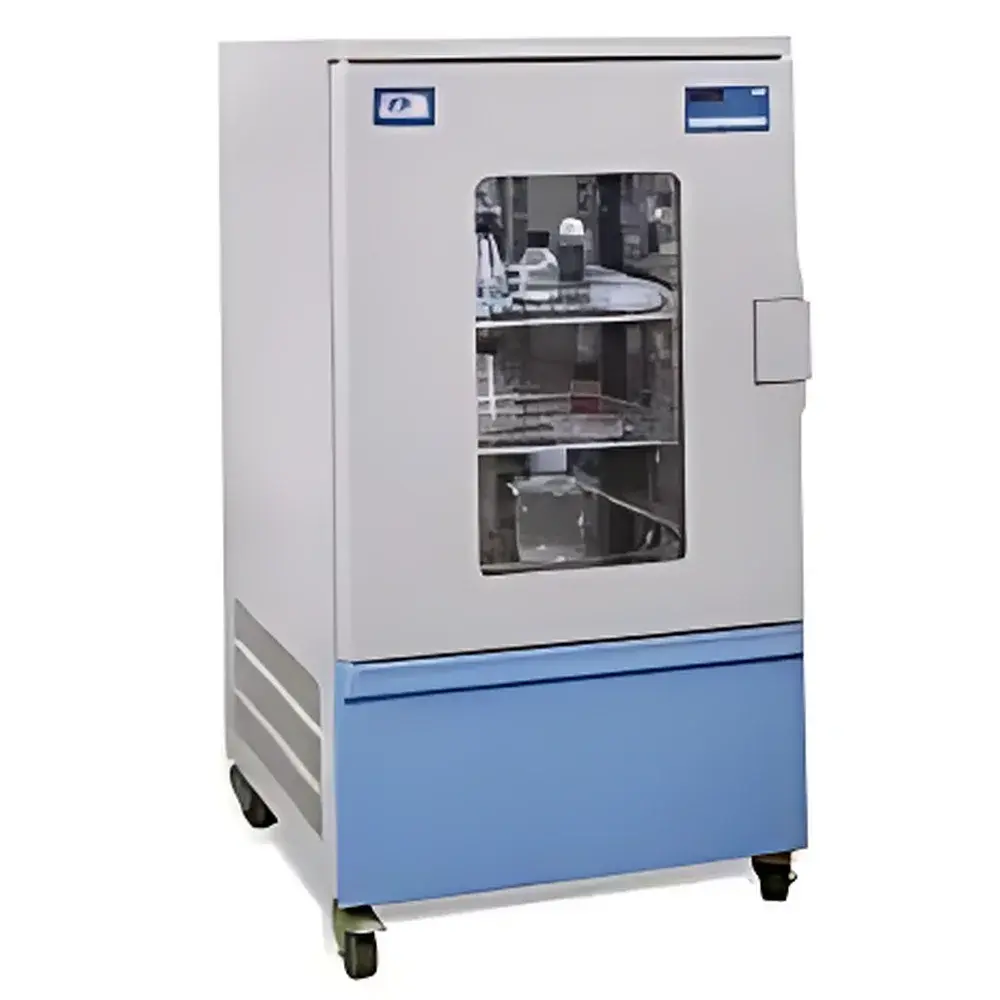
JP Hotcold S Series Laboratory Refrigerated Incubator
| Brand | JP |
|---|---|
| Origin | Spain |
| Model | Hotcold S |
| Instrument Type | Upright |
| Effective Volume | 50 L |
| Internal Dimensions (W×D×H) | 650 × 500 × 430 mm |
| External Dimensions (W×D×H) | 1280 × 630 × 630 mm |
| Power Supply | 220 V AC |
| Rated Power | 400 W |
| Temperature Range | +5 °C to +65 °C |
| Temperature Stability at 20 °C | ±0.1 °C |
| Temperature Uniformity at 20 °C | ±0.5 °C |
| Setpoint Accuracy | ±2 °C |
| Temperature Resolution | 0.1 °C |
| Cooling Medium | R134a |
| Construction | Epoxy-coated exterior shell, AISI 304 stainless steel interior chamber |
| Door | Double-glazed insulated glass |
| Features | Forced-air convection, digital electronic temperature controller with time display, internal fluorescent lighting, external access ports for probes/tubing, four casters with locking brakes |
| Safety | DIN 12880-2 compliant adjustable safety thermostat with manual reset and independent heater cutoff |
Overview
The JP Hotcold S Series is a precision-engineered upright laboratory refrigerated incubator designed for stable, uniform thermal control across a broad operational range—from +5 °C to +65 °C. Unlike ultra-low temperature freezers (ULTs), this unit operates as a *refrigerated incubator*, integrating active cooling (via R134a refrigerant) with forced-air convection and high-fidelity digital temperature regulation. Its architecture supports applications requiring both refrigeration and controlled warming—such as enzyme kinetics assays, serum and plasma fraction storage, BOD incubation, pharmaceutical stability testing, and microbial culture maintenance under defined thermal conditions. The unit complies with DIN 12880-2 for safety-critical temperature monitoring systems, ensuring fail-safe operation in regulated environments.
Key Features
- Epoxy-painted exterior housing for corrosion resistance and mechanical durability in multi-user lab settings.
- AISI 304 stainless steel interior chamber—non-porous, non-reactive, and compatible with routine disinfection protocols including ethanol, hydrogen peroxide vapor, and quaternary ammonium solutions.
- Double-glazed insulated door minimizes radiant heat transfer and maintains internal thermal integrity during frequent access cycles.
- Integrated fluorescent lighting with dedicated switch enables visual sample inspection without compromising chamber temperature stability.
- Two externally accessible measurement ports allow seamless integration of third-party temperature probes, humidity sensors, or tubing for gas exchange or media perfusion.
- Four heavy-duty casters with individual locking brakes facilitate safe repositioning within shared laboratory spaces while ensuring structural stability during operation.
- Digital electronic controller with real-time temperature readout (0.1 °C resolution) and elapsed time display supports GLP-compliant documentation workflows.
Sample Compatibility & Compliance
The Hotcold S Series accommodates standard laboratory vessels—including Petri dishes, multi-well plates, flasks, and cryovials—within its 50 L effective volume and optimized internal geometry (650 × 500 × 430 mm). Its temperature uniformity of ±0.5 °C at 20 °C meets ISO 15197:2013 and ASTM E2874-13 requirements for incubators used in clinical diagnostics and biopharmaceutical QC. The DIN 12880-2–certified dual-thermostat system provides redundant thermal protection: the primary controller regulates setpoint accuracy (±2 °C), while the independent safety thermostat interrupts heating circuit power upon deviation—requiring manual reset to prevent uncontrolled thermal excursions. This architecture aligns with FDA 21 CFR Part 11 expectations for audit-trail-capable critical equipment in GMP environments.
Software & Data Management
While the Hotcold S Series does not include embedded data logging or network connectivity, its analog-compatible output terminals (optional accessory) support connection to external chart recorders or SCADA systems. The digital controller retains last-set parameters through power interruption, minimizing reconfiguration overhead. For laboratories implementing electronic lab notebooks (ELNs) or LIMS integration, the unit’s stable thermal performance and repeatable ramp profiles enable correlation of incubation conditions with assay outcomes—supporting traceability in method validation per ICH Q5C and USP .
Applications
- Enzyme activity profiling across physiological and supra-physiological temperatures (e.g., Taq polymerase characterization, protease kinetics).
- Storage and incubation of serum, plasma fractions, and monoclonal antibody intermediates requiring tight thermal control between +5 °C and +25 °C.
- Biochemical oxygen demand (BOD) testing per EPA Method 405.1 and ISO 5815-1, where consistent 20 °C incubation is mandatory.
- Stability studies for cosmetics and topical formulations under ICH Q1A(R2)-defined intermediate conditions.
- Plant tissue culture initiation and bacterial growth phase synchronization in agricultural and synthetic biology research.
- Pre-incubation of reagents prior to ELISA, PCR setup, or flow cytometry staining protocols.
FAQ
Is the Hotcold S Series suitable for long-term cryogenic storage?
No. It is not an ultra-low temperature freezer (ULT); its minimum operating temperature is +5 °C. For storage below 0 °C, dedicated ULT systems are required.
Does the unit meet FDA 21 CFR Part 11 requirements?
The base configuration lacks electronic audit trails or user authentication; however, its DIN 12880-2 safety architecture and stable thermal performance support compliance when integrated into validated workflows with external data capture.
Can external sensors be connected for continuous monitoring?
Yes—two dedicated access ports enable physical routing of probe cables or tubing without compromising chamber seal integrity.
What maintenance is recommended for optimal performance?
Biannual cleaning of condenser coils, quarterly verification of door gasket integrity, and annual calibration of the digital temperature sensor against NIST-traceable references are advised.
Is R134a refrigerant compliant with current EU F-Gas Regulation (EU) No 517/2014?
R134a has a GWP of 1430 and remains permissible for laboratory equipment under current exemptions; however, users should consult local environmental compliance officers regarding phase-down timelines and reporting obligations.






