
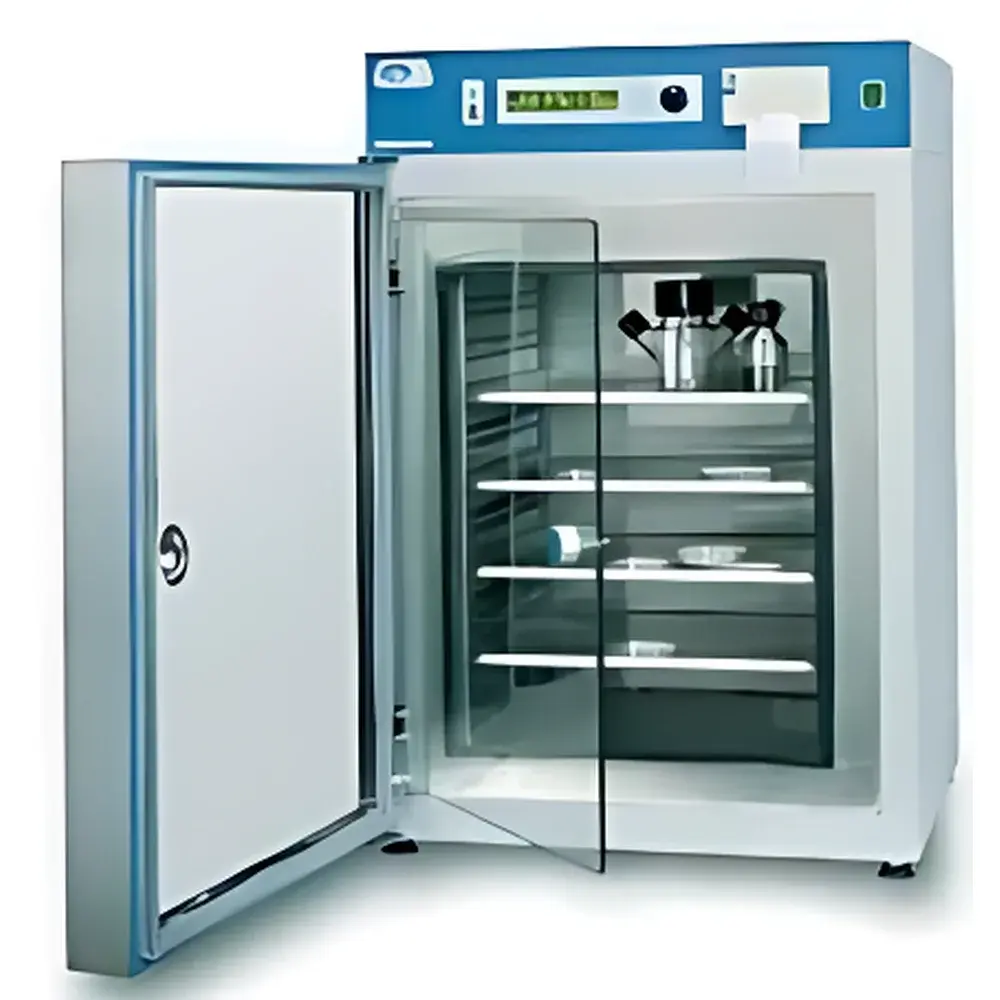
JP Incubator CO2 Advanced Carbon Dioxide Incubator
| Brand | JP |
|---|---|
| Origin | Spain |
| Model | Incubator CO2 |
| Temperature Range | 0–60 °C |
| Temperature Uniformity | ±0.5 °C |
| Humidity Range | 20–95% RH |
| Capacity | 150 L |
| CO₂ Range | 0–20% (±0.3% stability) |
| Temperature Resolution | 0.1 °C |
| CO₂ Resolution | 0.1% |
| Power Consumption | 800 W |
| Net Weight | 110 kg |
| Interface | RS-232 |
Overview
The JP Incubator CO2 Advanced Carbon Dioxide Incubator is a precision-engineered life science instrument designed to maintain tightly controlled physiological conditions for mammalian cell culture, stem cell expansion, and in vitro fertilization (IVF) workflows. It operates on the principle of dual-gas regulation—precisely modulating CO₂ concentration (via infrared or thermal conductivity sensing), temperature (via PID-controlled air-jacketed heating), and relative humidity (via integrated water reservoir and humidification system)—to replicate the in vivo microenvironment essential for sensitive biological samples. Engineered for reliability in regulated laboratory environments, this incubator meets core functional requirements aligned with ISO 13485 design controls and supports GLP-compliant documentation when paired with validated data logging protocols.
Key Features
- Stainless steel inner chamber with seamless welds and rounded corners for optimal sterility and ease of decontamination; removable, adjustable stainless steel shelving supports flexible load configuration and efficient airflow distribution.
- Dual-door architecture: an inner tempered glass door with silicone gasket seal minimizes thermal shock during routine access; an outer heated steel door with magnetic closure prevents condensation and frost formation—critical for maintaining uninterrupted CO₂ homogeneity during frequent use.
- Epoxy-coated external housing provides electrical insulation and corrosion resistance in shared lab environments; smooth, low-torque door operation eliminates mechanical vibration transmission to cultured monolayers or suspension flasks.
- Microprocessor-based control system with independent digital displays for temperature and CO₂ concentration; real-time monitoring and setpoint adjustment via intuitive front-panel interface.
- RS-232 serial port enables bidirectional communication with external PCs, data loggers, or USB-to-serial adapters for automated parameter recording, remote alarm notification, and integration into centralized lab management systems.
- Air-jacketed temperature control ensures rapid recovery (<15 min) after door opening and uniform thermal distribution (±0.5 °C across working volume at 37 °C), validated per ASTM E1545-22 standard test methods for incubator performance verification.
Sample Compatibility & Compliance
This incubator accommodates standard tissue culture vessels—including T-flasks (25 cm² to 225 cm²), multiwell plates (6–96-well), Petri dishes, roller bottles, and IVF culture dishes—within its 150 L working volume (internal dimensions: 65 × 50 × 46 cm H×W×D). The stainless steel interior and non-porous surfaces resist microbial adhesion and support validated cleaning with ethanol, hydrogen peroxide vapor (HPV), or sporicidal agents. While not certified as Class II biological safety equipment, it complies with IEC 61010-1:2010 for electrical safety in laboratory instruments and incorporates audible/visual alarms for temperature deviation (>±1.0 °C), CO₂ drift (>±0.5%), humidity loss, and door-open events—features aligned with FDA 21 CFR Part 11 audit trail readiness when connected to compliant software platforms.
Software & Data Management
The built-in RS-232 interface facilitates direct integration with third-party laboratory information management systems (LIMS) or custom Python/Excel-based logging tools. Users may configure periodic data export (e.g., every 30 seconds) of temperature, CO₂, and humidity values—including timestamps—to CSV or XML formats. When deployed with FDA 21 CFR Part 11-compliant software (e.g., LabArchives ELN or Thermo Fisher SampleManager), the incubator supports electronic signatures, user-level access control, and immutable audit trails—enabling full traceability for QC/QA documentation in pharmaceutical development, academic core facilities, and clinical embryology labs.
Applications
- Mammalian cell line maintenance (HEK293, CHO, HeLa) under standardized 5% CO₂ / 37 °C / >95% RH conditions.
- Primary neuron and iPSC-derived organoid culture requiring stable gas-phase pH buffering and minimal thermal perturbation.
- Assisted reproductive technology (ART) workflows including oocyte maturation, embryo culture, and blastocyst development.
- Microbial co-culture studies where selective CO₂ enrichment influences bacterial metabolism or fungal morphogenesis.
- Long-term stability testing of biologics formulated in cell-based delivery matrices.
FAQ
What CO₂ sensing technology does this incubator employ?
It utilizes a high-stability thermal conductivity sensor for CO₂ measurement, calibrated against NIST-traceable reference gases and verified annually per manufacturer-recommended maintenance schedules.
Is humidity control actively regulated or passively maintained?
Humidity is actively managed via a heated water reservoir and integrated evaporation surface, with feedback from capacitive RH sensors—ensuring dynamic compensation across ambient temperature fluctuations.
Can the incubator be validated for GMP compliance?
Yes; IQ/OQ protocols are available upon request, and the unit’s design supports installation in ISO Class 7 cleanrooms when coupled with HEPA-filtered air supply options.
What is the maximum recovery time after a 30-second door opening at 37 °C?
Temperature recovers to ±0.3 °C within 12 minutes; CO₂ concentration returns to setpoint (±0.2%) within 8 minutes, verified using calibrated portable gas analyzers.
Does the incubator support password-protected parameter locking?
Yes—user-defined access levels (Operator, Technician, Administrator) restrict modification of critical settings such as CO₂ setpoint, alarm thresholds, and calibration offsets.
Related Products



