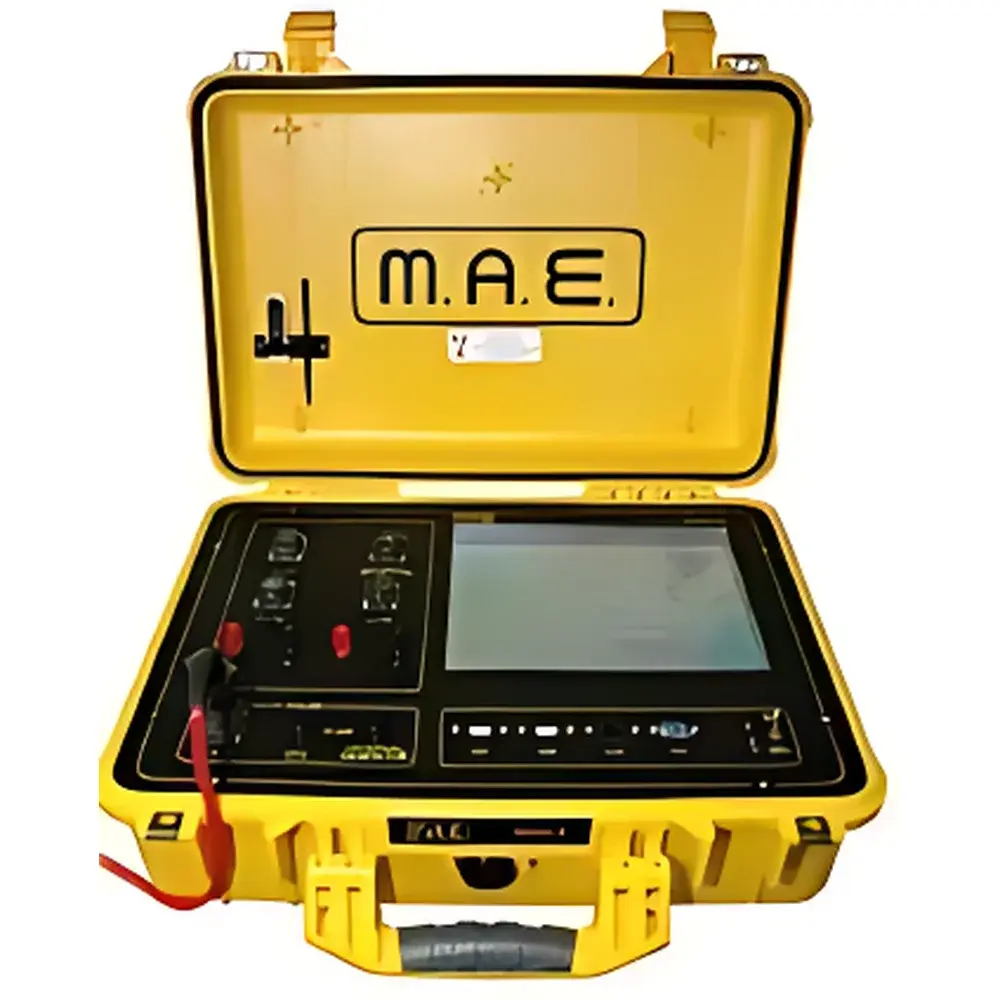
MAE A6000E Digital Ground Resistance Meter & Multi-Electrode Resistivity Imaging System
| Brand | MAE |
|---|---|
| Origin | Italy |
| Model | A6000E |
| Output Current | Up to 1.2 A @ 50 V (4-step auto-adjustable) |
| Output Voltage | ±50 V, ±100 V, ±250 V, ±500 V |
| Max Power | 60 W (extendable to 600 W with external generator) |
| Input Integration Time | 100 ms – 30 s (auto-ranging across 4 scales) |
| Full-Scale Input Voltage | 50 V |
| Input Impedance | 1 MΩ |
| Notch Filter | 50 Hz |
| Voltage Measurement Accuracy | ±38 µV (0–1.25 V range), ±1.53 mV (5–50 V range) |
| Resistance Measurement Accuracy | ±1% |
| Electrode Capacity | 32 standard electrodes |
| Electrode Cable | High-resistivity geophysical cable with 16 connectors per segment |
| inter-electrode spacing options | 2 m, 3 m, 5 m, or 10 m |
| Data Storage | Internal solid-state disk + USB flash drive support |
| Interface Ports | LAN, USB, VGA |
| Display | 10.4" resistive touchscreen |
| Embedded OS | Windows Embedded Standard 2009 |
| Operating Temperature | −20 °C to +80 °C |
| Dimensions | 470 × 229 × 351 mm |
| Weight | 9 kg |
| Power Supply | 12 V DC from integrated 24 Ah rechargeable battery pack (avg. current draw: 2 A) |
| Data Formats | TSV, CSV, DAT |
Overview
The MAE A6000E is a high-precision, microprocessor-controlled digital ground resistance meter and multi-electrode resistivity imaging system engineered for advanced geophysical surveying and geotechnical site characterization. Unlike conventional two- or four-pole earth resistance testers, the A6000E implements a true multi-channel, automated Wenner-Schlumberger and dipole-dipole acquisition architecture—enabling both vertical electrical sounding (VES) and 2D/3D electrical resistivity tomography (ERT). Its core measurement principle relies on controlled-source direct current (DC) injection with synchronous voltage potential measurement across configurable electrode arrays. The instrument delivers stable current output up to 1.2 A at variable voltages (±50 V to ±500 V), ensuring sufficient signal-to-noise ratio even in high-resistivity soils or arid bedrock environments. Designed and manufactured in Italy, the A6000E meets stringent European electromagnetic compatibility (EMC) and safety standards (EN 61326-1, EN 61000-6-3), and its embedded Windows Embedded Standard 2009 platform supports deterministic real-time data acquisition and onboard processing.
Key Features
- Automated multi-electrode control supporting up to 256 electrodes via optional external polarity-switching boxes—scalable in fixed increments of 16 electrodes for consistent channel synchronization.
- High-fidelity analog front-end with 50 Hz notch filtering, programmable integration time (100 ms–30 s), and auto-ranging input stages optimized for low-noise DC potential measurement (resolution down to ±38 µV in low-voltage ranges).
- Integrated 12 V / 24 Ah rechargeable battery system with microprocessor-based charge management; average power consumption of 2 A enables >8 hours of continuous field operation without external power.
- Expandable power architecture: internal 60 W DC-DC converter can be augmented by an external 600 W AC generator—critical for deep-probing surveys requiring higher current injection in resistive formations.
- 10.4-inch industrial-grade resistive touchscreen display with intuitive GUI navigation—no external PC required for setup, acquisition, or preliminary inversion.
- Onboard data logging to internal solid-state storage and simultaneous export to USB mass storage devices in standardized formats (TSV, CSV, DAT) compliant with common geophysical processing workflows (e.g., RES2DINV, EarthImager, PyGIMLi).
Sample Compatibility & Compliance
The A6000E is designed for direct coupling to standard geophysical electrode arrays using shielded, low-capacitance, high-resistance cables rated for outdoor deployment in harsh environmental conditions. Each 16-electrode cable segment supports configurable inter-electrode spacing (2 m, 3 m, 5 m, or 10 m), enabling flexible array geometry adaptation—from shallow utility detection (0.5–5 m depth) to deep geological profiling (>100 m). The system complies with IEC 61557-5 for earth resistance measurement instrumentation and adheres to ASTM G57-21 (Standard Test Method for Field Measurement of Soil Resistivity Using the Wenner Four-Electrode Method). Its robust mechanical housing (IP54-rated enclosure) ensures operational reliability across temperature extremes (−20 °C to +80 °C), while CE marking confirms conformity with EU health, safety, and environmental protection directives.
Software & Data Management
Data acquisition, configuration, and real-time visualization are managed through the native Windows Embedded Standard 2009 environment. The embedded software suite includes automated sequence programming (e.g., automatic electrode switching, current polarity reversal, and stacking), real-time noise rejection via configurable averaging (2–10 repeats per measurement), and hardware-level auto-zero compensation. All raw voltage/current pairs, along with metadata (electrode IDs, timing stamps, battery status, temperature), are timestamped and stored with full traceability. Exported files include header information compatible with industry-standard inversion tools and support GLP-aligned audit trails when used in regulated geotechnical reporting contexts. LAN and USB interfaces facilitate secure data transfer and remote firmware updates without physical media handling.
Applications
- Geotechnical site investigation for foundation design, landslide risk assessment, and karst cavity detection.
- Environmental monitoring: delineation of contaminant plumes, landfill leachate mapping, and saltwater intrusion studies.
- Archaeological prospection for subsurface feature identification without excavation.
- Corrosion control engineering: cathodic protection system evaluation and soil resistivity zoning for pipeline integrity management.
- Renewable energy infrastructure: grounding system validation for wind turbine towers and solar farm earthing networks per IEEE Std 80 and IEC 62305.
FAQ
What electrode configurations does the A6000E support?
The A6000E natively supports Wenner, Schlumberger, dipole-dipole, and gradient arrays. Custom sequences can be programmed via the touchscreen interface or imported from external configuration files.
Can the A6000E perform real-time resistivity inversion in the field?
No—it performs raw data acquisition and basic quality control (e.g., contact resistance check, repeatability flagging); full 2D/3D inversion requires post-processing with dedicated geophysical software.
Is the system compatible with third-party GPS modules?
Yes—via RS-232 or USB serial emulation, the A6000E accepts NMEA 0183-compliant position data for georeferenced survey lines.
Does the A6000E meet FDA or ISO 13485 requirements?
No—this is a geophysical instrumentation system, not a medical device; it is not subject to medical regulatory frameworks but conforms to applicable industrial EMC and safety standards.
How is calibration maintained in long-term field deployments?
The A6000E includes factory-traceable internal calibration references and supports user-performed verification using certified precision resistors; calibration logs are stored with each dataset.
Related Products