
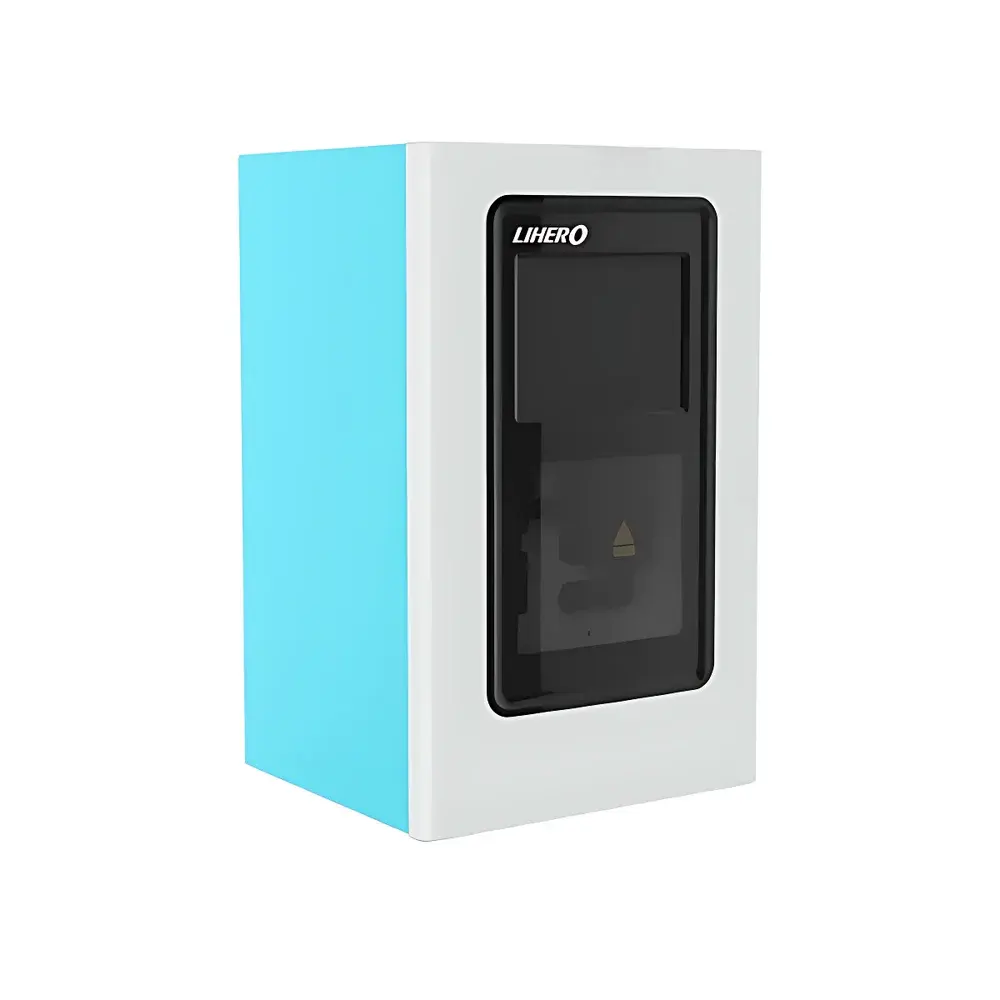
Lihero LFS-2002(Phe) Online Volatile Phenol Analyzer
| Brand | Lihero |
|---|---|
| Model | LFS-2002(Phe) |
| Detection Principle | 4-Aminoantipyrine Spectrophotometry |
| Sample Pretreatment | Integrated Online Steam Distillation + Constant Airflow Stripping |
| Reagent System | Automated Reagent Dispensing with K₃[Fe(CN)₆] Catalyst |
| Detection Wavelength | 510 nm |
| Detection Limit | ≤0.5 µg/L (as phenol) |
| Measurement Range | 0–0.5 mg/L, 0–2 mg/L (auto-ranging) |
| Compliance | Meets HJ 503-2009, ISO 6439:1984, and EPA Method 420.1 |
| Data Output | 4–20 mA analog + Modbus RTU/TCP + Optional OPC UA |
| Remote Control | Web-based HMI & SNMP/HTTP API support |
| Maintenance Cycle | 7–14 days (reagent refill), 30 days (system cleaning) |
Overview
The Lihero LFS-2002(Phe) Online Volatile Phenol Analyzer is a fully automated, continuous-monitoring instrument engineered for regulatory-grade measurement of volatile phenolic compounds in surface water, drinking water sources, wastewater effluents, and industrial discharge streams. It operates on the internationally standardized 4-aminoantipyrine (4-AAP) spectrophotometric method—codified in China’s HJ 503-2009, ISO 6439:1984, and U.S. EPA Method 420.1—where phenols react with 4-AAP under oxidative conditions (catalyzed by potassium ferricyanide, K₃[Fe(CN)₆]) to form a stable orange-red indophenol dye. Absorbance is measured at 510 nm using a dual-beam optical path with self-balancing photometric detection, ensuring long-term baseline stability and immunity to lamp drift or cell fouling. Unlike batch-mode laboratory analyzers, the LFS-2002(Phe) integrates inline steam distillation coupled with constant airflow stripping to selectively volatilize phenolic compounds (C₆H₅OH and substituted phenols with boiling points <200 °C) from complex matrices—effectively eliminating interferences from color, turbidity, suspended solids, and non-volatile organics prior to derivatization.
Key Features
- Integrated online distillation module with precise temperature and pressure control (±0.5 °C, ±1 kPa), enabling rapid, reproducible separation of volatile phenols within <12 minutes per cycle
- Dual-channel reagent delivery system with gravimetric dosing accuracy (±1.5% full scale) and real-time reagent level monitoring for 4-AAP, buffer, oxidant, and ferricyanide solutions
- Self-balancing optical path with reference and sample cuvettes housed in thermostatically stabilized (37 °C ±0.3 °C) quartz flow cells; automatic zero-point compensation before each measurement
- Multi-level quality assurance: automated zero check, span check, standard verification, calibration curve auto-generation (up to 8-point), and spike recovery testing (per ISO/IEC 17025 Annex A.3)
- Intelligent fault diagnostics: real-time monitoring of pump status, heater integrity, valve actuation, reagent depletion, sample flow interruption, and absorbance saturation; all events logged with timestamps and severity codes
- Adaptive range switching: seamless transition between low-range (0–0.5 mg/L) and high-range (0–2 mg/L) modes based on dynamic signal-to-noise assessment, minimizing manual intervention
- Onboard cleaning protocol: programmable acid wash (10% HCl), deionized water rinse, and air purge sequence executed automatically every 24–72 hours or after abnormal absorbance deviation
Sample Compatibility & Compliance
The LFS-2002(Phe) accepts raw water samples with pH 4–10, turbidity ≤200 NTU, and total suspended solids ≤150 mg/L without pre-filtration. It has been validated for use with river water, reservoir inflow, municipal secondary effluent, and cooling tower discharge. All operational parameters—including distillation time, reagent volumes, and photometric integration periods—are configurable to align with site-specific matrix challenges. The analyzer conforms to GLP data integrity requirements: audit trails record all user actions, method changes, calibration events, and alarm acknowledgments. Data export supports CSV, XML, and PDF report generation compliant with ISO 14001 environmental management systems and EU Water Framework Directive (WFD) reporting templates. Instrument firmware meets IEC 61508 SIL 2 functional safety requirements for unattended operation in Class 1 Div 2 hazardous locations.
Software & Data Management
Embedded Linux-based controller runs Lihero Analytical Suite v3.2, providing local touchscreen HMI (7″ capacitive display) and remote access via HTTPS-secured web interface. Data logging occurs at 1-minute intervals with 30-day onboard storage (expandable via microSD). Communication protocols include Modbus RTU (RS-485), Modbus TCP/IP (Ethernet), and optional OPC UA server for integration into SCADA, DCS, or cloud-based EMS platforms (e.g., Siemens Desigo, Honeywell Experion, or AWS IoT Core). All calibration and QA/QC records are digitally signed and timestamped, satisfying FDA 21 CFR Part 11 electronic record requirements when paired with enterprise authentication (LDAP/RADIUS). Firmware updates are delivered via signed OTA packages with SHA-256 verification.
Applications
- Real-time compliance monitoring at drinking water intake points for phenol concentrations below WHO guideline value (0.001 mg/L)
- Continuous emission monitoring (CEMS) of phenolic effluents from petrochemical refineries, coal gasification plants, and synthetic resin manufacturing facilities
- Early-warning detection in watershed protection zones where phenol contamination may indicate upstream industrial leakage or accidental spills
- Performance verification of activated carbon or advanced oxidation process (AOP) units treating phenol-laden wastewater
- Research-grade time-series analysis of phenol dynamics in eutrophic lakes or tidal estuaries subject to seasonal organic loading
FAQ
What regulatory methods does the LFS-2002(Phe) comply with?
It implements HJ 503-2009 (China), ISO 6439:1984 (international), and EPA Method 420.1 (U.S.), with documented method equivalence validation reports available upon request.
Can the analyzer operate without on-site technical staff?
Yes—it supports fully unattended 30-day operation with remote diagnostics, automated maintenance scheduling, and email/SMS alerting via integrated GSM or Ethernet notification modules.
How is reagent consumption managed for long-term deployment?
Reagent kits are supplied in sealed, light-protected cartridges with RFID-tagged lot traceability; average consumption is 1.2 mL per analysis cycle, supporting ≥1,200 measurements per 500-mL reagent pack.
Is third-party certification available for installation qualification (IQ) and operational qualification (OQ)?
Lihero provides IQ/OQ documentation packages aligned with ISO/IEC 17025 and ASTM D5847, including as-installed drawings, sensor calibration certificates, and performance verification test protocols.
Does the system support integration with existing LIMS or environmental data platforms?
Yes—via standardized RESTful APIs, HL7-compliant JSON payloads, or direct database write-through to PostgreSQL/SQL Server instances using secure TLS 1.2 encrypted connections.







