
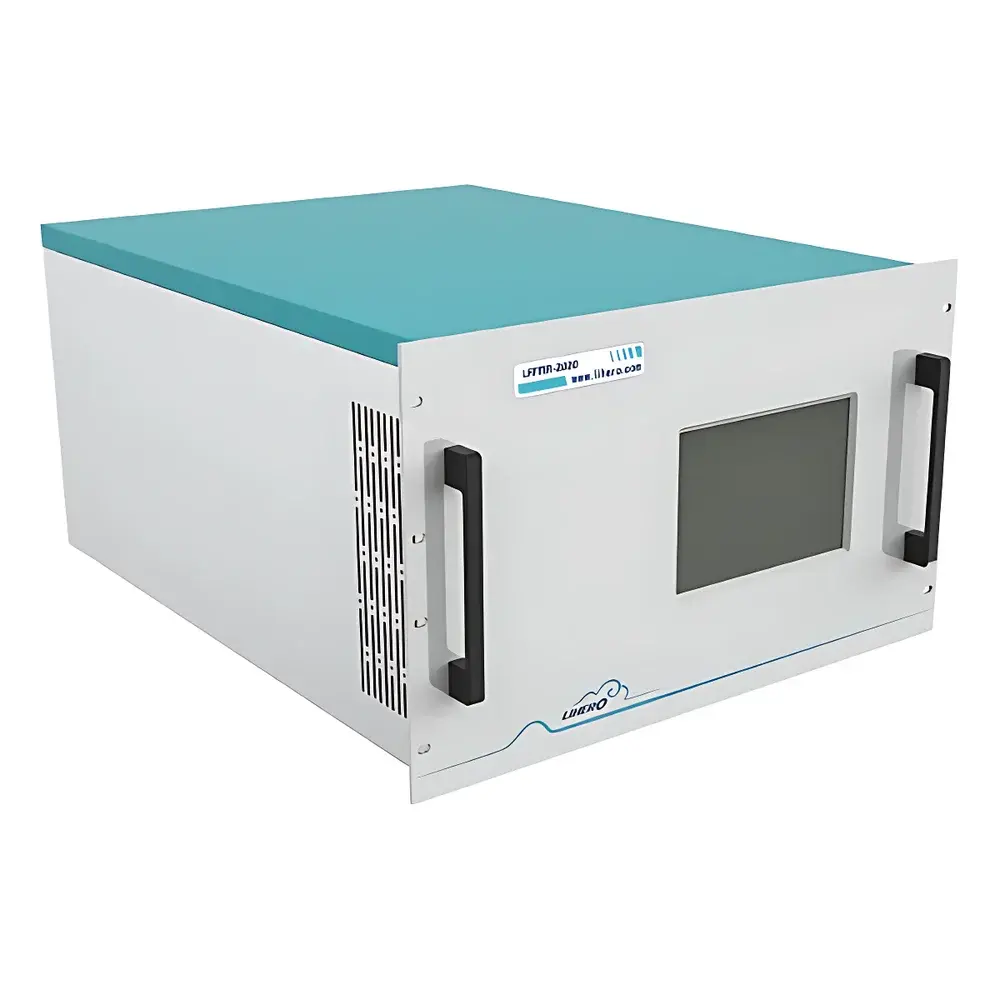
Lihero LFFTIR-2020 Fourier Transform Infrared (FTIR) Environmental Multi-Gas Analyzer
| Brand | Lihero |
|---|---|
| Model | LFFTIR-2020 |
| Principle | Fourier Transform Infrared Absorption Spectroscopy |
| Type | Online Continuous Emission Monitoring System |
| Gas Targets | CO₂, CH₄, N₂O, HFCs, PFCs, SF₆, NF₃ |
| Spectral Resolution | ≤0.5 cm⁻¹ |
| Detection Limit | Sub-ppb to low-ppb range (gas-dependent) |
| Response Time | <10 seconds (T₉₀) |
| Operating Environment | −10 °C to 50 °C, 0–95% RH (non-condensing) |
| Compliance | Designed for compliance with EPA Method 320, ISO 14956, and EN 15267-3 frameworks |
Overview
The Lihero LFFTIR-2020 is a high-performance, online Fourier Transform Infrared (FTIR) environmental multi-gas analyzer engineered for continuous, real-time quantification of regulated and emerging greenhouse gases (GHGs) in ambient air. Unlike filter-based or electrochemical sensors, the LFFTIR-2020 employs broadband mid-infrared absorption spectroscopy—measuring molecular vibrational-rotational transitions across a spectral range of 600–4000 cm⁻¹—to enable simultaneous, non-destructive detection of up to 12 target analytes without cross-interference calibration drift. Its optical architecture integrates a thermoelectrically cooled MCT detector, a high-stability Michelson interferometer with laser-referenced path-length control, and a multipass White cell (optical path length: 20 m), delivering robust spectral fidelity under field-deployable conditions. The system is configured for unattended operation in fixed-site monitoring stations, mobile laboratories, and boundary-layer atmospheric research platforms—supporting long-term trend analysis, emission source attribution, and verification of climate mitigation efforts per IPCC Tier 2/3 reporting requirements.
Key Features
- High-resolution FTIR spectroscopy with ≤0.5 cm⁻¹ nominal resolution ensures baseline separation of overlapping absorption features—for example, distinguishing CH₄ (2917 cm⁻¹) from C₂H₆ (2962 cm⁻¹) and resolving individual HFC isomers (e.g., HFC-134a vs. HFC-125).
- Signal-to-noise ratio (SNR) > 15,000:1 (at 4 cm⁻¹, 1-minute scan) enables sub-part-per-trillion (ppt) detection limits for SF₆ and NF₃, and low-part-per-trillion (ppt) sensitivity for CH₄ and N₂O—meeting stringent data quality objectives outlined in WMO GAW guidelines.
- Pre-loaded quantitative spectral library containing >250 reference compounds—including all Kyoto Protocol GHGs, ozone-depleting substances (ODS), volatile organic compounds (VOCs), and combustion byproducts—supports automated peak fitting using classical least-squares (CLS) and partial least-squares (PLS) algorithms.
- Ruggedized optomechanical design meets MIL-STD-810G shock/vibration specifications; operational stability maintained across temperature gradients and mechanical motion—validated for deployment on unmanned aerial vehicles (UAVs), light aircraft, and ground-based mobile monitoring trailers.
- Real-time spectral acquisition at 1 Hz frame rate with full interferogram processing yields gas concentration updates every 5–8 seconds (T₉₀), enabling rapid plume tracking and dynamic flux estimation via inverse dispersion modeling.
Sample Compatibility & Compliance
The LFFTIR-2020 draws ambient air through a heated, particle-filtered sampling line (standard 1/4″ SS tubing, 50 °C trace heating) to prevent condensation and adsorption losses. It accommodates variable flow rates (0.5–2.0 L/min) and integrates pressure/temperature/humidity compensation in real time using calibrated transducers. The analyzer complies with the technical performance criteria of EPA Method 320 (Determination of Vapor Phase Organic and Inorganic Emissions by Extractive FTIR), supports ISO 14956:1999 (Air Quality — Evaluation of Ambient Air Quality Measurement Methods), and aligns with EN 15267-3:2017 (Performance certification of automatic measuring systems). All raw interferograms and processed spectra are timestamped and stored with instrument metadata, fulfilling audit-trail requirements for GLP-compliant environmental monitoring programs.
Software & Data Management
The embedded Linux-based acquisition engine runs proprietary Lihero SpectraView™ software, providing real-time spectral visualization, automated baseline correction, and multi-component quantification with uncertainty propagation. Data export formats include NetCDF-4 (CF-compliant), CSV, and XML—compatible with EPA’s AQS, EEA’s AirBase, and ICOS data ingestion pipelines. Remote access is enabled via TLS-secured HTTPS interface with role-based user authentication. Audit logs record all configuration changes, calibration events, and manual interventions—supporting 21 CFR Part 11–compliant electronic records when deployed in regulatory QA/QC workflows.
Applications
- Urban and regional background air quality monitoring networks targeting GHG inventories and verification of national mitigation pledges (NDCs).
- Industrial fence-line monitoring for fugitive emissions from semiconductor fabrication, refrigerant manufacturing, and aluminum smelting facilities.
- Atmospheric research campaigns—including tower-based vertical profiling, airborne eddy covariance, and satellite validation studies (e.g., TROPOMI, GOSAT-2).
- Landfill and wastewater treatment plant methane flux quantification using open-path or extractive configurations.
- Calibration transfer and reference standard generation for lower-cost sensor networks (e.g., metal oxide, NDIR, photoacoustic systems).
FAQ
Does the LFFTIR-2020 require daily calibration with certified gas standards?
No—its laser-referenced interferometer provides intrinsic wavenumber accuracy; routine calibration uses a single NIST-traceable multi-gas standard every 7–14 days, depending on operational intensity.
Can it detect gases not included in the default spectral library?
Yes—users may import custom reference spectra (in JCAMP-DX format) and retrain quantification models via the offline SpectraModeler™ toolkit.
Is the system compatible with existing SCADA or EMS platforms?
Yes—it supports Modbus TCP, OPC UA, and MQTT protocols for seamless integration into industrial environmental management systems.
What maintenance is required beyond annual optical alignment verification?
Routine tasks include quarterly更换 of inlet particulate filters, biannual desiccant replacement in the purge gas dryer, and semiannual verification of detector dark current stability.
How is data integrity ensured during power interruptions or network outages?
All spectra and derived concentrations are written to redundant onboard eMMC storage with journaling file system; unsynchronized data auto-uploads upon network recovery with sequence-verified packet transmission.
Related Products







