
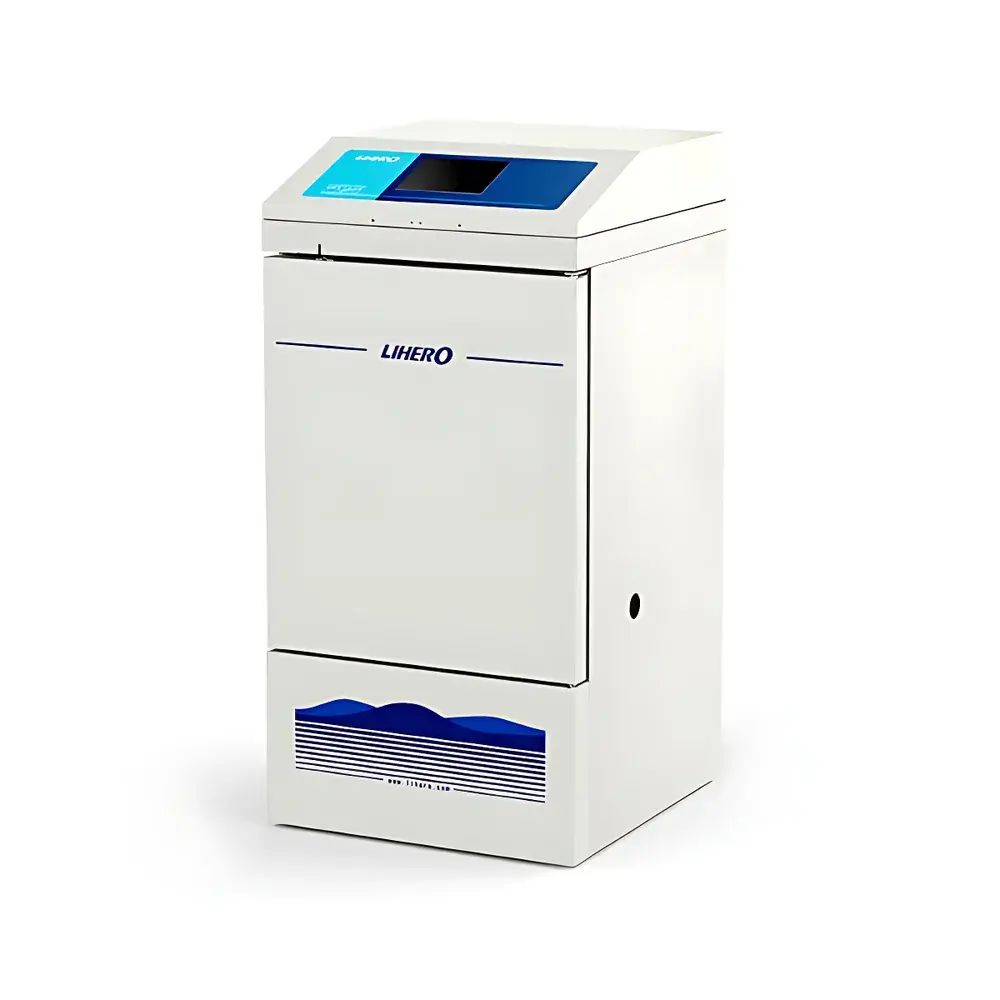
Lihero LFLY-DW2004 Automated Water Sampler
| Brand | Lihero |
|---|---|
| Origin | Hunan, China |
| Manufacturer Type | Authorized Distributor |
| Country of Manufacture | China |
| Model | LFLY-DW2004 |
| Pricing | Available Upon Request |
| Cooling Capacity | 2–8 °C |
| Sample Bottle Capacity | ≥24 positions |
| Power Backup | Integrated rechargeable battery supporting ≥8 h operation during mains failure |
| Sampling Modes | Time-proportional, flow-proportional, time-and-flow-proportional, user-defined programmable schedules |
| Sample Collection Types | Instantaneous and composite (time-weighted or flow-weighted) |
| Environmental Rating | IP55 enclosure |
| Compliance | Designed to support EPA Method 1664, ISO 5667-10, and EN 14185-1 requirements for automated sampling in regulatory monitoring programs |
Overview
The Lihero LFLY-DW2004 Automated Water Sampler is an industrial-grade,全天候 (24/7) unattended sampling system engineered for long-term deployment in municipal wastewater treatment plants, surface water quality monitoring stations, industrial effluent discharge points, and drinking water intake facilities. It operates on the principle of programmable peristaltic or vacuum-assisted aspiration—configured to interface with level sensors, flow meters, or external SCADA systems—to execute precise, traceable, and auditable sampling sequences under variable environmental conditions. Its architecture integrates robust mechanical design with embedded microcontroller logic, enabling deterministic timing resolution down to one-minute intervals and synchronized event-triggered acquisition based on real-time hydrological or operational parameters.
Key Features
- Programmable multi-mode sampling logic: supports fixed-interval (isochronous), flow-proportional (ISO 5667-10 compliant), combined time-and-flow-proportional, and fully customizable user-defined schedules via onboard keypad or remote configuration.
- Integrated refrigerated sample storage: maintains collected samples at 2–8 °C using a thermoelectric cooling module, ensuring analyte stability for subsequent analysis of BOD, COD, nutrients, metals, and microbiological parameters per EPA and ISO preservation guidelines.
- Automated post-sampling maintenance: performs self-cleaning cycles using deionized water or designated rinse solution, followed by full line evacuation to prevent cross-contamination and biofilm accumulation between sampling events.
- Secure sample integrity management: features motor-driven lid sealing for each vial upon filling, tamper-evident door lock with access control (PIN or RFID optional), and internal audit log recording all door openings, sampling triggers, and error states.
- Resilient power architecture: includes a built-in sealed lead-acid or LiFePO₄ battery capable of sustaining full operational functionality—including refrigeration, actuation, and data logging—for a minimum of eight hours during utility outage, meeting IEC 62040-3 backup duration benchmarks.
- Real-time status monitoring: provides dry-contact alarm outputs for low-sample-level detection, vial overflow, temperature excursion, battery depletion, and mechanical fault conditions; supports Modbus RTU and analog 4–20 mA output for integration into central supervisory systems.
Sample Compatibility & Compliance
The LFLY-DW2004 accommodates standard 60 mL or 100 mL polyethylene or glass sampling vials (configurable tray layout), with optional compatibility for larger containers up to 1 L when used in instantaneous grab-sampling mode. All wetted materials—including tubing, valves, and pump heads—are chemically inert (FDA-compliant EPDM or PTFE-lined), minimizing adsorption or leaching for trace metal and organic analyses. The system meets functional requirements outlined in US EPA Guidance Document QA/G-5S (2012), ISO 5667-10:2021 (Water quality — Sampling — Part 10: Guidance on sampling of water and wastewater), and EN 14185-1:2003 (Automatic samplers for water — Part 1: Requirements and test methods). Its data logging firmware supports GLP-aligned timestamping and immutable event records required for regulatory chain-of-custody documentation.
Software & Data Management
Configuration and diagnostics are performed via a high-contrast LCD interface with tactile keypad or through optional USB-to-serial connection using Lihero’s PC-based SAMPLINK™ configuration utility (Windows-compatible). The device logs all sampling events—including date/time stamp, vial position, volume aspirated, triggering condition, ambient temperature, and battery voltage—in a non-volatile memory buffer (≥10,000 entries). Export options include CSV via USB mass storage or ASCII over RS-232. When integrated with telemetry gateways, it supports MQTT or HTTP POST protocols for cloud-based data ingestion into platforms such as AWS IoT Core or custom LIMS environments. Audit trail records comply with ALCOA+ principles and may be exported for FDA 21 CFR Part 11–aligned review where electronic signatures and operator authentication are implemented externally.
Applications
- Municipal wastewater influent/effluent compliance monitoring per NPDES permit requirements
- River, lake, and reservoir surveillance programs tracking seasonal nutrient loading and algal bloom precursors
- Industrial pretreatment verification at CIU (Controlled Industrial User) discharge points
- Drinking water source protection and treatment plant raw water characterization
- Stormwater outfall monitoring with rainfall-triggered sampling logic
- Long-term ecological research requiring preserved composite samples for retrospective analysis
FAQ
Does the LFLY-DW2004 support flow-proportional sampling with external flow meter input?
Yes—it accepts pulse output (0.1–10 Hz) or 4–20 mA analog signals from ultrasonic, magnetic, or area-velocity flow meters, enabling true volumetric proportionality per ISO 5667-10 Annex C.
Can the unit operate continuously in sub-zero ambient temperatures?
The enclosure is rated IP55 and tested for operation between –10 °C and +50 °C; however, refrigeration performance is optimized above 0 °C ambient, and external heating jackets are recommended for sustained deployment below freezing.
Is remote firmware update supported over cellular or Ethernet?
Firmware updates require physical USB connection; however, configuration changes, schedule edits, and log retrieval can be performed remotely via Modbus TCP or serial-over-IP bridges.
What is the maximum allowable suction lift for the peristaltic pump?
The standard configuration supports up to 6 m static suction lift at 20 °C; vacuum-assisted variants extend this to 8.5 m with appropriate tubing selection and priming protocol.
How is data integrity ensured during power interruption?
All critical operational states—including current schedule, last executed sample, and battery charge level—are retained in EEPROM; no configuration or log data is lost during brownout or blackout events.



