
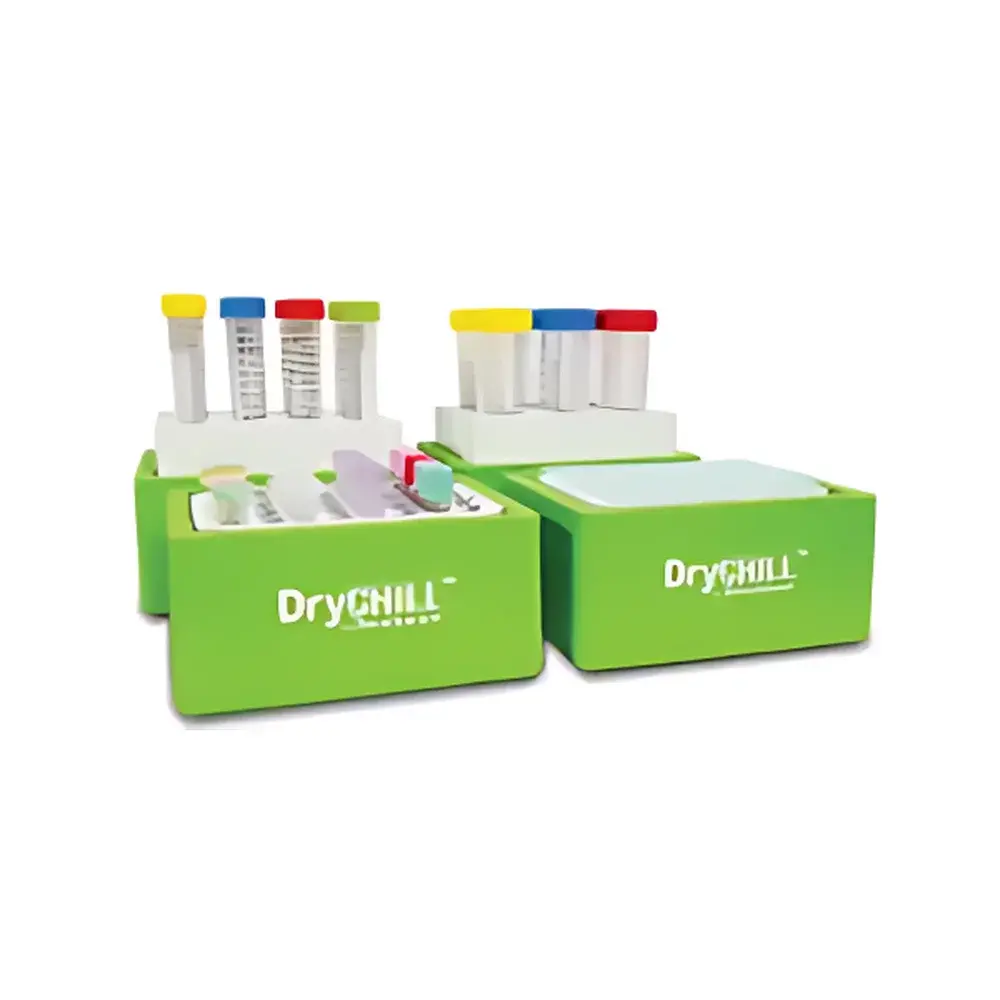
Benchmark DryChill Passive Cooling Block
| Brand | Benchmark |
|---|---|
| Origin | USA |
| Manufacturer Type | Authorized Distributor |
| Origin Category | Imported |
| Model | DryChill |
| Pricing | Contact for Quote |
Overview
The Benchmark DryChill Passive Cooling Block is an engineered thermal management solution designed for benchtop sample stabilization at 4 °C without reliance on ice, refrigeration, or external power. Unlike conventional ice baths—prone to water accumulation, temperature drift, and cross-contamination—the DryChill block employs a proprietary phase-change gel matrix housed within a thermally optimized aluminum alloy housing. This architecture enables passive, conductive heat absorption and sustained isothermal maintenance via latent heat exchange, operating strictly within the non-freezing range (typically 2–6 °C) for up to 200 minutes under standard ambient laboratory conditions (22 ± 2 °C, 40–60% RH). Its principle of operation aligns with ASTM E2913-21 (Standard Practice for Thermal Stability Assessment of Biological Samples), supporting cold-chain integrity during short-term handling in QC, clinical diagnostics, and molecular biology workflows.
Key Features
- Ice-free, electricity-free operation: Eliminates condensation, spill risk, and freezer dependency while maintaining consistent 4 °C surface temperature.
- Visual temperature indicator: Integrated thermochromic polymer layer transitions from purple (≤4 °C) to pink (>5 °C), providing real-time, non-instrumental verification of thermal state.
- Four interchangeable well configurations: Compatible with tubes ranging from 0.2 mL PCR strips to 50 mL conical centrifuge tubes; each block variant features precision-machined, tapered wells for secure tube retention and optimal thermal contact.
- Corrosion-resistant anodized aluminum construction: Ensures long-term dimensional stability, chemical resistance to common lab reagents (e.g., ethanol, dilute acids/bases), and compatibility with ISO 13485-certified cleanroom handling protocols.
- Passive thermal decay profile: Validated to sustain ≤4.5 °C surface temperature for ≥200 minutes post-equilibration, per internal benchmarking per ICH Q5C stability guidelines for biologics handling.
Sample Compatibility & Compliance
The DryChill block accommodates standard polypropylene, polycarbonate, and glass tubes—including microcentrifuge tubes (0.5–2.0 mL), PCR tubes (0.2 mL), snap-cap tubes (15 mL), and conical tubes (50 mL)—without deformation or thermal stress-induced leaching. Its non-penetrating cooling mechanism avoids direct contact with sample contents, preserving sterility and eliminating contamination vectors associated with wet ice. The device complies with general laboratory safety standards (ANSI Z9.5, ISO 15190) and supports Good Laboratory Practice (GLP) documentation requirements through traceable thermal performance history when used in conjunction with validated environmental monitoring logs. While not a medical device, its design adheres to principles referenced in FDA Guidance for Industry: Bioanalytical Method Validation (May 2018) regarding sample integrity during pre-analytical holding periods.
Software & Data Management
As a passive hardware-only platform, the DryChill Cooling Block does not incorporate embedded electronics, firmware, or connectivity interfaces. Consequently, it requires no software installation, driver configuration, or cybersecurity validation. Its operational status is assessed solely via the integrated visual indicator—eliminating dependencies on computer systems, network infrastructure, or regulatory-compliant audit trails (e.g., 21 CFR Part 11). For laboratories requiring documented thermal assurance, users may integrate DryChill blocks into existing electronic lab notebook (ELN) or LIMS workflows by recording indicator color state, equilibration time, and ambient conditions at point-of-use—fully compatible with ISO/IEC 17025:2017 clause 7.7 (Control of Equipment Records).
Applications
- Short-term storage of enzymatic reaction mixtures (e.g., restriction digests, ligations, RT-PCR setup) prior to thermal cycling.
- Holding temperature-sensitive reagents (e.g., Taq polymerase, dNTPs, antibodies) during multi-step assay preparation.
- Stabilization of clinical specimens (whole blood, plasma, CSF) during aliquoting and labeling prior to frozen storage or transport.
- Buffer and standard solution conditioning in HPLC and mass spectrometry sample preparation workflows.
- Supporting GLP-compliant sample handover between analytical shifts where active refrigeration is unavailable or impractical.
FAQ
How long does the DryChill block remain effective at 4 °C?
Validated duration is ≥200 minutes under controlled ambient conditions (22 °C, 40–60% RH); actual performance varies with ambient temperature, humidity, and frequency of tube insertion/removal.
Can the DryChill block be reused indefinitely?
Yes—provided it is cleaned with 70% ethanol or isopropanol between uses and stored at room temperature in a dry environment; no degradation of gel matrix has been observed after >500 thermal cycles in accelerated aging studies.
Does the visual indicator affect sample integrity?
No—the thermochromic layer is sealed beneath the aluminum surface and does not contact samples or emit volatile compounds; it meets USP extractables testing thresholds for Class VI plastics.
Is calibration required?
No—thermal performance is inherent to material properties and geometry; however, users may verify surface temperature using a NIST-traceable contact thermometer before critical applications.
Can DryChill blocks be used inside a biosafety cabinet?
Yes—the absence of water, ice, or electrical components makes them ideal for sterile environments; aluminum housing is compatible with standard cabinet decontamination protocols (e.g., vaporized hydrogen peroxide).



