
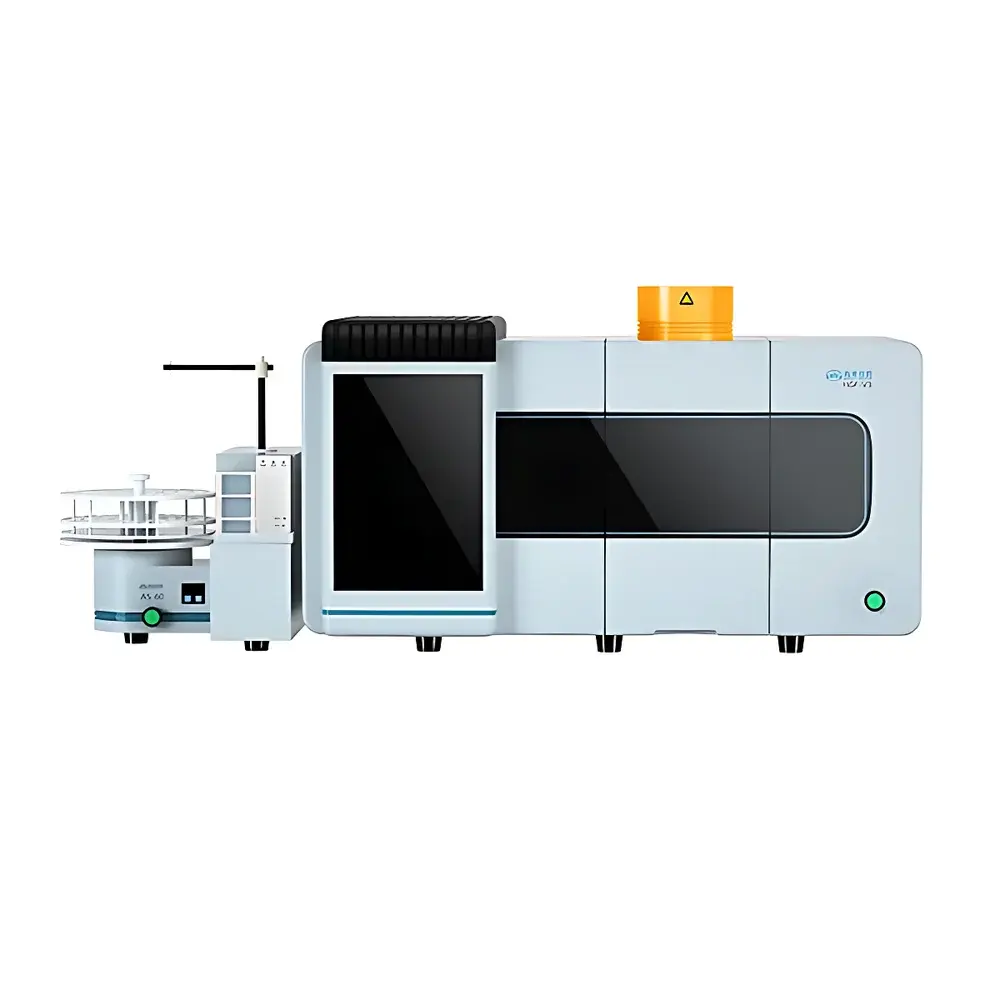
Haiguang HGF-V3 Atomic Fluorescence Spectrometer
| Brand | Haiguang Instrument |
|---|---|
| Origin | Beijing, China |
| Manufacturer Type | Authorized Distributor |
| Product Category | Domestic (China-made) |
| Model | HGF-V3 |
| Instrument Type | Multi-channel Atomic Fluorescence Spectrometer |
| Sample Introduction | Dual Sequential Injection Pump |
| Waste Liquid Disposal | Gravity-driven (Static) |
| Sample Introduction Mode | Vapor Generation / Hydride Generation |
| Gas Flow Control | Mass Flow Controllers (MFCs) |
| Detectable Elements | As, Se, Pb, Bi, Sb, Te, Sn, Hg, Cd, Ge, Zn, Au |
| Relative Standard Deviation (RSD) | < 0.6% |
| Linear Dynamic Range | > 3 orders of magnitude |
| Detection Limits | As, Se, Pb, Bi, Sb, Te, Sn < 0.01 µg/L |
| Photomultiplier Tube Wavelength Range | 160–320 nm |
| Atomizer Temperature Control Range | 50–450 °C |
Overview
The Haiguang HGF-V3 Atomic Fluorescence Spectrometer is a high-performance, multi-channel analytical instrument engineered for trace-level quantification of hydride-forming and cold-vapor elements in complex matrices. Operating on the principle of atomic fluorescence spectroscopy (AFS), the system excites ground-state atoms—generated in situ via hydride generation (HG) or cold vapor atomic fluorescence (CV-AFS)—using element-specific hollow cathode lamps (HCLs), and measures the intensity of characteristic fluorescent emission at defined wavelengths (160–320 nm). Designed as part of Haiguang’s AFS 4.0 platform, the HGF-V3 integrates advanced optical, fluidic, thermal, and control architectures to deliver long-term stability, minimal memory effects, and robust performance across environmental, food safety, clinical, geological, and regulatory testing laboratories. Its architecture conforms to fundamental requirements for trace metal analysis under ISO/IEC 17025-accredited workflows and supports method validation per USP , EPA Method 1631E, and ISO 17294-2.
Key Features
- Multi-channel, multi-lamp-source system with automatic lamp selection and alignment-free operation—eliminating manual optical adjustment and reducing operator dependency.
- Optimized optical path featuring internal light-trapping threads, asymmetric apertures, and proprietary anti-stray-light coating—achieving signal-to-noise ratio (SNR) enhancement critical for sub-part-per-trillion detection.
- 3D-integrated microfluidic flow path—minimizing dead volume, suppressing mercury carryover, and mitigating memory effects through geometrically constrained reagent and sample routing.
- Microliter-precision sequential injection system—fully maintenance-free, pump-tube-free, and enabling fully automated analysis, post-run cleaning, and system conditioning without consumable replacement.
- Triple-gas digital mass flow control (carrier, auxiliary, and shielding gases)—providing milliliter-per-minute precision and real-time feedback regulation for reproducible atomization and plasma stability.
- Self-regulating, water-cooled, overflow-type three-stage gas–liquid separator—designed for high-organic-content samples; suppresses foam formation, removes moisture, and ensures consistent waste discharge without manual intervention.
- Dual-zone temperature-controlled quartz atomizer—separate thermal regulation of carrier gas and shielding gas zones maintains optimal atomization efficiency across extended operational cycles (50–450 °C).
- Ignition system rated for >1 million firings—solid-state ignition eliminates filament degradation, ensuring uninterrupted startup reliability over instrument lifetime.
- Hg lamp drift compensation algorithm—continuously monitors and corrects for spectral intensity drift during prolonged mercury analysis, preserving quantitative accuracy.
- Integrated sensor suite—including leak detection, gas flow verification, ignition current monitoring, and real-time atomization chamber video surveillance—for comprehensive system health diagnostics.
- High-speed LAN and optional Wi-Fi connectivity—enabling remote operation, centralized fleet management, and seamless integration into LIMS environments.
Sample Compatibility & Compliance
The HGF-V3 accommodates aqueous digests (microwave- or hot-block–assisted), filtered environmental waters, acid-extracted soils/sediments, enzymatically hydrolyzed biological fluids (urine, blood), and food homogenates following standardized pretreatment protocols. It meets technical and procedural requirements embedded in key international and national standards, including but not limited to: GB 5009.11–2014 and GB 5009.17–2021 (food); HJ 694–2014, HJ 680–2013, and HJ 1133–2020 (environmental); GB/T 22105–2008 (soil); and GBZ/T 302–2018 and GBZ/T 316.3–2018 (occupational biomonitoring). The system supports audit-ready data integrity features compatible with GLP/GMP-aligned workflows, including electronic signatures, full audit trail logging, and user-access tiering compliant with FDA 21 CFR Part 11 principles.
Software & Data Management
The HGF-V3 is operated via Haiguang’s next-generation AFS Control Suite—a Windows-based application supporting method development, sequence scheduling, real-time spectral visualization, calibration curve fitting (linear/log-linear), QC charting (Levey-Jennings, Shewhart), and automated report generation (PDF/CSV/XLSX). All raw and processed data are stored with immutable timestamps, operator IDs, instrument configuration snapshots, and metadata tags. Software modules include auto-validation checks for linearity (r² ≥ 0.999), RSD thresholds (<0.6%), and blank response limits. Data export complies with ASTM E1461 and ISO/IEC 17025 traceability frameworks.
Applications
The HGF-V3 delivers validated performance in routine and research-grade applications requiring ultra-trace quantification of 12 priority elements: arsenic speciation screening in rice and seafood; mercury monitoring in fish tissue and drinking water per WHO guidelines; antimony and bismuth analysis in occupational urine specimens; selenium status assessment in clinical nutrition studies; lead exposure evaluation in children’s blood; and multi-element screening in wastewater, landfill leachate, and mining-impacted soils. Its hydride-generation compatibility extends utility to regulatory compliance testing for EU REACH, China’s GB standards, and U.S. EPA Clean Water Act reporting.
FAQ
What elements can the HGF-V3 quantify, and what are typical detection limits?
The instrument detects As, Se, Pb, Bi, Sb, Te, Sn, Hg, Cd, Ge, Zn, and Au. For As, Se, Pb, Bi, Sb, Te, and Sn, the method detection limit is < 0.01 µg/L under standard hydride generation conditions.
Is the system compliant with FDA 21 CFR Part 11 requirements?
Yes—the software implements role-based access control, electronic signatures, and tamper-evident audit trails aligned with Part 11 Annex A guidance for regulated laboratories.
How does the HGF-V3 handle high-organic-content samples such as serum or plant extracts?
Its dedicated three-stage, water-cooled, self-overflow gas–liquid separator actively suppresses foaming, separates moisture, and prevents organic buildup—enabling direct analysis without dilution or offline cleanup.
Does the instrument support unattended overnight operation?
Yes—full automation includes scheduled sequences, auto-cleaning cycles between samples, system shutdown, and error-triggered alerts via network notification.
What maintenance is required for the sequential injection system?
None—the microfluidic manifold contains no elastomeric pump tubing; all wetted components are chemically inert fused silica or PTFE, and require only periodic rinsing per SOP.
Related Products





