
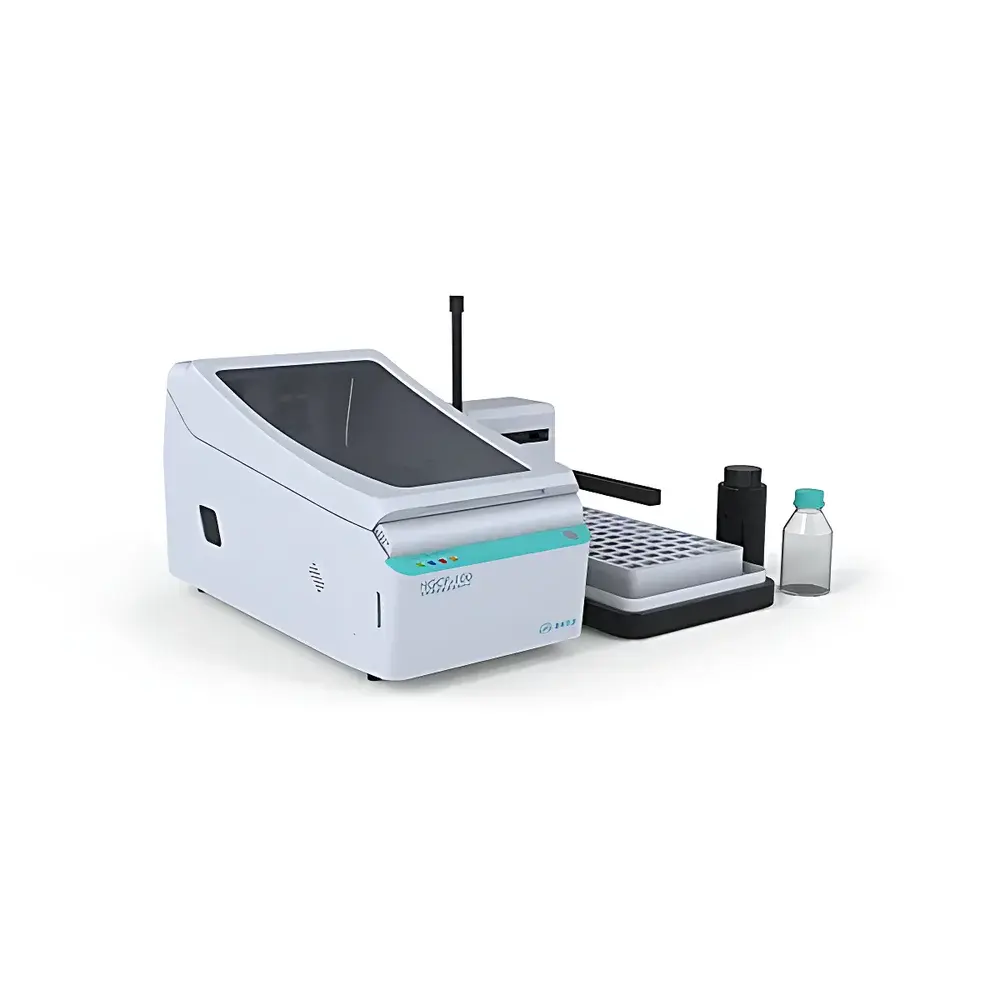
Haiguang HGCF-100 Continuous Flow Analyzer for Volatile Phenol
| Brand | Haiguang Instrument |
|---|---|
| Origin | Beijing, China |
| Model | HGCF-100 (Volatile Phenol Configuration) |
| Instrument Type | Benchtop Laboratory Continuous Flow Analyzer |
| Compliance | GB, HJ, EPA, ISO Standard Methods |
| Sample Throughput | Batch-mode Automated Analysis |
| Detection Principle | Air-Segmented Continuous Flow with On-line Distillation and Spectrophotometric Detection |
| Optical Detection | Full-spectrum CCD or Dual-beam Silicon Photodiode Detector |
| Reaction Coil | 2 mm ID Quartz Mixing Coil |
| On-line Pretreatment | Integrated Steam Distillation, Heating, Mixing, Dilution, and Auto-Cleaning |
| Automation Level | Fully Automated Including Auto-Sampling, Reagent Dispensing, Reaction Control, Data Acquisition, and System Flush |
Overview
The Haiguang HGCF-100 Continuous Flow Analyzer for Volatile Phenol is a benchtop laboratory instrument engineered for high-throughput, standardized quantification of volatile phenolic compounds in aqueous environmental matrices. It implements air-segmented continuous flow analysis (CFA) coupled with on-line steam distillation—a methodology aligned with internationally recognized protocols including EPA Method 420.1, ISO 6439, HJ 503–2009, and GB/T 5750.5–2023. Unlike discrete batch analyzers or manual colorimetric methods, the HGCF-100 automates the entire analytical sequence—from sample introduction and matrix-specific pretreatment to reaction, optical detection, and data reporting—within a fully enclosed, chemically inert fluidic path. Its core architecture integrates segmented flow hydraulics, thermally controlled distillation, and dual-detection capability (CCD or silicon photodiode), enabling robust performance across heterogeneous samples such as wastewater, surface water, seawater, and digested soil extracts.
Key Features
- Air-segmented CFA architecture ensures complete reaction homogeneity, minimizes carryover (<0.05%), and eliminates cross-contamination between samples.
- Integrated on-line steam distillation module operates at precisely controlled temperature and pressure profiles, delivering quantitative recovery of volatile phenols from complex, high-TDS, or suspended-solid-laden matrices without manual intervention.
- Quartz reaction coil (2 mm internal diameter) provides superior chemical resistance, low memory effect, and consistent laminar flow—critical for reproducible calibration and long-term stability.
- Two optical detection options: (a) Full-spectrum CCD detector enabling simultaneous multi-wavelength acquisition for background correction and interference compensation; (b) Dual-beam silicon photodiode detector offering wide dynamic range (>3.5 AU), high signal-to-noise ratio, and thermal drift compensation.
- Modular channel design: Each analysis channel houses independent peristaltic pumping, reagent delivery, reaction manifold, detector, and control electronics—allowing parallel multi-parameter analysis when configured with additional modules.
- On-line pretreatment suite supports automated heating, digestion (where applicable), dilution, phase separation, and post-run system flush—all programmable via method editor.
- Low-power LED light source (peak wavelength matched to phenol-4-aminoantipyrine chromophore) achieves <1 s warm-up time, ±0.2% intensity stability over 8 h, and >20,000 h operational lifetime.
Sample Compatibility & Compliance
The HGCF-100 is validated for direct analysis of raw or minimally prepared samples—including untreated wastewater, river water, groundwater, seawater, and leachates—without mandatory pre-filtration or degassing. Its distillation-integrated workflow meets regulatory requirements for volatile phenol determination under multiple frameworks: U.S. EPA Method 420.1 (phenol), ISO 6439 (water quality—determination of phenolic compounds), China’s HJ 503–2009 and GB/T 5750.5–2023, and ASTM D1783 (for phenolic content in industrial effluents). The system supports GLP-compliant operation through audit-trail-enabled software, electronic signature support, and user-access-level permissions. All hardware components contacting reagents or samples comply with FDA-recommended materials (e.g., PTFE, quartz, borosilicate glass), and fluidic pathways are certified for Class A volumetric accuracy per ISO 8655.
Software & Data Management
Control and data handling are managed via Haiguang’s proprietary CFA-Studio software, a Windows-based platform compliant with 21 CFR Part 11 requirements. It features method-driven workflow automation, real-time chromatogram visualization, peak integration with baseline correction algorithms, calibration curve generation (linear, quadratic, or cubic), and automatic QC flagging (e.g., drift >2%, RSD >5% across replicates). Raw spectral data, detector voltage logs, pump status timestamps, and maintenance records are stored in encrypted SQLite databases with configurable backup intervals. Export formats include CSV, PDF analytical reports, and LIMS-compatible ASTM E1384 XML. Software validation documentation (IQ/OQ/PQ templates) and electronic audit trail review tools are provided for regulated laboratories.
Applications
The HGCF-100 serves environmental monitoring labs, municipal water treatment facilities, third-party testing organizations, and research institutions conducting routine compliance testing and method development. Primary applications include: volatile phenol quantification in discharge permits (e.g., NPDES), drinking water safety verification (per WHO guidelines), wastewater treatment plant efficiency assessment, sediment pore-water characterization, and multi-analyte screening in ecological risk assessments. With optional module expansion, the platform supports parallel determination of ammonia nitrogen, cyanide, anionic surfactants, orthophosphate, total phosphorus, nitrate/nitrite, sulfide, hexavalent chromium, permanganate index, and urea—each adhering to its respective standard method without hardware modification.
FAQ
Does the HGCF-100 require sample filtration prior to analysis?
No. The integrated steam distillation and robust quartz flow path eliminate the need for pre-filtration—even for samples containing suspended solids or high turbidity.
Can the system be validated for 21 CFR Part 11 compliance?
Yes. CFA-Studio includes electronic signatures, role-based access control, immutable audit trails, and full traceability of all analytical events and parameter changes.
What is the typical detection limit for phenol using this system?
Under optimized conditions per EPA 420.1, the method detection limit (MDL) is ≤0.5 µg/L for phenol in clean water matrices; MDL increases slightly in high-conductivity or humic-rich samples due to matrix effects—not instrument limitation.
Is remote monitoring or unattended overnight operation supported?
Yes. Scheduled run sequences, auto-shutdown, and email/SNMP alerting for error conditions enable lights-out operation for up to 48 h with appropriate reagent volume and waste management.
How is carryover managed between high- and low-concentration samples?
Air segmentation, programmable post-sample rinse cycles (up to 3× with fresh reagent or blank), and quartz coil geometry collectively reduce carryover to <0.05%—verified per ISO 5725-2 precision studies.







