
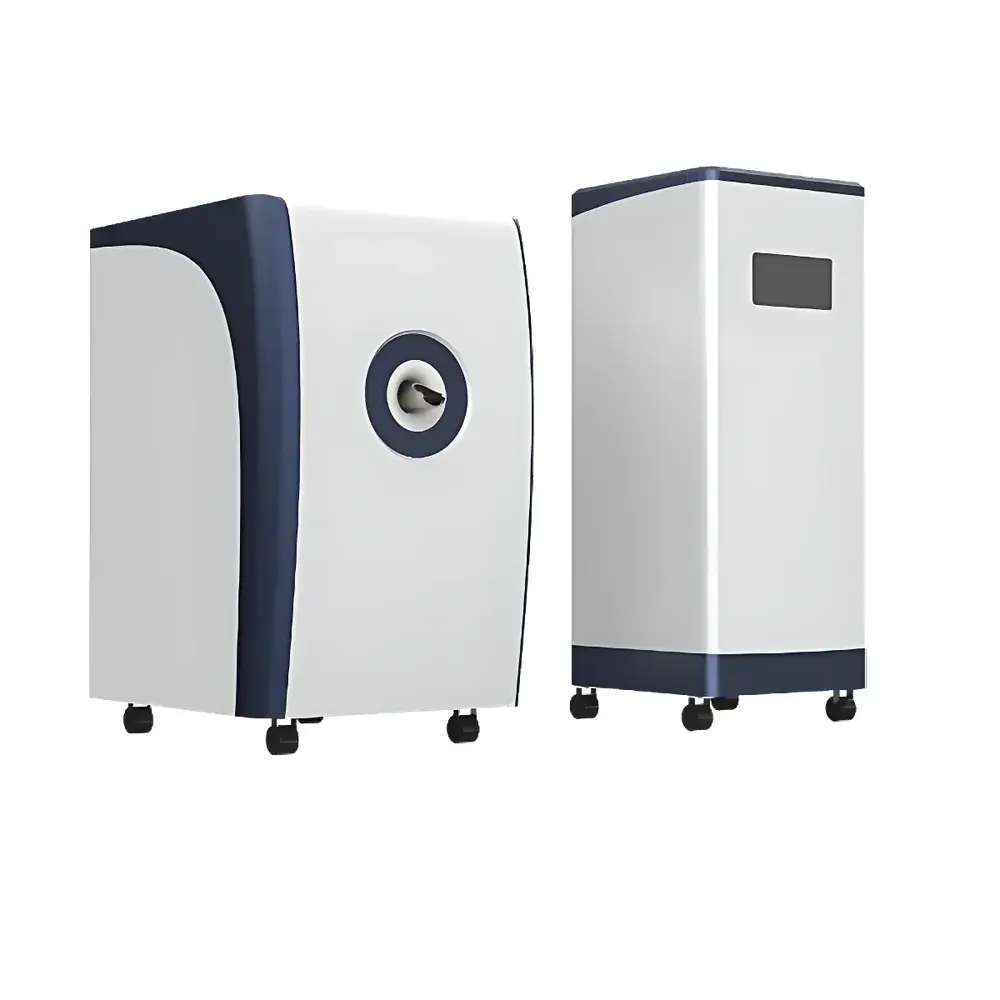
HTNMR HT-MRSI60-50 Series Multi-Nuclear Small Animal MRI and Relaxometry System
| Brand | HTNMR |
|---|---|
| Origin | Shanghai, China |
| Manufacturer Type | Direct Manufacturer |
| Region of Origin | Domestic (China) |
| Model | HT-MRSI60-50 Series |
| Instrument Type | Preclinical Magnetic Resonance Imaging System |
| Animal Model | Mouse (also compatible with rat and small biological specimens) |
| Spatial Resolution (in vivo) | 0.15 mm (standard), down to 0.08 mm (high-resolution mode) |
| Field Strength | 1.5 T (permanent magnet) |
| Bore Diameter | Φ50 mm × H80 mm |
| Maximum Sample Depth | 50 mm |
| Image Matrix Options | 128×128×128 (standard), 256×256×128 (high-res), 512×512×128 (ultra-high-res) |
| Nuclei Supported | ¹H, ¹⁹F, ³¹P |
| Magnetic Field Homogeneity | ≤8 ppm over DSV 30 mm |
| Field Stability | ≤100 Hz/h frequency drift |
| Shielding | Integrated self-shielding (no external RF or magnetic shielding required) |
| Cryogen-Free | Yes (permanent magnet design) |
Overview
The HTNMR HT-MRSI60-50 Series is a preclinical, permanent-magnet-based magnetic resonance imaging (MRI) and relaxometry platform engineered for high-fidelity, multi-nuclear (1H/19F/31P) in vivo imaging and quantitative T1/T2 mapping in small animal models. Operating at a stable 1.5 T field strength, the system leverages a self-shielded, cryogen-free permanent magnet architecture—eliminating reliance on liquid helium, superconducting infrastructure, or dedicated magnetic shielding rooms. This design significantly reduces total cost of ownership while maintaining field homogeneity ≤8 ppm over a 30-mm diameter spherical volume (DSV) and long-term stability of ≤100 Hz/h. The system implements standard MR physics principles: nuclear spin polarization under static B0, RF excitation via tunable broadband probes, signal reception using optimized surface or volume coils, and Fourier-based spatial encoding to reconstruct 3D anatomical, functional, and molecular contrast. It is explicitly designed for longitudinal studies requiring reproducible relaxation quantification and multi-contrast acquisition across cohorts.
Key Features
- Multi-nuclear capability: Native support for 1H (anatomical reference), 19F (quantitative cell tracking, perfluorocarbon-labeled agents), and 31P (metabolic imaging, phosphocreatine/ATP mapping) without hardware reconfiguration.
- High-resolution 3D imaging: Achieves in vivo isotropic resolution down to 0.08 mm (512×512×128 matrix) within a 50-mm bore—optimized for murine whole-body, cardiac, renal, and neuroimaging applications.
- Integrated relaxometry suite: Built-in inversion-recovery (IR), spin-echo (SE), and multi-echo gradient-echo (MEGE) sequences enable robust T1 and T2 mapping with pixel-wise fitting and export of parametric maps in DICOM/NIfTI format.
- Permanent magnet advantages: Zero cryogen consumption, minimal siting requirements (standard lab floor loading), no quench risk, and negligible operational downtime—ideal for GLP-compliant core facilities and academic imaging labs.
- Modular RF probe ecosystem: Interchangeable transmit/receive coils—including quadrature volume coils and phased-array surface coils—optimized for SNR and penetration depth up to 50 mm.
- Comprehensive pulse sequence library: Includes RARE, FLASH, EPI, PROPELLER, and custom sequence scripting via vendor-provided C++/Python API for method development.
Sample Compatibility & Compliance
The HT-MRSI60-50 accommodates live mice (up to 40 g) and rats (up to 300 g) under isoflurane anesthesia, with integrated physiological monitoring (respiratory gating, temperature control, ECG synchronization). Sample handling conforms to IACUC and AAALAC guidelines for humane endpoints and imaging duration limits. Data acquisition and storage comply with DICOM 3.0 Part 10 standards; audit trails, user authentication, and electronic signatures align with FDA 21 CFR Part 11 readiness for regulated preclinical studies. All pulse sequences are validated against ASTM E2827–12 (Standard Practice for MRI System Performance Testing) and ISO/IEC 17025–2017 traceability requirements for metrological confidence.
Software & Data Management
The system runs on a Linux-based acquisition workstation with HTNMR’s proprietary ParaVision-compatible software suite. It provides real-time reconstruction, interactive ROI analysis, voxel-based T1/T2 fitting, and batch processing pipelines. Raw k-space data is stored in Bruker-compatible format (.fid/.dcm), enabling third-party analysis in MATLAB, Python (NiBabel, nibabel), or FSL. DICOM export supports PACS integration, while NIfTI output facilitates downstream use in SPM, AFNI, or ANTs. Audit logs record operator ID, timestamp, sequence parameters, and calibration history—fully compliant with GLP/GMP documentation requirements.
Applications
- Longitudinal tumor xenograft monitoring (T2-weighted anatomy + 19F-labeled nanoparticle accumulation)
- Cardiac function assessment (cine-MRI, late gadolinium enhancement, T1 mapping for fibrosis)
- Renal perfusion and oxygenation (BOLD MRI + 31P spectroscopy of ATP/PCr ratios)
- Neuroinflammation tracking (USPIO-enhanced T2* mapping + 19F cell labeling)
- In vitro relaxivity measurement (vial-based T1/T2 determination for contrast agent characterization per USP )
- Multimodal validation: Correlative MRI with PET, optical imaging, or histopathology via fiducial-based registration.
FAQ
Is the system capable of spectroscopic imaging (MRSI)?
Yes—the platform supports single-voxel and chemical shift imaging (CSI) for 1H, 19F, and 31P, with spectral bandwidths up to 200 kHz and minimum echo times of 1.5 ms.
What coil options are available for high-SNR cardiac imaging?
Dedicated 4-channel phased-array mouse cardiac coils (with respiratory gating interface) and dual-tuned 1H/19F volume coils are offered as factory-configured options.
Does the system meet regulatory requirements for IND-enabling toxicology studies?
While not FDA-cleared for human use, the system’s hardware validation, software audit trail, and DICOM compliance support data submission in nonclinical study reports under ICH S6(R1) and FDA guidance for imaging biomarkers.
Can users implement custom pulse sequences?
Yes—via the open-source sequence development toolkit (SDK), which includes C++ templates, GPU-accelerated reconstruction hooks, and full access to gradient waveforms and RF amplitude modulation.
What maintenance is required for the permanent magnet?
None beyond annual field homogeneity verification and RF coil integrity testing; no cryogens, vacuum pumps, or shimming currents are involved.



