
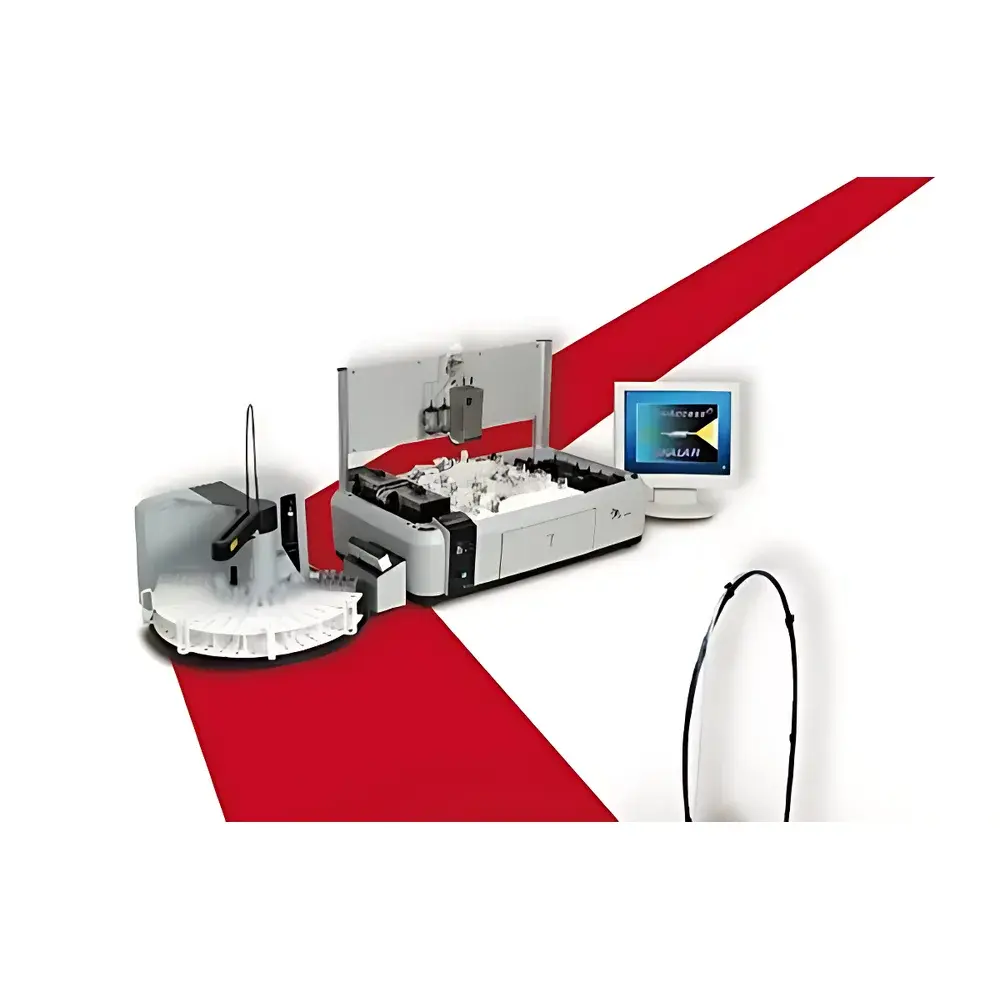
Skalar SAN++ Continuous Flow Analyzer
| Origin | Netherlands |
|---|---|
| Manufacturer Type | Authorized Distributor |
| Origin Category | Imported |
| Model | SAN++ |
| Price | USD 165,000 (approx.) |
| Product Type | Continuous Flow Analyzer |
| Wavelength Range | 400–900 nm |
| Sample Capacity | 200 or 300 positions |
| Reagent Positions | 36 |
| Flow Cell Path Length | 100 mm |
| Light Source | High-Stability LED |
Overview
The Skalar SAN++ Continuous Flow Analyzer is a fully automated, modular wet-chemistry platform engineered for high-throughput, reproducible colorimetric and spectrophotometric determinations in environmental, food & beverage, agricultural, and industrial laboratories. Based on classical continuous flow analysis (CFA) principles—where samples and reagents are propelled through precisely dimensioned tubing under controlled laminar flow, mixed in segmented streams, and reacted under defined time–temperature conditions—the SAN++ delivers robust quantification of analytes such as nitrate, phosphate, ammonium, silica, cyanide, phenol, and total Kjeldahl nitrogen (TKN). Unlike flow injection analysis (FIA), CFA employs air segmentation to physically separate discrete reaction zones, minimizing carryover and enabling extended reaction times for complete chromophore development. The system’s architecture adheres to ISO/IEC 17025 foundational requirements for analytical competence and supports method validation per EPA, ASTM D3370, ISO 15681, and EN ISO 1192, making it suitable for regulatory-compliant reporting in water quality monitoring and GLP environments.
Key Features
- Modular, field-upgradable hardware design allowing flexible configuration for 1–16 parallel analytical channels
- High-stability LED light source with narrow spectral bandwidth (±5 nm) and drift <0.002 AU/h over 8 h, ensuring long-term photometric consistency
- Digital photometer with 16-bit A/D conversion and linear dynamic range spanning 0.001–3.000 AU, supporting detection from sub-ppb to high-ppm concentrations
- Automated sample handling with dual-capacity carousel (200- or 300-position), programmable aspiration volume (10–1000 µL), and integrated barcode scanning
- 36-position reagent carousel with temperature-controlled storage (4–10 °C optional), compatible with viscous and volatile reagents
- Self-calibrating peristaltic pump system with pressure monitoring and automatic tube wear compensation; pump life extended via overnight shutdown protocol and idle-mode flushing
- On-board dilution module capable of up to 1000× pre- or post-dilution with programmable accuracy ±1.5% RSD
- Integrated UV digestion, thermal incubation (up to 100 °C), dialysis, and liquid–liquid extraction modules—all controlled via centralized method editor
Sample Compatibility & Compliance
The SAN++ accommodates aqueous matrices including raw and treated drinking water, wastewater, soil extracts, plant digests, wine, beer, tobacco homogenates, and fertilizer solutions. Sample viscosity range: 0.8–3.5 cP; suspended solids ≤50 mg/L (pre-filtration recommended). All fluidic pathways are constructed from chemically inert PTFE, FEP, and quartz to prevent adsorption or leaching. The system complies with ISO 9001:2015 manufacturing standards and is designed to support audit-ready workflows aligned with FDA 21 CFR Part 11 (electronic records/signatures), EU Annex 11, and GLP/GMP documentation requirements. Method templates are pre-validated against standard methods including US EPA 353.2, ISO 6878, and APHA 4500-NH₃ F.
Software & Data Management
SAN++ is operated via the proprietary SAN++ Control Software v5.x—a Windows-based application supporting method creation, real-time chromatogram visualization, peak integration, calibration curve generation (linear, quadratic, log-log), and QC flagging (e.g., drift, blank deviation, recovery failure). Raw data files (.saf) are stored with full audit trail: timestamped operator ID, instrument state logs, reagent lot tracking, and version-controlled method parameters. Export formats include CSV, PDF reports, and LIMS-compatible ASTM E1384 XML. Optional 21 CFR Part 11 compliance package includes electronic signatures, role-based access control, and immutable archive mode.
Applications
- Environmental: Routine monitoring of nutrients (NO₃⁻, PO₄³⁻, NH₄⁺) and metals (Fe, Mn, Cu) in surface, ground, and wastewater per ISO 15681-1/2
- Food & Beverage: Determination of SO₂ in wine, alcohol in beer, protein (via Kjeldahl), and free amino nitrogen (FAN) in brewing
- Agriculture: Analysis of NPK content in fertilizers, nitrate in leaf sap, and phosphate in soil extracts per AOAC 971.22
- Tobacco: Quantification of nicotine, reducing sugars, and total alkaloids in cured leaf and smoke condensate
- Industrial: Quality control of process waters in pharmaceutical manufacturing and electroplating effluents
FAQ
What distinguishes continuous flow analysis (CFA) from flow injection analysis (FIA)?
CFA uses air segmentation to isolate discrete reaction zones, enabling longer reaction times and higher sensitivity for slow-developing colorimetric assays; FIA relies on dispersion gradients and shorter residence times, favoring speed over completeness of reaction.
Can the SAN++ be integrated into an existing LIMS?
Yes—via ASTM E1384-compliant XML export or ODBC driver; custom API integration is supported under Skalar’s Professional Services agreement.
Is UV digestion included as standard or optional?
UV digestion is available as a factory-installed module (SAN++ UV-Digester); it is not part of the base configuration but is required for total phosphorus or total nitrogen determination.
How often does the system require recalibration?
Calibration frequency depends on application stringency; routine use typically requires daily bracketing with standards and weekly full calibration verification per ISO/IEC 17025 Clause 7.7.
What maintenance intervals are recommended for peristaltic pump tubing?
Tubing lifetime averages 3–6 months under continuous operation; the system logs cumulative pump revolutions and alerts at 90% estimated wear—replacing tubing proactively maintains volumetric accuracy within ±1.0% RSD.




