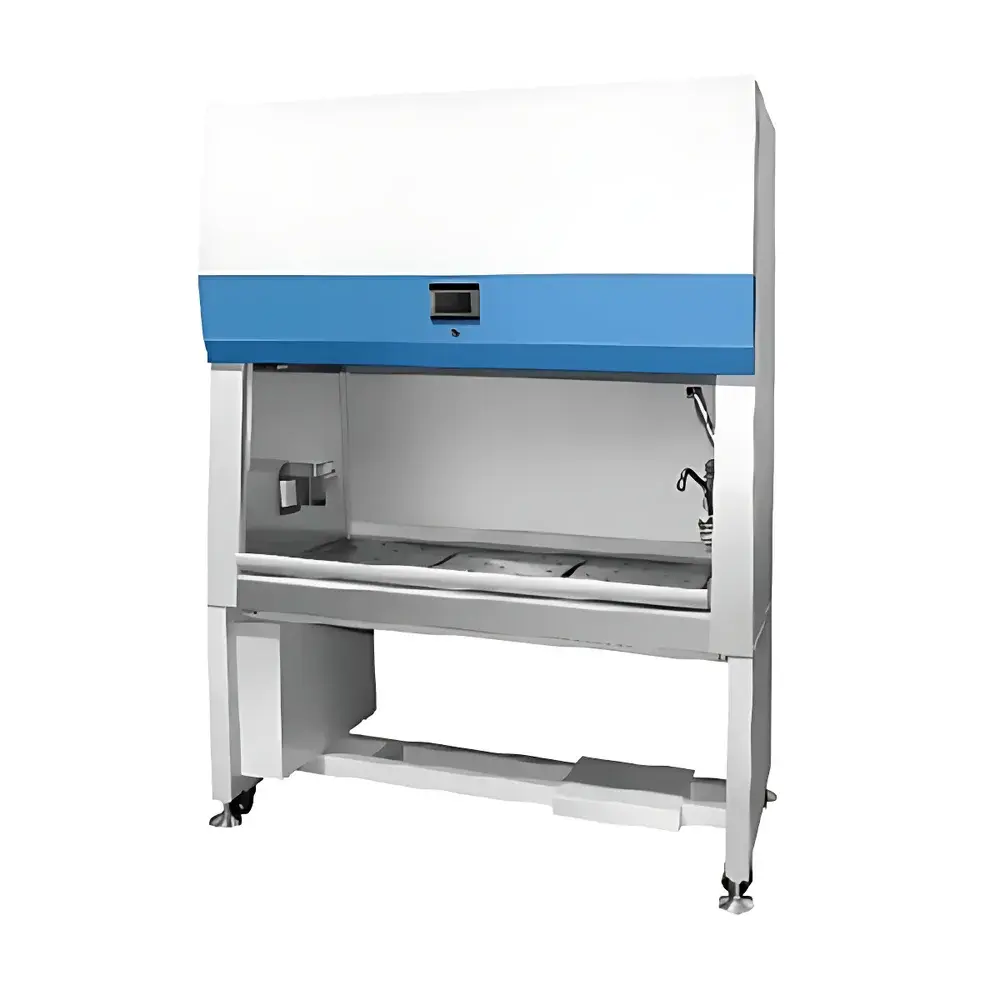
HRH-ADS1500 Negative-Pressure Necropsy Cabinet
| Brand | Huironghe |
|---|---|
| Origin | Beijing, China |
| Manufacturer Type | Authorized Distributor |
| Country of Origin | China |
| Model | HRH-ADS1500 |
| Price | Upon Request |
| Construction Material | SUS304 Stainless Steel with Powder-Coated Exterior |
| Work Surface | Concave Design with 3 Removable Trays, Integrated Drainage Trough, Dual Faucets & Handheld Spray Gun |
| Airflow Velocity at Sash Opening | ≥ 0.5 m/s (inward) |
| Total Exhaust Airflow Capacity | 1500 m³/h |
| Fan | EBM-Papst High-Efficiency Low-Noise Centrifugal Blower |
| Filtration | H14 HEPA Filter (≥99.99% @ 0.1 µm), In-Situ Leak Testing & Decontamination Capable |
| Electrical Supply | AC 220 V / 50 Hz |
| UV Disinfection | Dual 254 nm Germicidal Lamps |
| Safety Alarms | Sash Height Monitoring, Filter Differential Pressure Alert |
| Dimensions (W×D×H) | 1500 × 820 × 2220 mm |
| Power Outlets | Two IP44-Rated 220 V / 10 A Splash-Proof Sockets |
| Compliance | Designed for ABSL-3/ABSL-4 Containment Environments |
| Application Scope | Inhalation Exposure Studies (Infection, Immunization, Formulation Development) |
Overview
The HRH-ADS1500 Negative-Pressure Necropsy Cabinet is an engineered biosafety containment system specifically developed for necropsy procedures involving small-to-medium-sized laboratory animals in high-containment biological laboratories (ABSL-3 and ABSL-4). It operates on the principle of directional airflow containment—maintaining a stable inward-facing air curtain across the work opening to prevent escape of bioaerosols generated during tissue dissection, organ harvesting, or pathogen-laden sample handling. The cabinet integrates structural integrity, aerodynamic control, and multi-layered decontamination protocols to fulfill stringent occupational health and environmental protection requirements defined under WHO Biorisk Management Guidelines, ISO 15190:2020 (Medical laboratories — Requirements for safety), and national biosafety regulations governing high-consequence pathogen research. Its design prioritizes operator safety without compromising ergonomic access or procedural efficiency.
Key Features
- Robust SUS304 stainless steel construction with powder-coated exterior finish ensures long-term corrosion resistance and compatibility with frequent disinfectant exposure (e.g., 70% ethanol, 0.5% sodium hypochlorite, hydrogen peroxide vapor).
- Dual inclined sash windows conform to anthropometric standards, enabling unobstructed visual monitoring and comfortable arm positioning during prolonged dissection tasks.
- Stable inward airflow profile maintained at ≥0.5 m/s average velocity across the entire sash cross-section—validated via smoke visualization and anemometric mapping per EN 12464-1 and NSF/ANSI 49 Annex D protocols.
- High-capacity exhaust system delivering up to 1500 m³/h, driven by a certified EBM-Papst centrifugal blower offering low power consumption (<1.2 kW), acoustic noise ≤62 dB(A), and continuous duty cycle reliability.
- H14-class HEPA filtration (EN 1822-1 compliant) installed in the exhaust pathway provides ≥99.99% particle removal efficiency for airborne contaminants down to 0.1 µm—critical for aerosolized viruses, bacteria, and prion-associated particles.
- In-situ filter integrity testing capability using photometer-based scanning (e.g., TSI 8130A) and integrated vapor-phase hydrogen peroxide (VHP) decontamination port support full lifecycle validation without filter removal.
- Integrated drainage infrastructure includes a recessed stainless steel work surface with three removable specimen trays, a perimeter drain channel, dual fixed faucets, and a handheld spray gun—all connected to a sealed waste collection interface compatible with autoclave bags or UN-certified biohazard containers.
- Dual 254 nm germicidal UV-C lamps (30 W each) mounted on side walls provide validated surface disinfection cycles (≥30 min exposure time recommended per ISO 15714:2019) prior to and after procedures.
- Real-time safety monitoring via programmable logic controller (PLC) includes sash height deviation alert, HEPA filter pressure differential threshold warning (>250 Pa), and audible/visual alarm activation with event logging.
Sample Compatibility & Compliance
The HRH-ADS1500 accommodates rodents (mice, rats, guinea pigs), lagomorphs (rabbits), and non-human primates (up to ~10 kg body weight) for terminal necropsy, tissue sampling, and post-exposure assessment in inhalation toxicology and infectious disease models. It complies with biosafety infrastructure prerequisites outlined in CDC/NIH Biosafety in Microbiological and Biomedical Laboratories (BMBL), 6th Edition, and supports GLP-compliant study execution when paired with documented SOPs, calibration records, and preventive maintenance logs. While not classified as a Class II Biological Safety Cabinet per NSF/ANSI 49, its engineering controls align with risk-based containment strategies endorsed by the European Committee for Standardization (CEN) Technical Report CEN/TR 16743:2014 for animal necropsy enclosures.
Software & Data Management
The embedded control unit features a 7-inch industrial touchscreen HMI with password-protected configuration access, real-time display of airflow velocity, filter delta-P, UV lamp operational status, and alarm history (retained for ≥30 days). All events—including sash position changes, alarm triggers, and manual override actions—are timestamped and exportable via USB or RS-485 interface in CSV format. Optional integration with laboratory information management systems (LIMS) is supported through Modbus RTU protocol, enabling audit-ready traceability aligned with FDA 21 CFR Part 11 requirements for electronic records and signatures.
Applications
- Inhalation challenge studies requiring post-exposure necropsy under containment (e.g., SARS-CoV-2, influenza A/H5N1, Mycobacterium tuberculosis).
- Preclinical evaluation of inhaled therapeutics, including dry powder inhalers (DPIs), nebulized biologics, and nanoparticle-based delivery systems.
- Biosafety Level 3/4 vaccine immunogenicity assessments involving live-attenuated or viral-vectored platforms.
- Pathogenesis investigations where aerosolized shedding must be prevented during organ harvest and histopathological processing.
- Training environments for ABSL-3/4 facility personnel performing standardized necropsy techniques under supervised conditions.
FAQ
Can the HRH-ADS1500 be installed in a standard laboratory room without dedicated ductwork?
Yes—the unit supports recirculation mode with optional dual-stage filtration (pre-filter + H14 HEPA) for indoor exhaust, provided ambient room ventilation meets minimum air exchange requirements (≥12 ACH) and ceiling-mounted exhaust ducting is not feasible.
Is the H14 filter certified according to EN 1822-1?
Yes—each filter carries individual test certification from an accredited third-party laboratory confirming fractional efficiency ≥99.995% at MPPS (Most Penetrating Particle Size) of 0.1–0.2 µm.
What is the recommended maintenance interval for the EBM fan and HEPA filter?
Fan performance verification is required every 6 months; HEPA filter replacement is scheduled annually or after 10,000 operating hours—whichever occurs first—subject to in-situ integrity test results.
Does the cabinet support validation documentation for regulatory submissions?
Yes—factory-provided IQ/OQ documentation templates, airflow mapping reports, and filter certification dossiers are supplied to support GxP-aligned qualification activities.
Can the UV lamps be operated while the sash is open?
No—UV emission is interlocked with sash position sensors and automatically deactivates when the sash exceeds 50 mm opening height to prevent ocular and dermal exposure.
Related Products