
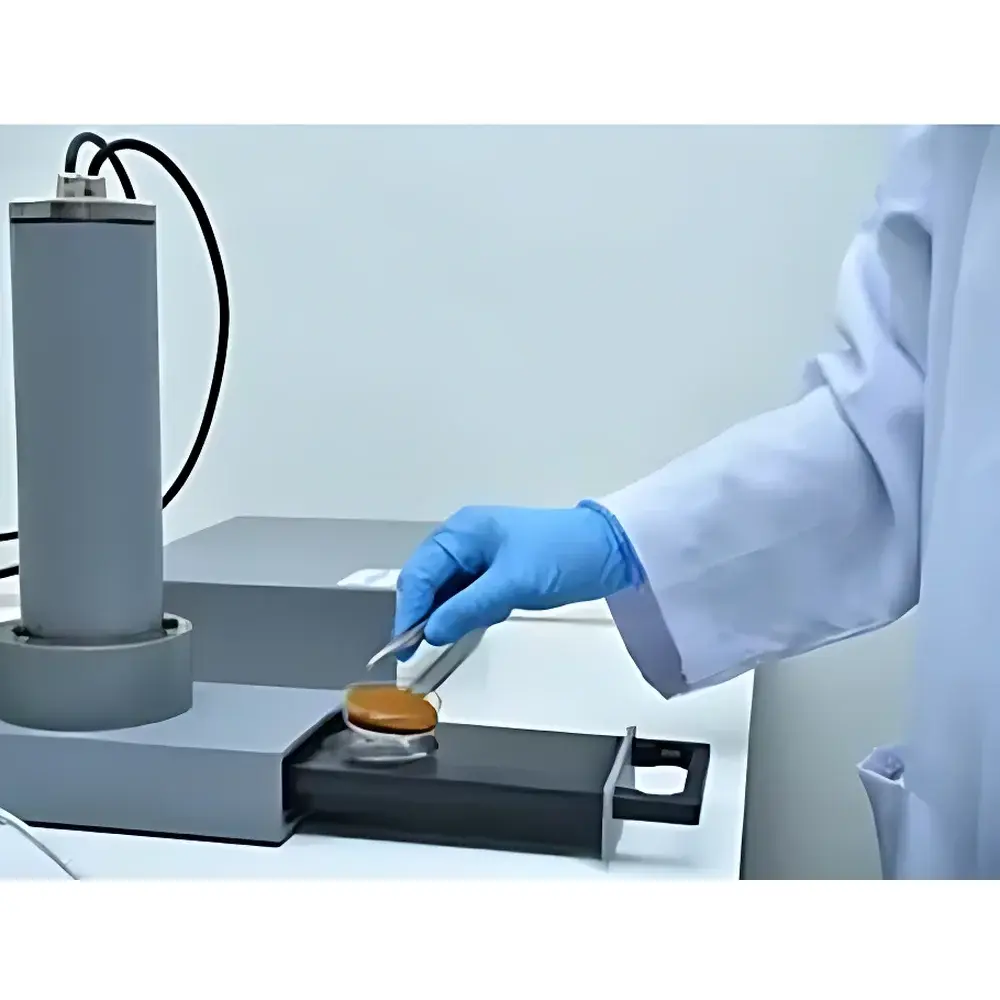
SURRC SUERC Pulsed Photo-Stimulated Luminescence (PPSL) Irradiated Food Screening System
| Brand | Farrel |
|---|---|
| Origin | Beijing, China |
| Manufacturer Type | Authorized Distributor |
| Origin Category | Domestic |
| Model | SUERC |
| Pricing | Upon Request |
Overview
The SURRC SUERC Pulsed Photo-Stimulated Luminescence (PPSL) Irradiated Food Screening System is a compact, benchtop analytical instrument engineered for rapid, non-destructive identification of ionizing radiation treatment in food and herbal products. Unlike thermal luminescence (TL) methods—which require post-sampling re-irradiation to generate reference signals—the SUERC system utilizes pulsed optical stimulation (typically in the blue–green spectral range, ~470 nm) to release trapped electrons from crystalline lattice defects (e.g., silicate minerals naturally present in spices, herbs, or shell fragments). The resulting photon emission is detected via a high-gain photomultiplier tube (PMT) coupled to a UK-patented photon counting architecture (UK Patent No. 2291707), enabling quantification of photo-stimulated luminescence (PSL) intensity and decay kinetics. This principle aligns with internationally recognized screening protocols defined in EN 13751:2022 and ISO/IEC 17025-accredited laboratory workflows. The system delivers objective, binary classification—“irradiated” or “non-irradiated”—based on statistically validated PSL signal thresholds, making it suitable for routine QC/QA in food manufacturing, import control laboratories, and regulatory inspection units.
Key Features
- Integrated pulsed LED excitation source with precise temporal control (pulse width < 100 µs, repetition rate adjustable up to 10 Hz)
- High-sensitivity bialkali PMT detector with thermoelectric cooling (−15 °C nominal operating temperature) to minimize dark current noise
- Dedicated photon counting electronics featuring real-time dead-time correction and event timestamping
- Compact footprint (≤350 × 300 × 250 mm) and low power consumption (<60 W), enabling deployment in field labs or mobile inspection units
- Zero-reagent operation: no chemical etching, no sample dissolution, no radioactive sources
- Non-contact measurement geometry minimizes cross-contamination risk between samples
- Two operational modes: standalone (15-second rapid screening with tri-color LED status indicator) and PC-connected (60-second full-curve acquisition with kinetic analysis)
Sample Compatibility & Compliance
The SUERC system is validated for direct analysis of dry, solid-phase food matrices containing intrinsic mineral dosimeters—including silicates (e.g., quartz, feldspar), calcium sulfate, and apatite. Compatible sample types include ground spices (e.g., black pepper, paprika), dried herbs (e.g., oregano, thyme), dehydrated vegetables, powdered botanicals, crustacean shells, bone fragments, and frozen-dried fruit preparations. Sample preparation is minimal: particulate samples ≤250 µm pass directly; larger particles require homogenization to ≤1 mm size prior to loading into standard 35 mm Petri dishes (sample mass: 100–300 mg, monolayer distribution recommended). The methodology conforms to European Standard EN 13751:2022 (“Foodstuffs — Detection of Irradiated Food Using Photo-Stimulated Luminescence”) and supports GLP-compliant documentation when used with audit-trail-enabled software. It is not intended for liquid, oily, or highly hygroscopic matrices without prior lyophilization or matrix isolation.
Software & Data Management
The bundled SUERC Control Suite (v3.x) provides full instrument control, real-time signal visualization, and automated PSL curve fitting using multi-exponential decay models. Each measurement generates a timestamped data package including raw photon counts, integrated PSL area (0–5 s), peak intensity, and signal-to-background ratio—exportable as CSV or XML for LIMS integration. Software features include user-level access control, electronic signature capability compliant with FDA 21 CFR Part 11 (when deployed on validated Windows OS environments), and built-in calibration verification routines traceable to NIST-traceable light sources. Audit logs record all parameter changes, measurement events, and user actions, supporting ISO/IEC 17025 internal audits and regulatory inspections.
Applications
- Routine screening of imported spices and dried herbs for compliance with EU Regulation (EC) No 1999/1999 and FDA 21 CFR §179.26
- Verification of irradiation claims on organic-certified products where irradiation is prohibited
- Post-process quality assurance in contract sterilization facilities handling medical devices or packaging materials
- Forensic analysis of suspected undeclared irradiation in supply chain traceability investigations
- Method validation studies comparing PPSL performance against TL and ESR reference techniques
- Research applications in radiation-induced defect physics within natural mineral systems
FAQ
What types of food cannot be tested with the SUERC system?
Samples with high moisture content (>12% w/w), liquid suspensions, emulsions, or those containing significant iron oxide or manganese compounds are unsuitable due to signal quenching effects and lack of stable luminescent traps.
Is sample grinding always required?
Grinding is only necessary for heterogeneous or coarse materials (e.g., whole peppercorns, dried ginger slices); fine powders and commercially milled spices may be measured directly without further preparation.
How does SUERC compare to thermoluminescence (TL) testing?
SUERC eliminates the need for laboratory-based re-irradiation and high-temperature readout ovens, reducing turnaround time from hours to seconds and avoiding potential signal fading during storage.
Can the system be used for quantitative dose estimation?
No—the SUERC is a qualitative screening tool per EN 13751. Quantitative dosimetry requires calibrated TL or ESR instrumentation and certified reference materials.
What maintenance is required for long-term reliability?
Annual PM includes PMT gain calibration verification, optical path cleaning, and firmware update; no consumables or periodic replacement parts are specified under normal operating conditions.





