
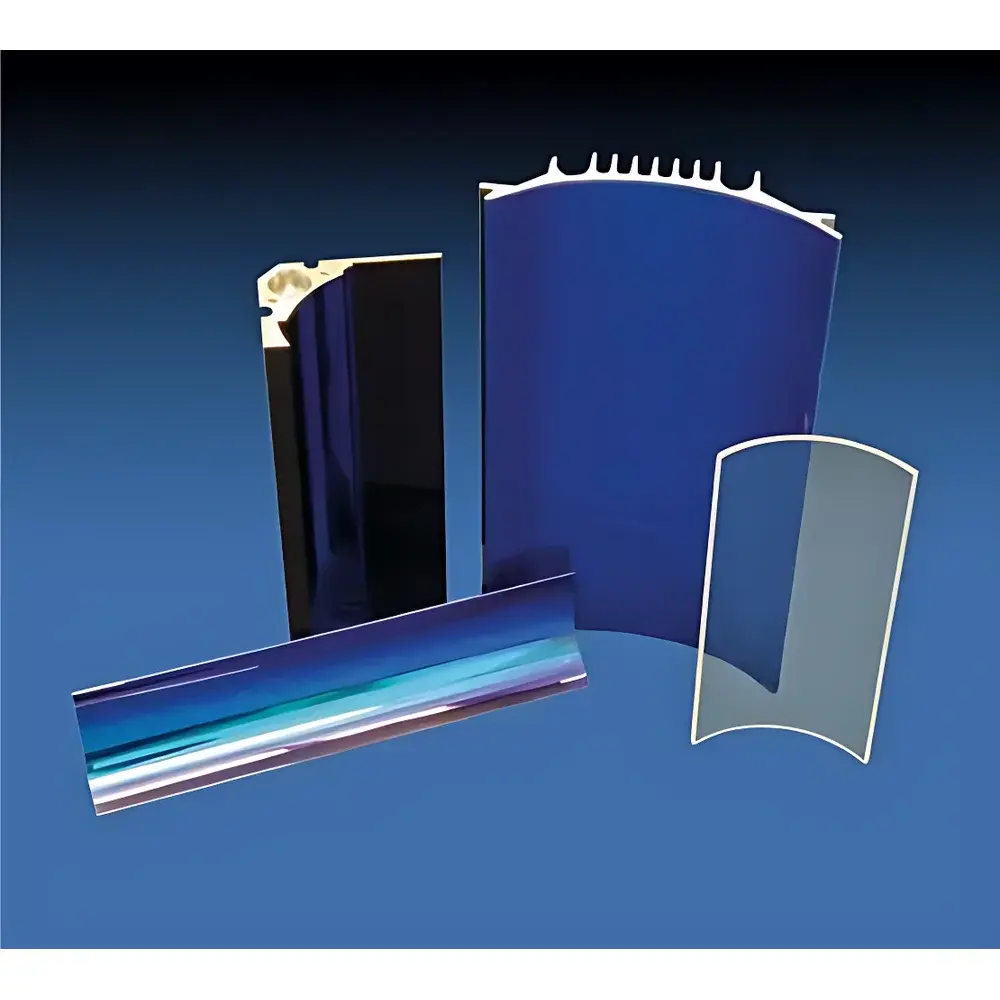
Hoenle Reflective UV Mirror Plate
| Brand | Hoenle |
|---|---|
| Origin | Germany |
| Type | UV-Reflective Optical Component |
| Model | Reflective Mirror Plate (Cold Mirror Variant Available) |
| Coating | Multi-layer Dielectric Stack under High Vacuum |
| Substrate Options | Borosilicate Glass or Anodized Aluminum |
| IR-Blocking Performance | Optimized for UV-A/UV-B (250–400 nm) with >95% UV reflectance and <15% IR transmission (800–2000 nm) |
| Manufacturing Process | Automated Precision Sputter Coating |
| Geometry Support | Flat and Convex Surfaces |
| Customization | OEM/ODM Available |
Overview
The Hoenle Reflective UV Mirror Plate is a precision optical component engineered for high-efficiency ultraviolet radiation management in industrial UV curing, photolithography, fluorescence excitation, and UV disinfection systems. Unlike standard aluminum or silver-coated mirrors, this reflective plate employs a multi-layer dielectric thin-film architecture deposited under ultra-high vacuum conditions—ensuring atomic-level interface control and minimal interlayer diffusion. Its operational principle relies on constructive interference of UV wavelengths within the stack, enabling selective spectral reflectance: peak reflectivity (>95%) across the UV-A and UV-B bands (250–400 nm), while simultaneously suppressing infrared (IR) transmission (<15% from 800–2000 nm). This spectral selectivity is critical for thermally sensitive substrates—including polymer films, printed electronics, biological samples, and coated optics—where uncontrolled IR heating induces dimensional drift, coating delamination, or photochemical side reactions.
Key Features
- Multi-layer dielectric coating system optimized for UV spectral range (250–400 nm), fabricated via magnetron sputtering under <1×10⁻⁶ mbar vacuum
- Cold mirror functionality: integrated IR attenuation without compromising UV reflectance—enabling stable thermal profiles during prolonged irradiation
- Substrate flexibility: available on optically polished borosilicate glass (for high wavefront fidelity) or lightweight anodized aluminum (for thermal mass optimization)
- Geometric adaptability: precision coating uniformity maintained on both planar and convex surfaces (radius down to 50 mm), verified by spectrophotometric mapping
- OEM-grade manufacturing: fully traceable process documentation aligned with ISO 9001:2015; coating thickness monitored in real time via quartz crystal microbalance
Sample Compatibility & Compliance
The Hoenle Reflective UV Mirror Plate is compatible with all major medium-pressure mercury vapor, UV-LED, and excimer lamp configurations used in industrial UV processing lines. It meets material compatibility requirements for Class 8 cleanroom environments (ISO 14644-1) and exhibits no outgassing under UV exposure per ASTM E595. The dielectric stack demonstrates long-term stability under continuous UV irradiance up to 500 mW/cm² (365 nm), validated over 5,000 hours of accelerated aging testing. For regulated applications—including medical device manufacturing and pharmaceutical packaging—coating lot traceability supports GLP/GMP audit readiness. While not a standalone medical device, it conforms to RoHS Directive 2011/65/EU and REACH Annex XVII restrictions on heavy metals and halogenated compounds.
Software & Data Management
As a passive optical component, the mirror plate does not incorporate embedded electronics or firmware. However, its performance parameters—including spectral reflectance curves, angular dependence data (±15° incidence), and thermal expansion coefficients—are supplied in standardized ASCII-based .csv and NIST-compatible .spc formats. These datasets integrate seamlessly into optical simulation platforms such as Zemax OpticStudio, CODE V, and FRED for ray-tracing analysis and system-level irradiance modeling. Hoenle provides full spectral characterization reports (per ISO/DIS 9211-4) for each production lot, including measurement uncertainty budgets traceable to PTB (Physikalisch-Technische Bundesanstalt) reference standards.
Applications
- UV curing of low-Tg acrylates and epoxy resins in flexible packaging and automotive interior coatings
- High-resolution mask aligners requiring uniform UV flux distribution across 200 mm wafers
- UV-LED array collimation systems for additive manufacturing (e.g., DLP resin printing)
- Fluorescence microscopy illumination paths where IR-induced sample heating degrades signal-to-noise ratio
- UV water disinfection reactors demanding stable reflectance under humid, oxidative ambient conditions
FAQ
What is the typical lifetime of the dielectric coating under continuous UV exposure?
Under nominal operating conditions (365 nm, 300 mW/cm², ambient temperature), the coating maintains >98% initial reflectance after 3,000 hours—verified per IEC 61215 UV preconditioning protocols.
Can the mirror be cleaned without damaging the coating?
Yes—using spectroscopic-grade methanol and class-100 lint-free wipes; abrasive solvents (e.g., acetone) and mechanical scrubbing must be avoided per MIL-C-48497A cleaning guidelines.
Is angular performance data available for off-normal incidence?
Yes—spectral reflectance is characterized at 0°, 10°, and 20° angles of incidence; polarization-dependent loss remains below 1.2% across the UV band.
Do you offer custom curvature or mounting interface machining?
Yes—custom radii (±0.5 µm tolerance), kinematic mounts, and threaded flange interfaces are supported under NDA-compliant engineering review.
Are calibration certificates provided with each shipment?
Yes—NIST-traceable spectral reflectance certificates (with expanded uncertainty ≤0.8% k=2) accompany every batch, along with substrate flatness verification (λ/10 @ 633 nm).




