
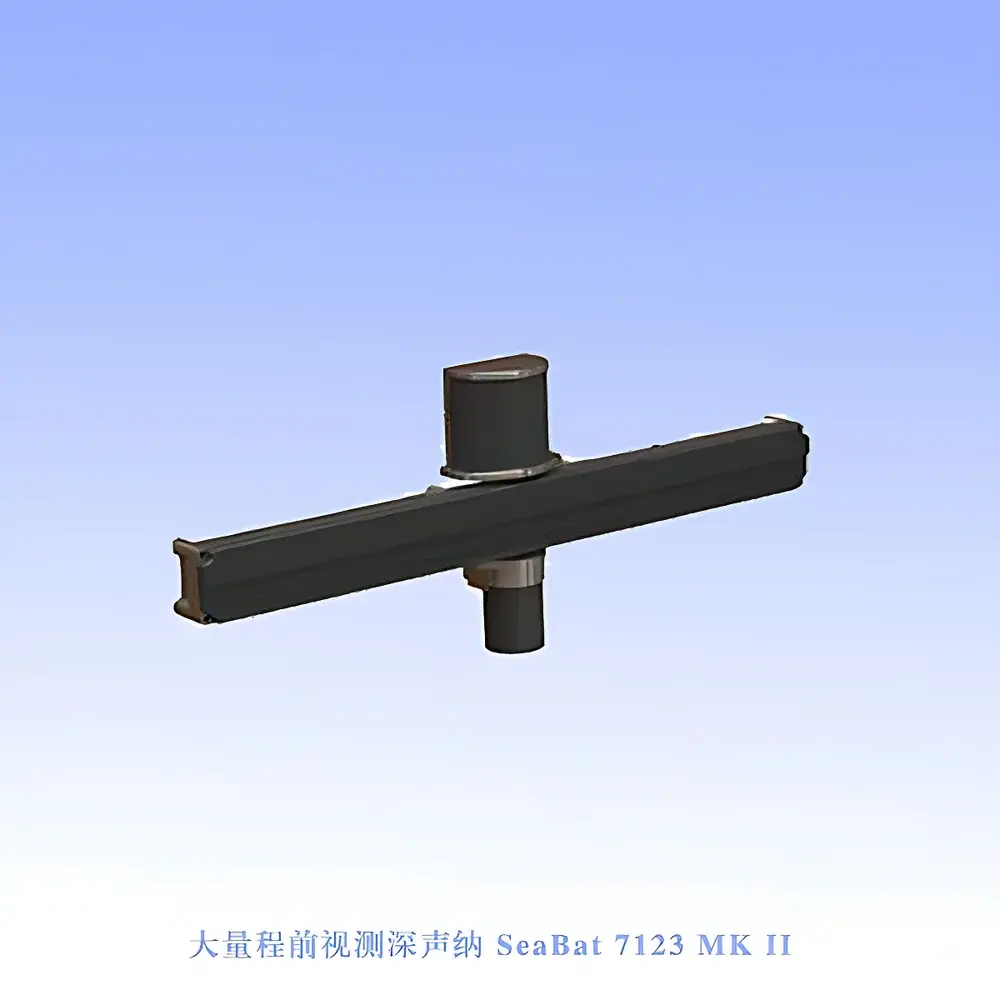
Reson SeaBat 7123 MK II High-Resolution Forward-Looking Multibeam Sonar
| Origin | Denmark |
|---|---|
| Manufacturer Type | Authorized Distributor |
| Origin Category | Imported |
| Model | SeaBat 7123 MK II |
| Price | USD 100,000 (FOB Copenhagen) |
Overview
The Reson SeaBat 7123 MK II is a high-performance, forward-looking multibeam sonar system engineered for long-range, real-time 3D bathymetric imaging in marine defense, hydrographic survey, and autonomous underwater vehicle (AUV) navigation applications. Operating on the principle of active acoustic beamforming, the system transmits synchronized pulse sequences across three discrete frequency bands—100 kHz, 200 kHz, and 400 kHz—and receives backscattered echoes to reconstruct high-fidelity volumetric seabed and obstacle maps. Its forward-looking architecture enables proactive detection of unexploded ordnance (UXO), naval mines, submerged infrastructure, and natural hazards at standoff distances up to 800 meters—critical for safe operation in mine countermeasures (MCM), harbor surveillance, and obstacle avoidance during AUV missions. Unlike downward-looking echosounders, the SeaBat 7123 MK II is optimized for horizontal and near-horizontal acoustic projection, delivering wide azimuthal coverage while maintaining angular resolution sufficient for target discrimination and classification.
Key Features
- Triple-frequency operation: Simultaneous or selectable transmission at 100 kHz (0.8° vertical × >120° horizontal beamwidth), 200 kHz (0.4° × >90°), and 400 kHz (0.2° × >60°), enabling adaptive resolution–range trade-off based on mission requirements.
- Extended maximum range: Rated operational range of 800 meters in seawater (1500 m/s sound speed profile), validated per ISO 17025-accredited calibration protocols.
- Real-time 3D point cloud generation: Onboard processing delivers georeferenced XYZ point clouds at up to 10 Hz update rate, compatible with industry-standard coordinate reference systems (WGS84, UTM).
- Ruggedized titanium housing: Pressure-rated to 6000 m depth, compliant with IEC 60529 IP68 and MIL-STD-810G environmental specifications.
- Integrated motion sensor interface: Synchronous input support for pitch/roll/yaw data from external IMUs or inertial navigation systems (INS) to correct for platform motion artifacts.
- Low-power architecture: Designed for integration on battery-constrained platforms including AUVs, USVs, and towed bodies, with nominal power draw < 120 W at full duty cycle.
Sample Compatibility & Compliance
The SeaBat 7123 MK II is deployed in open-ocean, coastal, and littoral environments where acoustic propagation characteristics vary significantly with salinity, temperature, and suspended particulate matter. It is certified for use in NATO STANAG 4579-compliant mine-hunting operations and meets relevant sections of IMO Resolution A.890(21) for hydrographic data quality assurance. The system adheres to EU RoHS Directive 2011/65/EU and CE marking requirements under the Marine Equipment Directive (MED) 2014/90/EU. Data outputs conform to S-100 and S-102 standards for digital hydrographic data exchange, ensuring interoperability with ECDIS, GIS, and command-and-control systems used by naval and civilian maritime authorities.
Software & Data Management
The sonar is operated via Reson’s proprietary PDS2020 software suite, which provides real-time visualization, automated target detection (ATD), and post-mission processing workflows. PDS2020 supports audit-trail logging in accordance with GLP and GMP principles, including timestamped configuration changes, raw data archiving (in .s7k format), and metadata embedding compliant with ISO 19115-3. Export options include ASCII XYZ, LAS/LAZ, GeoTIFF, and OGC-compliant WMS/WFS services. For integration into larger autonomy stacks, a documented TCP/IP API and ROS2-compatible drivers are available under NDA, enabling seamless fusion with SLAM algorithms and mission planning frameworks.
Applications
- Mine countermeasures (MCM): Detection, classification, and localization of buried and proud mines in cluttered seabeds.
- AUV-based pipeline and cable route surveys: Forward-looking obstacle assessment prior to deployment or maintenance operations.
- Harbor and port security: Persistent monitoring of submerged intrusion threats and anomalous object movement.
- Underwater infrastructure inspection: Pre-dive reconnaissance of offshore wind foundations, bridge pilings, and dam intakes.
- Scientific benthic habitat mapping: High-resolution characterization of coral reefs, seagrass beds, and cold-water coral mounds.
- Search and recovery (SAR): Rapid area scanning for aircraft wreckage, shipwrecks, or lost cargo in deepwater environments.
FAQ
What is the minimum detectable target size at 500 m range using the 400 kHz channel?
At 500 m, the 400 kHz channel resolves targets ≥ 0.3 m in cross-range dimension under standard oceanic conditions (transmission loss ≤ 85 dB). Target detectability is further enhanced by coherent integration and CFAR-based detection algorithms.
Does the system support real-time data streaming over Ethernet?
Yes—raw beamformed data, processed point clouds, and diagnostic telemetry are streamed simultaneously over Gigabit Ethernet using UDP multicast, with configurable packetization and latency thresholds.
Is third-party software integration supported?
The SeaBat 7123 MK II exposes a documented RESTful API and binary protocol specification for OEM integration; MATLAB, Python (via resonsdk), and C++ SDKs are provided under commercial license.
How is calibration traceability maintained?
Each unit ships with a factory calibration certificate traceable to DTU Fotonik’s primary acoustic standards (DKK-PTB accredited), updated annually per ISO/IEC 17025 requirements.
Can the sonar be operated from a moving surface vessel without motion compensation?
Motion compensation is mandatory for quantitative accuracy. The system requires synchronized input from an external INS or AHRS; onboard tilt sensors alone are insufficient for sub-decimeter positional fidelity.




