
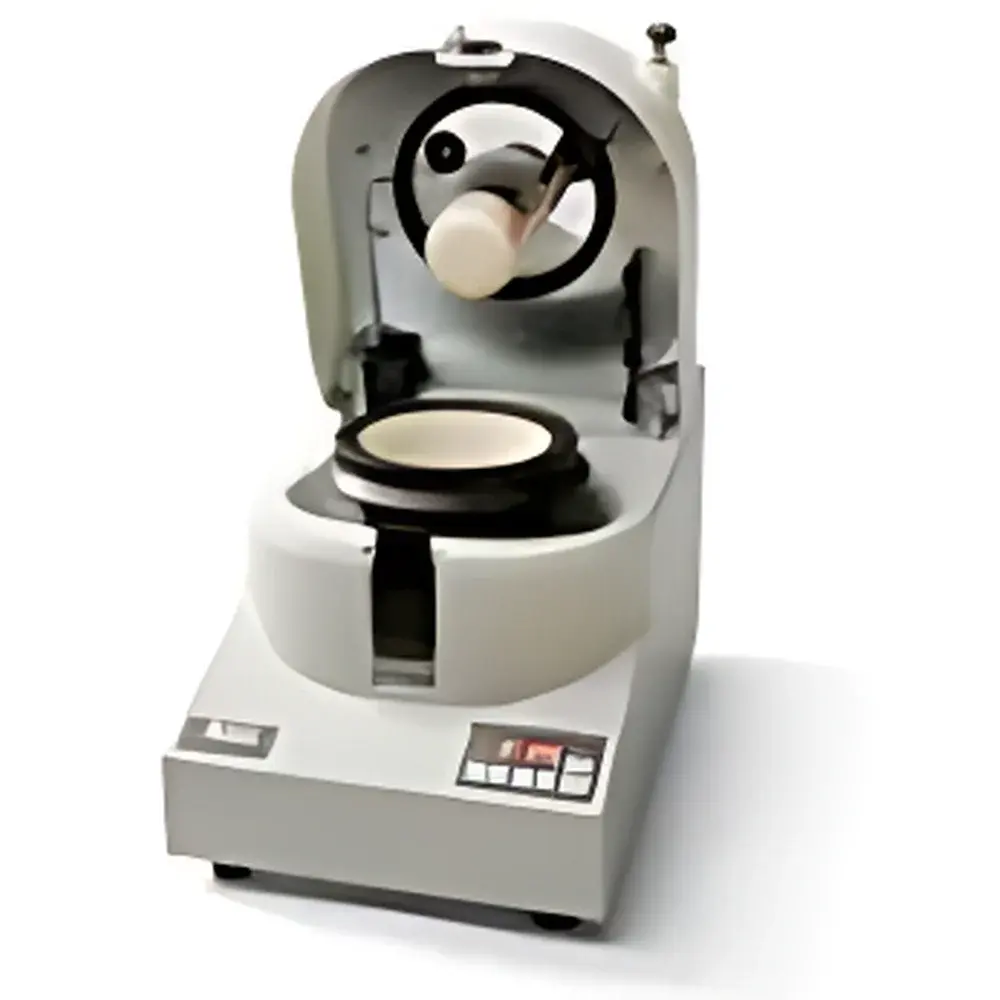
FRITSCH P-2 Cryo-Mortar Grinder
| Brand | FRITSCH |
|---|---|
| Origin | Germany |
| Manufacturer | FRITSCH GmbH |
| Product Type | Cryogenic Mortar Grinder |
| Model | P-2 |
| Input Size | ≤ 8 mm |
| Batch Volume | 10–190 mL |
| Final Particle Size | ≤ 10 µm |
| Motor Speed | ~70 rpm (50 Hz) / ~80 rpm (60 Hz) |
| Bowl ID/OD | 130 / 200 mm |
| Power Supply | 200–240 V, 1~ , 50–60 Hz, 250 W |
| Net Weight | 24 kg |
| Dimensions (L×W×H) | 31 × 46 × 41 cm |
| Compliance | EN 61010-1 |
Overview
The FRITSCH P-2 Cryo-Mortar Grinder is a precision-engineered laboratory mortar mill designed for reproducible, low-contamination size reduction of temperature-sensitive, brittle, or soft materials under cryogenic conditions. Operating on the principle of mechanical compression and shear between a rotating pestle and a stationary mortar bowl, the P-2 delivers controlled comminution without significant thermal input—enabling preservation of volatile compounds, polymorphic integrity, and biological activity. Unlike high-energy impact mills, the P-2’s low-speed, high-torque grinding mechanism minimizes amorphization and heat-induced degradation, making it particularly suitable for pharmaceutical active pharmaceutical ingredients (APIs), plant tissues, polymers, clays, and geological samples where structural fidelity is critical. Its design conforms to IEC/EN 61010-1 safety standards for electrical equipment used in laboratory environments, ensuring operational reliability and user protection during routine and regulated workflows.
Key Features
- Integrated cryogenic capability: Equipped with a sealed mortar bowl featuring dual inlet/outlet ports for continuous liquid nitrogen or chilled gas circulation, enabling sub-ambient grinding down to –196 °C.
- Digital speed control and real-time display: Precise adjustment of rotational speed (70 rpm at 50 Hz / 80 rpm at 60 Hz) ensures consistent energy input across batches.
- Optical process monitoring: Reinforced borosilicate glass viewport allows unobstructed visual observation of sample homogeneity and grinding progress without interrupting operation.
- Tool-free bowl exchange system: Quick-release clamping mechanism enables rapid, contamination-free replacement of mortar bowls—critical for cross-sample integrity in GMP/GLP environments.
- Dust-tight sealing: Patented O-ring–based lid seal prevents sample loss and airborne particulate dispersion, supporting ISO 14644-1 Class 5 cleanroom compatibility when operated in controlled enclosures.
- Material-flexible grinding sets: Seven certified bowl/pestle material options—including agate, aluminum oxide, zirconium oxide, stainless steel, tempered steel, tungsten carbide, and technical ceramics—allow selection based on hardness, chemical inertness, and trace-metal sensitivity requirements.
- Low-power, high-torque motor (250 W): Optimized for sustained torque delivery at low RPM, reducing mechanical wear and enhancing long-term repeatability.
Sample Compatibility & Compliance
The P-2 accommodates a broad spectrum of sample types: dry powders, frozen biological tissues, hydrated clays, pastes, and suspensions containing solid particulates. It is routinely employed for XRF sample preparation (per ASTM E1361 and ISO 29541), pharmaceutical blend homogenization (aligned with USP ), soil geochemical analysis (in accordance with ISO 11464), and ceramic raw material conditioning. All wetted components are traceable to material certifications (e.g., DIN ISO 10474), and grinding surfaces comply with FDA-relevant 3-A Sanitary Standards for non-porous, cleanable surfaces. The instrument supports audit-ready documentation through optional external data logging interfaces compatible with 21 CFR Part 11–compliant systems.
Software & Data Management
While the P-2 operates via an embedded microcontroller with local digital interface, it integrates seamlessly with FRITSCH’s optional LabSolutions™ data acquisition module. This module records timestamped parameters—including runtime, speed, ambient temperature, and optional cryogen flow rate—for export in CSV or XML formats. Metadata fields support sample ID, operator ID, and SOP version tagging, facilitating alignment with laboratory information management systems (LIMS) and electronic lab notebooks (ELN). Audit trails are maintained for all parameter changes, satisfying GLP and GMP data integrity requirements per ALCOA+ principles.
Applications
- Pharmaceutical: Pre-formulation particle size reduction of thermolabile APIs; cryo-milling of amorphous solid dispersions prior to DSC/XRD analysis.
- Environmental: Homogenization of frozen soil cores for heavy metal extraction (EPA Method 3050B); cryogenic pulverization of sediment samples to preserve redox-sensitive species.
- Materials Science: Preparation of uniform feedstock powders for sintering trials; dispersion of nanocomposite precursors in ceramic matrices.
- Food & Agriculture: Grinding of freeze-dried plant material for metabolomic profiling; cell-wall disruption in cereal grain analysis without starch gelatinization.
- Geology & Mining: Production of representative sub-10 µm fractions from ore samples for ICP-MS quantification, minimizing elemental fractionation.
FAQ
Can the P-2 be used for wet grinding?
Yes—the P-2 supports wet grinding with solvents or cryogenic liquids, provided the selected mortar material is chemically compatible and the bowl seal remains intact.
What is the recommended maintenance interval for the pestle bearing?
Under standard usage (≤ 4 hrs/day), FRITSCH recommends inspection every 1,000 operating hours and lubrication with food-grade grease compliant with NSF H1 specifications.
Is method validation support available for regulated industries?
FRITSCH provides application notes and IQ/OQ templates aligned with ASTM E2922 and ISO/IEC 17025, along with on-site qualification assistance for 21 CFR Part 11 and EU Annex 11 compliance.
How does the P-2 compare to planetary ball mills for cryogenic applications?
The P-2 offers superior control over mechanical stress and thermal history due to its deterministic compression-shear mechanism, whereas planetary mills introduce stochastic impact forces that may induce unintended phase transitions or contamination from media wear.
Are replacement bowls calibrated or certified for mass balance?
Each mortar bowl is individually weighed and labeled with its tare mass; optional NIST-traceable calibration certificates are available upon request for quantitative gravimetric workflows.



