
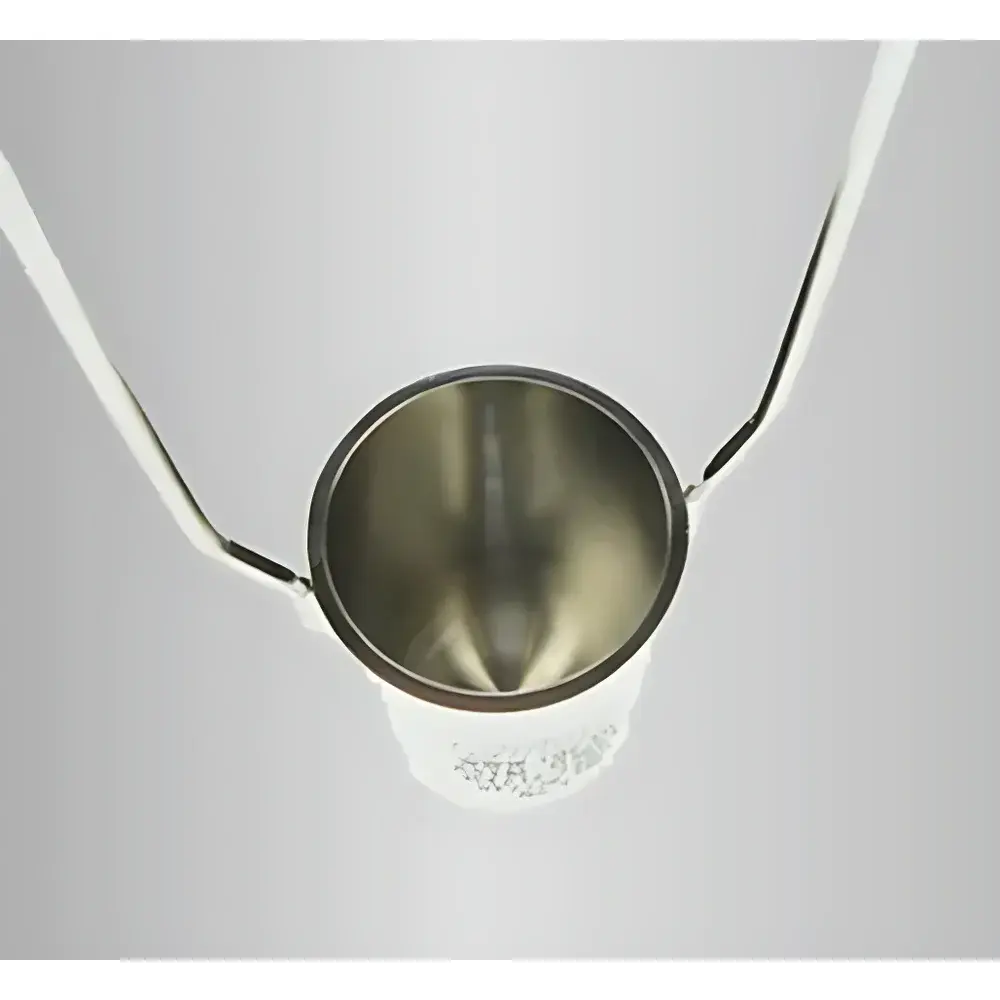
TQC Sheen Efflux Cup
| Brand | TQC |
|---|---|
| Origin | Netherlands |
| Manufacturer Type | Authorized Distributor |
| Origin Category | Imported |
| Model | Sheen Efflux Cup |
| Pricing | Upon Request |
Overview
The TQC Sheen Efflux Cup is a precision-engineered gravimetric viscometer designed for rapid, field- and workshop-compatible determination of kinematic viscosity in Newtonian and near-Newtonian liquids. Operating on the principle of efflux time measurement—where the time required for a fixed volume of liquid to drain through a standardized orifice under gravity—is directly correlated to its kinematic viscosity (ν, in mm²/s or cSt). This method conforms to established empirical calibration protocols defined in ASTM D1084 (Standard Test Method for Viscosity of Adhesives by Efflux Viscometer) and ASTM D4212 (Standard Test Method for Viscosity of Paints, Varnishes, Lacquers, and Related Products by Dip-Type Viscometer), enabling traceable, repeatable assessments without requiring powered instrumentation or complex fluid handling systems.
Key Features
- Single-piece stainless steel construction with precisely machined orifice and smooth internal bore—eliminating crevices, seams, or recessed zones that trap residue and compromise measurement repeatability.
- Ergonomic extended handle with integrated suspension ring—ensures stable vertical withdrawal from test fluid and minimizes operator-induced tilt or acceleration artifacts during efflux initiation.
- Individually laser-engraved serial number—supporting instrument traceability, calibration history tracking, and compliance with ISO/IEC 17025 and GLP documentation requirements.
- Rigorous in-process quality control per DIN 55350 Part 19—each unit undergoes dimensional verification of orifice diameter, cup volume, and wall thickness tolerance before release.
- Supplied in protective rigid polymer case lined with anti-static foam—preventing mechanical damage and surface abrasion during transport and storage.
Sample Compatibility & Compliance
The Sheen Efflux Cup is validated for use with low-to-medium viscosity coatings, inks, resins, thin oils, and solvent-based formulations exhibiting minimal thixotropy or yield stress (i.e., apparent viscosity changes <5% over 30 s at shear rates typical of efflux flow). It is not suitable for non-Newtonian fluids with pronounced shear-thinning, viscoelasticity, or particle-laden suspensions where sedimentation or channeling may occur. Compliance extends to ASTM D1084 (adhesives), ASTM D4212 (liquid coatings), and ISO 2431 (paints and varnishes), with optional M-class calibration certificate (VF2231) issued per DIN 55350—providing metrological traceability to national standards laboratories.
Software & Data Management
As a manual gravimetric device, the Sheen Efflux Cup does not integrate with digital software platforms. However, its operational protocol supports full auditability under regulated environments: efflux time recordings are manually entered into laboratory notebooks or LIMS systems; temperature data (±0.2 °C at 25 °C per ASTM requirements) must be documented contemporaneously; and calibration certificates (VF2231) include uncertainty budgets and reference standard identifiers. When paired with the DI0076 LCD stopwatch (9h 59m 59.99s resolution, ±0.01 s accuracy), timing data meets FDA 21 CFR Part 11 “electronic record” criteria when logged with user ID, timestamp, and instrument ID—provided the stopwatch firmware supports secure audit trail generation.
Applications
- Quality control of incoming raw materials (e.g., solvents, monomers, diluents) prior to batch formulation.
- In-process viscosity monitoring during coating, ink, or adhesive manufacturing—enabling real-time adjustment of solvent ratios or resin solids content.
- Field verification of product consistency across production shifts or supplier lots—without reliance on AC power or environmental conditioning.
- Pre-screening tool prior to high-precision rotational viscometry (e.g., Brookfield or Haake measurements) to select appropriate spindle/speed combinations.
- Educational demonstrations of Newtonian fluid behavior, capillary flow, and empirical viscosity correlation principles in polymer science and materials engineering curricula.
FAQ
What is the recommended cleaning procedure between measurements?
Rinse immediately after use with a compatible solvent (e.g., acetone for acrylic systems, xylene for alkyds), then dry with lint-free tissue. Inspect the orifice under magnification; clean with a calibrated orifice cleaning wire (not abrasive tools) only if visible blockage persists.
Can the efflux cup be used above or below 25 °C?
No—ASTM D4212 mandates testing at 25 °C ±0.2 °C. Viscosity–temperature dependence is nonlinear; uncorrected deviations invalidate kinematic viscosity conversion and compromise inter-laboratory reproducibility.
How often should calibration verification be performed?
Perform daily verification using a certified reference fluid (e.g., silicone oil with known cSt at 25 °C); full recalibration with VF2231 certificate is recommended annually or after mechanical impact.
Why is orifice geometry critical for ASTM compliance?
Orifice diameter directly governs flow regime (laminar vs. transitional), discharge coefficient, and meniscus correction factor—deviations >±1% from nominal dimension invalidate conformance to ASTM D4212 Annex A1 tolerances.
Is the efflux time directly equivalent to kinematic viscosity?
No—it is an empirical proxy. Conversion to cSt requires application-specific calibration curves or standardized conversion charts (e.g., TQC viscosity conversion ruler VF2053), derived from reference fluids measured under identical thermal and procedural conditions.



