
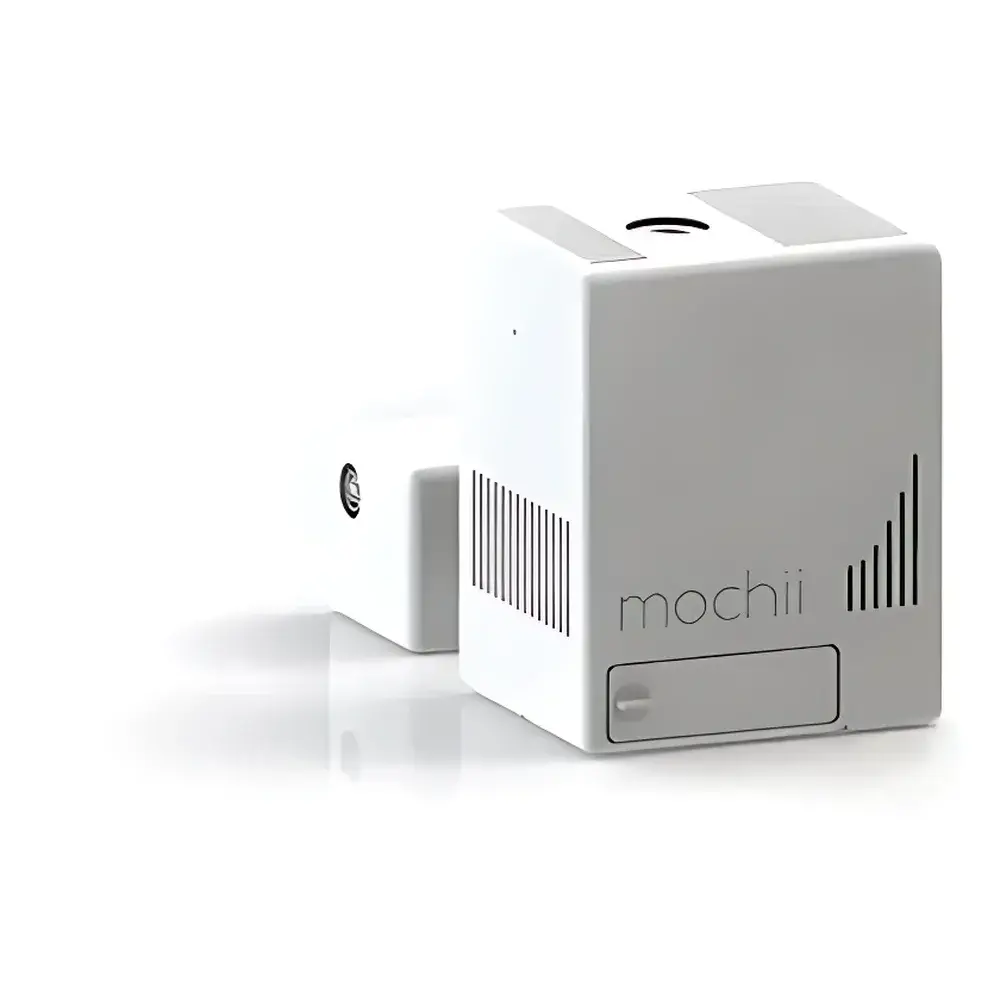
Auniontech Mochii™ S Portable Scanning Electron Microscope
| Brand | Auniontech |
|---|---|
| Origin | Shanghai, China |
| Model | Mochii™ S |
| Instrument Type | Benchtop SEM |
| Max. Magnification | 5,000× |
| Max. Sample Dimensions | 20 × 20 × 20 mm |
| Detector | Quadrant Backscatter Electron (BSE) Array |
| Accelerating Voltage | 10 kV |
| Stage | Two-Axis Automated |
| Interface | Apple iOS Device (iOS 10+) |
| System Dimensions | 210 × 210 × 265 mm |
| Power Supply | 110–240 VAC, 50–60 Hz |
| Total Weight | <13 kg |
| Integrated EDS | Yes (Compact Energy-Dispersive X-ray Spectrometer) |
Overview
The Auniontech Mochii™ S Portable Scanning Electron Microscope is a compact, benchtop-grade electron optical platform engineered for rapid nanoscale imaging and elemental characterization in non-traditional laboratory environments. Unlike conventional high-vacuum SEMs requiring dedicated rooms and vibration-isolated foundations, the Mochii™ S employs a sealed, differential-pumped electron column with a field-emission-inspired electron source operating at a fixed 10 kV accelerating potential. Its scanning mechanism leverages electrostatic beam deflection and real-time stigmator correction, enabling stable imaging without mechanical scan coils. The system is designed for secondary electron (SE) and backscattered electron (BSE) detection using a quadrant BSE array detector—providing simultaneous topographic and atomic-number contrast with auto-calibrated gain and offset compensation. Integration of a compact, silicon-drift detector (SDD)-based energy-dispersive X-ray spectrometer (EDS) allows qualitative and semi-quantitative elemental mapping without external cryogenic cooling or vacuum transfer locks.
Key Features
- Benchtop form factor with total system weight under 13 kg—enabling transport between labs, cleanrooms, production floors, or field sites without disassembly.
- Wireless iOS-native control interface compatible with iPad and iPhone (iOS 10+), eliminating proprietary hardware controllers and enabling intuitive touch-based navigation, real-time image annotation, and remote session sharing.
- Pre-aligned, maintenance-free electron column with factory-optimized gun alignment and automated astigmatism correction—no user tuning required for routine operation.
- Two-axis motorized stage (X/Y) with sub-micron repeatability and software-defined coordinate referencing—supporting multi-region stitching and positional recall for longitudinal sample tracking.
- Integrated EDS module with real-time spectrum acquisition, peak identification (using standardless ZAF deconvolution), and overlay mapping synchronized to SEM frame capture.
- Self-contained vacuum architecture featuring dual-stage pumping (rotary vane + ion pump) achieving base pressure <5 × 10⁻⁵ Pa within 90 seconds—no external roughing pump or liquid nitrogen required.
Sample Compatibility & Compliance
The Mochii™ S accommodates conductive and non-conductive samples up to 20 mm × 20 mm × 20 mm in volume. Standard operation supports uncoated insulators via low-voltage imaging (10 kV) and charge-compensation algorithms embedded in the acquisition firmware. Optional carbon or gold sputter coating can be applied externally for enhanced signal-to-noise ratio in high-resolution SE mode. The system complies with IEC 61000-6-3 (EMC emission standards) and IEC 61010-1 (safety requirements for electrical equipment for measurement). Data integrity workflows align with GLP and GMP documentation principles: all images and spectra are timestamped, user-authenticated, and stored with full metadata (kV, dwell time, working distance, detector gain, stage coordinates). Audit trails are exportable in CSV/JSON format for regulatory review.
Software & Data Management
The native Mochii™ Control Suite runs exclusively on iOS devices and provides full instrument control, live imaging, EDS spectral analysis, and report generation. All acquired data—including raw TIFF stacks, calibrated spectra (.eds), and annotated PDF reports—are saved locally on the device and synchronizable via iCloud or enterprise MDM platforms. Export options include ASTM E1351-compliant spectral files, ISO 16700-structured image metadata, and USP traceable calibration logs. No cloud processing occurs by default; data residency remains under user control. For integration into LIMS or ELN ecosystems, RESTful API endpoints support programmatic access to acquisition parameters, image thumbnails, and elemental quantification results.
Applications
- Failure analysis of microelectronics packaging and solder joints in semiconductor manufacturing QA labs.
- In-field particle morphology and composition assessment for pharmaceutical excipient characterization (e.g., crystallinity, agglomeration, contamination screening).
- Teaching and demonstration of electron-specimen interactions in undergraduate materials science curricula—without facility retrofitting.
- Rapid forensic examination of toolmarks, gunshot residue, or fiber evidence in crime lab satellite units.
- On-site evaluation of corrosion products, coating delamination, or additive manufacturing defects during aerospace component acceptance testing.
FAQ
Does the Mochii™ S require high-vacuum infrastructure or external pumps?
No. It incorporates an integrated dual-stage vacuum system with no external roughing pump or liquid nitrogen dependency.
Can non-conductive samples be imaged without metallization?
Yes. Charge mitigation is achieved through optimized 10 kV beam energy, dwell time control, and real-time pixel-level signal normalization.
Is EDS quantification compliant with ISO 14705 or ASTM E1508?
The system supports standardless quantification per ISO 14705 Annex A and offers optional certified reference material calibration kits traceable to NIST SRMs.
What is the minimum detectable element for EDS analysis?
With the integrated SDD, elements from boron (Z=5) upward are detectable at ≥0.1 wt% concentration under optimal geometry and counting statistics.
How is software updated and validated for regulated use?
Firmware and application updates undergo internal IQ/OQ protocols; version-controlled release notes and change logs are provided with each deployment for 21 CFR Part 11 readiness.





