
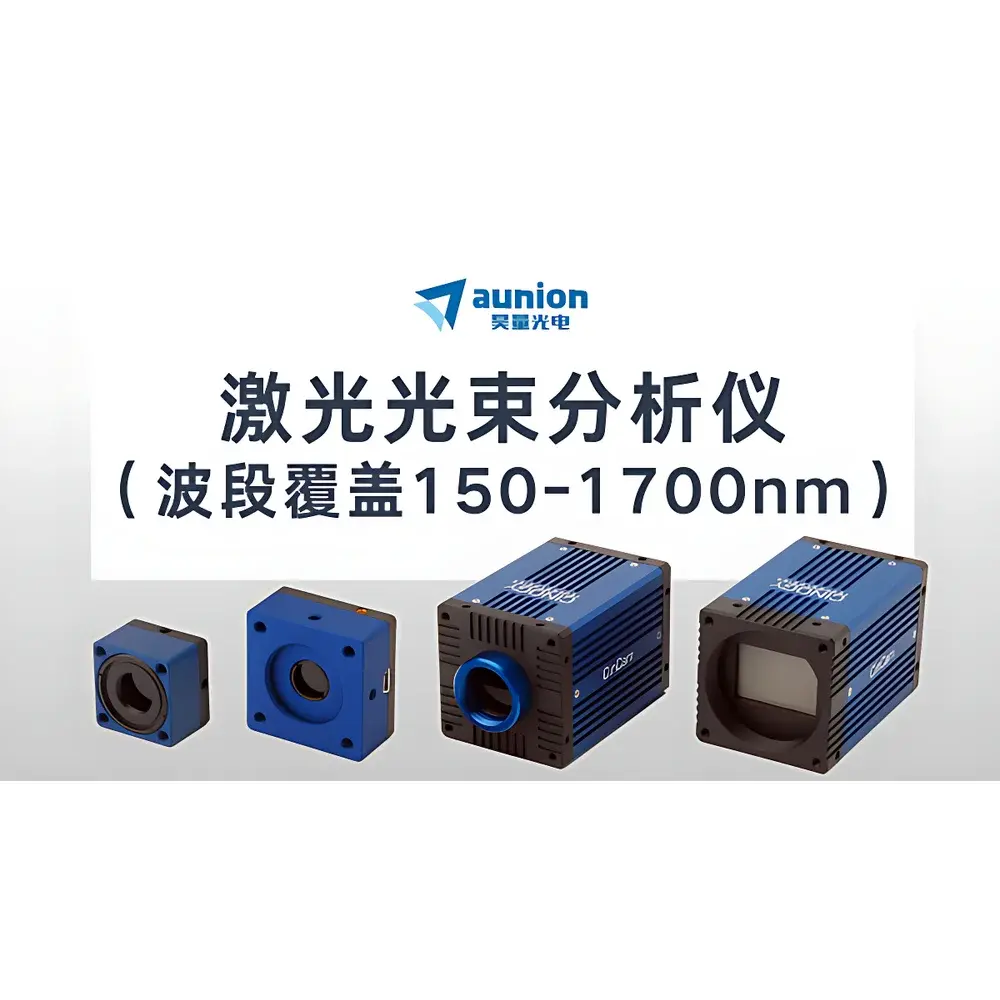
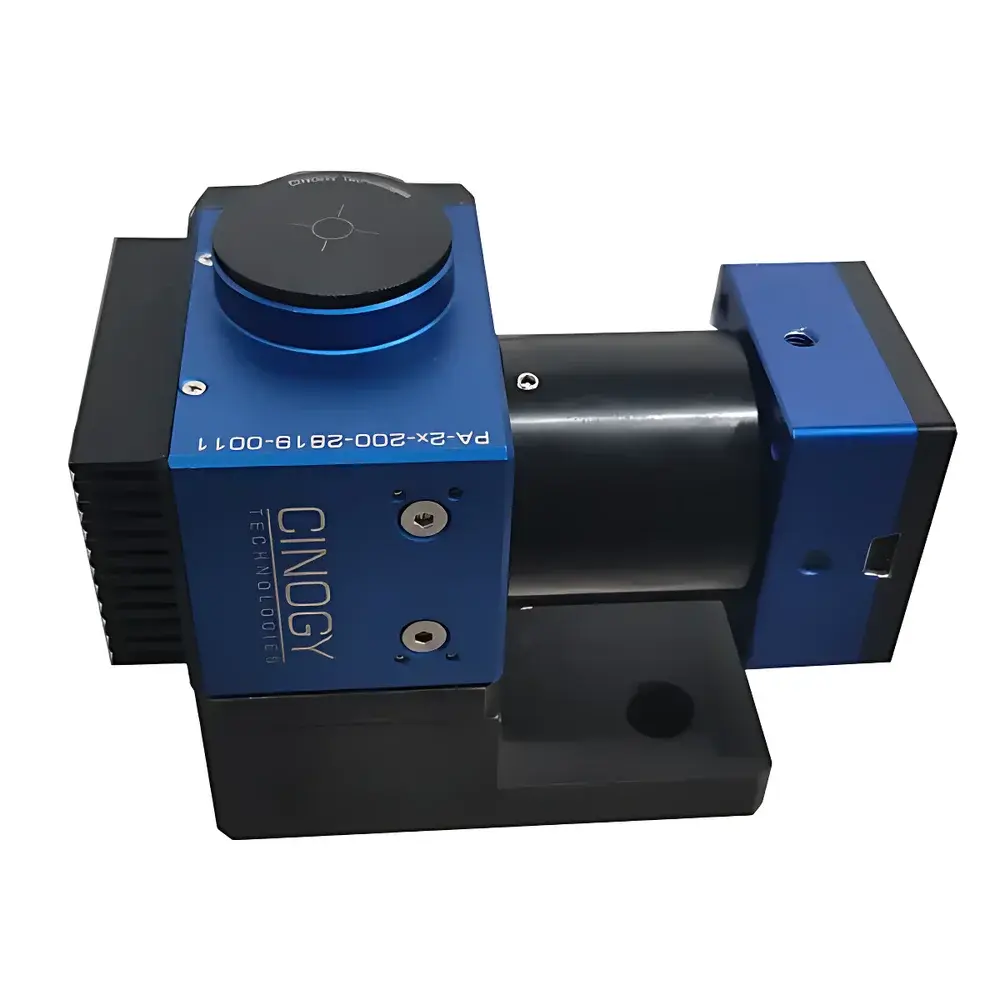
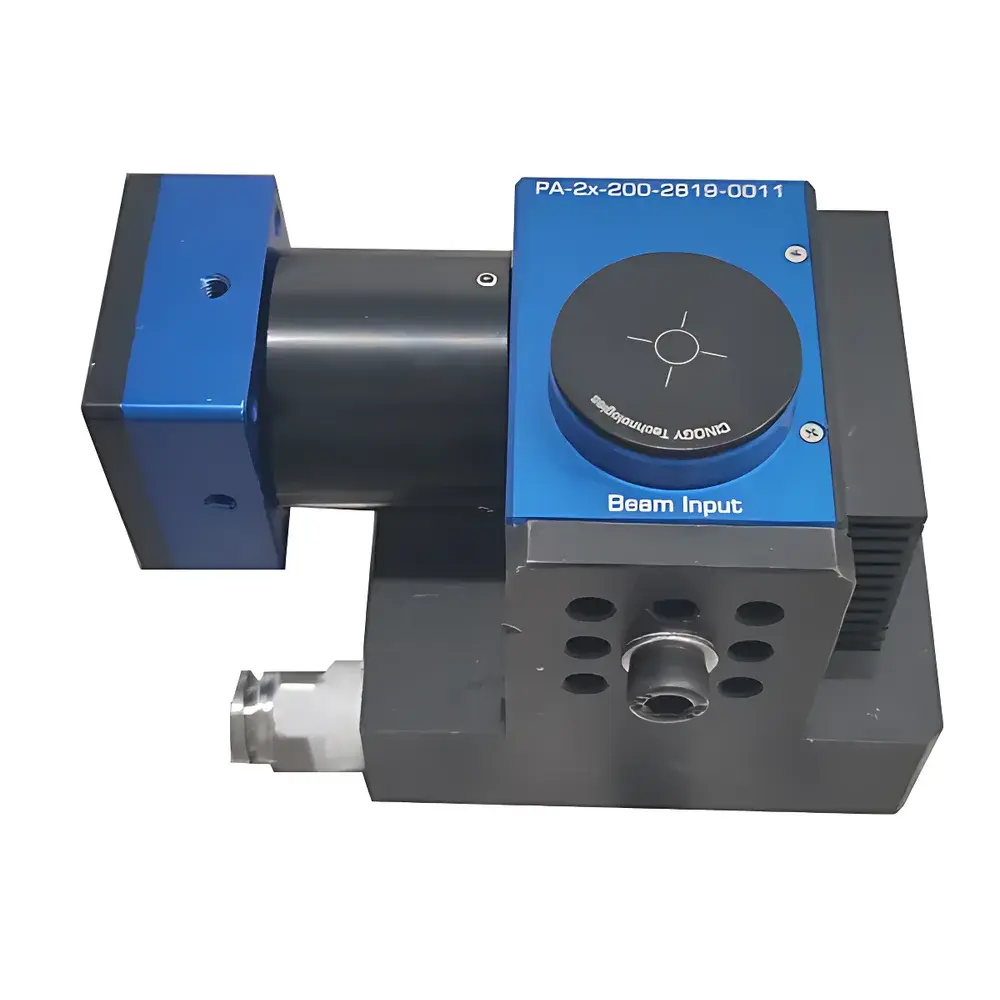
Cinogy CinSpot AUT-1204 Focused Laser Beam Profiler
| Brand | Cinogy |
|---|---|
| Origin | Germany |
| Model | CinSpot AUT-1204 |
| Wavelength Range | 320–1150 nm |
| Minimum Measurable Focus Spot Size | 22 µm |
| Power Handling | Air-Cooled ≤ 5 W, Water-Cooled ≤ 100 W or 200 W (configurable) |
| Energy Density Limits | CW ≤ 100 MW/cm², Pulsed ≤ 2 GW/cm² |
| Focus Position Accuracy | ±100 µm |
| Spot Size Measurement Accuracy | ±3–5% (typical) |
| Interface | USB 3.0 |
| Software | RayCi-Pro |
| Compliance | CE, RoHS |
Overview
The Cinogy CinSpot AUT-1204 Focused Laser Beam Profiler is a compact, high-precision instrument engineered for quantitative characterization of tightly focused laser beams in industrial and R&D environments. Operating on the principle of direct imaging via high-resolution CMOS sensor technology (CinCam series), the system captures beam intensity distributions at the focal plane with sub-micron spatial sampling capability. Designed specifically for post-focusing measurement—rather than collimated or near-field analysis—the AUT-1204 enables rigorous evaluation of critical beam quality parameters including focal spot size (diameter at 1/e² intensity), focal position (axial and lateral), M² factor, Rayleigh length, and total power/energy density. Its spectral response spans 320–1150 nm, covering UV, visible, and NIR wavelengths commonly used in additive manufacturing, microfabrication, and semiconductor processing. Unlike scanning-slit or knife-edge profilers, the AUT-1204 delivers full 2D intensity maps in real time, supporting both continuous-wave (CW) and pulsed laser sources under defined energy density limits.
Key Features
- Compact, modular architecture integrating a high-sensitivity CinCam CMOS camera, precision PA-type attenuator, and thermally optimized cooling subsystem (air- or water-cooled variants)
- Dual thermal management options: air-cooled configuration rated for ≤5 W average power; water-cooled version supports up to 100 W (standard) or 200 W (optional) average power handling
- Minimum resolvable focused spot size of 22 µm — validated across wavelength range with calibrated pixel pitch and optical magnification
- USB 3.0 interface ensures low-latency data transfer and plug-and-play operation without external frame grabbers or proprietary controllers
- RayCi-Pro software provides ISO 11146-compliant beam parameter calculation, including second-moment (D4σ) and knife-edge equivalent diameters, centroid tracking, and dynamic focus shift analysis
- Robust mechanical housing with standardized kinematic mounts (e.g., SM1-threaded ports) facilitates integration into optical tables, laser workstations, and OEM production lines
Sample Compatibility & Compliance
The CinSpot AUT-1204 is compatible with Gaussian, multimode, top-hat, and structured laser beams delivered through standard focusing optics (e.g., f-theta lenses, microscope objectives, or parabolic mirrors). It complies with IEC 60825-1:2014 (laser safety) and EN 61326-1:2013 (EMC for laboratory equipment). All hardware and firmware meet CE marking requirements and RoHS 2011/65/EU directives. The RayCi-Pro software supports audit-trail logging and user-access control, enabling alignment with GLP and basic GMP documentation practices. While not FDA 21 CFR Part 11 certified out-of-the-box, the software architecture permits traceable data export (CSV, TIFF, HDF5) and timestamped metadata capture required for internal quality systems in regulated manufacturing.
Software & Data Management
RayCi-Pro is a Windows-based application developed by Cinogy for comprehensive beam diagnostics. It offers real-time visualization of horizontal/vertical beam cuts, 2D/3D intensity heatmaps, and temporal averaging over user-defined frame counts. Key computational modules include ISO 11146-1/2 compliant M² calculation using variable propagation distance analysis, depth-of-focus profiling, and automatic detection of ellipticity, astigmatism, and beam walk-off. Data export supports industry-standard formats for downstream statistical process control (SPC) and integration with MATLAB, Python (via provided SDK), or LabVIEW. Raw image buffers are stored with embedded calibration metadata (pixel size, magnification, wavelength), ensuring metrological traceability per ISO/IEC 17025 guidelines when used with accredited calibration services.
Applications
- Metal powder bed fusion (PBF) additive manufacturing: in-process verification of focal spot geometry, positional stability, and power density distribution across build platforms
- Laser welding and cutting: optimization of focal offset, beam symmetry, and mode structure to minimize spatter, improve seam consistency, and extend nozzle lifetime
- OLED and display panel micromachining: precise alignment of focused UV beams for scribing, patterning, and edge deletion with <50 µm positional repeatability
- Semiconductor wafer processing: monitoring of ablation thresholds and heat-affected zone (HAZ) control during laser annealing or surface texturing
- R&D labs validating novel focusing optics (e.g., axicons, Bessel generators, multi-core fibers) where M² and focal volume quantification are essential
FAQ
What is the smallest measurable focused spot size, and how is it verified?
The system resolves spots down to 22 µm (1/e² diameter) under optimal illumination and alignment conditions. Verification is performed using NIST-traceable pinhole targets and calibrated stage translation, following ISO 13694 procedures.
Can the AUT-1204 measure ultrafast pulsed lasers?
Yes — provided pulse energy density remains below 2 GW/cm² (peak) and repetition rate allows adequate frame synchronization. Single-shot profiling is supported via external trigger input.
Is RayCi-Pro compatible with Windows 11 and 64-bit systems?
Yes — RayCi-Pro v4.2+ is fully compatible with Windows 10/11 (64-bit), requiring .NET Framework 4.8 and DirectX 12.
Does the system support automated calibration routines?
It includes built-in flat-field correction, background subtraction, and pixel-response non-uniformity compensation. Full radiometric calibration requires optional NIST-traceable reference sources.
How is thermal drift managed during extended measurements?
The water-cooled variant maintains sensor temperature within ±0.5 °C over 8-hour runs; air-cooled units incorporate active fan speed modulation and thermal shielding to limit drift to <2% intensity variation per hour.






