
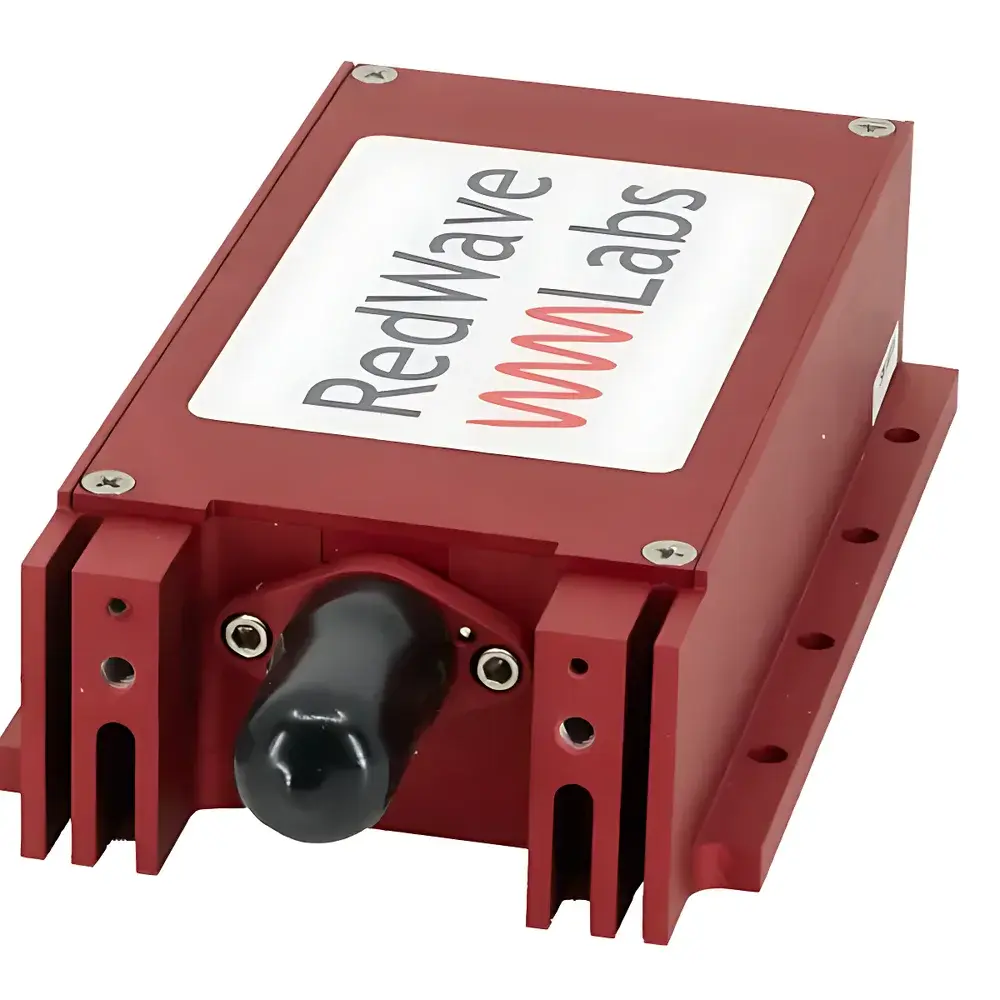
Auniontech AD200 Visible-Wavelength Single-Photon Avalanche Diode (SPAD) Detector Module
| Brand | Auniontech |
|---|---|
| Origin | Shanghai, China |
| Model | AD200 |
| Wavelength Range | 400–1100 nm |
| Peak Detection Efficiency | 70% @ 650 nm, 55% @ 800 nm |
| Dark Count Rate | 25 cps @ −20 °C (typ.) |
| Dead Time | 40 ns |
| Output Pulse Width | 20 ns |
| Active Area | 500 µm diameter |
| Breakdown Voltage | 125 V @ 25 °C |
| Operating Voltage | +12 V |
| Temperature Control | Digital PID with Active Quenching |
| Interface | SMB (output & time-gating), USB Type-B (data & control) |
| Dimensions (W×H×D) | 120 × 92 × 30 mm |
| Weight | 350 g |
| Storage Temperature | −20 to +85 °C |
Overview
The Auniontech AD200 is a compact, OEM-ready single-photon avalanche diode (SPAD) detector module engineered for high-fidelity time-resolved photon counting in the visible to near-infrared spectrum. Built around a passivated silicon APD operating in Geiger mode, the AD200 delivers deterministic photon detection with sub-40 ns dead time and integrated digital temperature stabilization—enabling stable operation across ambient fluctuations without external chillers. Its 500 µm active area balances collection efficiency and timing resolution, while the proprietary active quenching circuit ensures rapid recovery and low afterpulsing probability. Unlike analog photomultiplier tubes or hybrid photodetectors, the AD200 implements fully digital signal conditioning: each detected photon triggers a standardized TTL-compatible 20 ns pulse at the SMB output, synchronized with an internal 100 MHz timebase. This architecture eliminates analog gain drift and supports direct integration into FPGA-based time-correlated single-photon counting (TCSPC) systems, pulsed laser ranging platforms, and quantum optics testbeds requiring deterministic event timestamps.
Key Features
- High quantum efficiency: 70% peak at 650 nm; >55% up to 800 nm—optimized for common visible lasers (e.g., 405 nm, 488 nm, 635 nm, 785 nm)
- Digital temperature regulation with real-time feedback loop—maintains breakdown voltage stability within ±0.2 V over −20 °C to +40 °C ambient range
- Integrated counter and USB Type-B interface enabling standalone operation and real-time data streaming without external DAQ hardware
- Programmable time-gating via SMB input: enables background suppression in fluorescence lifetime imaging (FLIM) or gated Raman spectroscopy
- Rugged mechanical design: aluminum housing with thermal mass buffering; RoHS-compliant PCB layout and conformal coating for lab and field deployment
- Low intrinsic jitter (<150 ps FWHM) and minimal timing walk—validated per IEEE 1851-2014 TCSPC metrology guidelines
Sample Compatibility & Compliance
The AD200 is compatible with standard optical coupling configurations—including fiber-pigtailed (FC/PC, SMA905), free-space collimated, and lens-coupled illumination geometries. Its spectral response (400–1100 nm) aligns with ISO 11146 (laser beam diagnostics), ASTM E275 (spectrophotometer validation), and IEC 61228 (UV/VIS/NIR detector calibration protocols). The module complies with CE marking requirements for electromagnetic compatibility (EN 61326-1) and safety (EN 61010-1). Firmware supports audit-trail logging and user-defined calibration coefficients—facilitating GLP/GMP-aligned instrument qualification under FDA 21 CFR Part 11 when deployed in regulated QC environments (e.g., pharmaceutical particle sizing via dynamic light scattering with photon-counting detection).
Software & Data Management
Auniontech provides a cross-platform SDK (Windows/Linux/macOS) with C/C++, Python (PyAD200), and LabVIEW drivers. The native GUI enables real-time histogramming, dark count monitoring, gate delay sweeps, and export of timestamped .phd (PTU) or ASCII-compatible event lists. All configuration parameters—including temperature setpoint (−30 °C to +10 °C), count threshold, and gate width—are stored in non-volatile memory with write-protection options. Data streams support NIST-traceable time-stamping via PTPv2 synchronization when used with compatible network interfaces—critical for multi-detector coincidence measurements in quantum entanglement verification or LIDAR point-cloud registration.
Applications
- Time-resolved fluorescence spectroscopy and FLIM—particularly for dye-labeled nanoparticles and quantum dot suspensions
- Dynamic light scattering (DLS) systems requiring photon-counting sensitivity below 10⁴ cps for sub-10 nm particle sizing
- Quantum key distribution (QKD) receiver modules operating at 650–800 nm wavelengths
- Pulsed LIDAR for micro-particulate monitoring in environmental aerosol chambers
- Single-molecule detection in microfluidic cytometry and nanopore translocation assays
- Calibration reference for radiometric transfer standards in national metrology institutes
FAQ
What is the recommended optical coupling method for maximum quantum efficiency?
Free-space coupling using AR-coated aspheric lenses (f = 12 mm, NA 0.5) achieves >92% coupling efficiency for collimated beams; fiber coupling requires FC/PC patch cables with ≤0.1 dB insertion loss.
Does the AD200 support external clock synchronization?
Yes—the SMB time-gate input accepts TTL-level trigger signals up to 50 MHz; internal clock phase-locking is configurable via USB command set.
Can multiple AD200 units be operated simultaneously on one host PC?
Up to eight units are supported via USB hub with individual device enumeration; each maintains independent temperature and gating settings.
Is firmware upgrade capability available in the field?
Yes—USB-based firmware updates preserve user calibration tables and require no hardware rework.
What documentation is provided for regulatory compliance validation?
A full IQ/OQ protocol package—including traceable calibration certificates, electrical safety reports, and EMV test summaries—is supplied upon request for GxP environments.



