
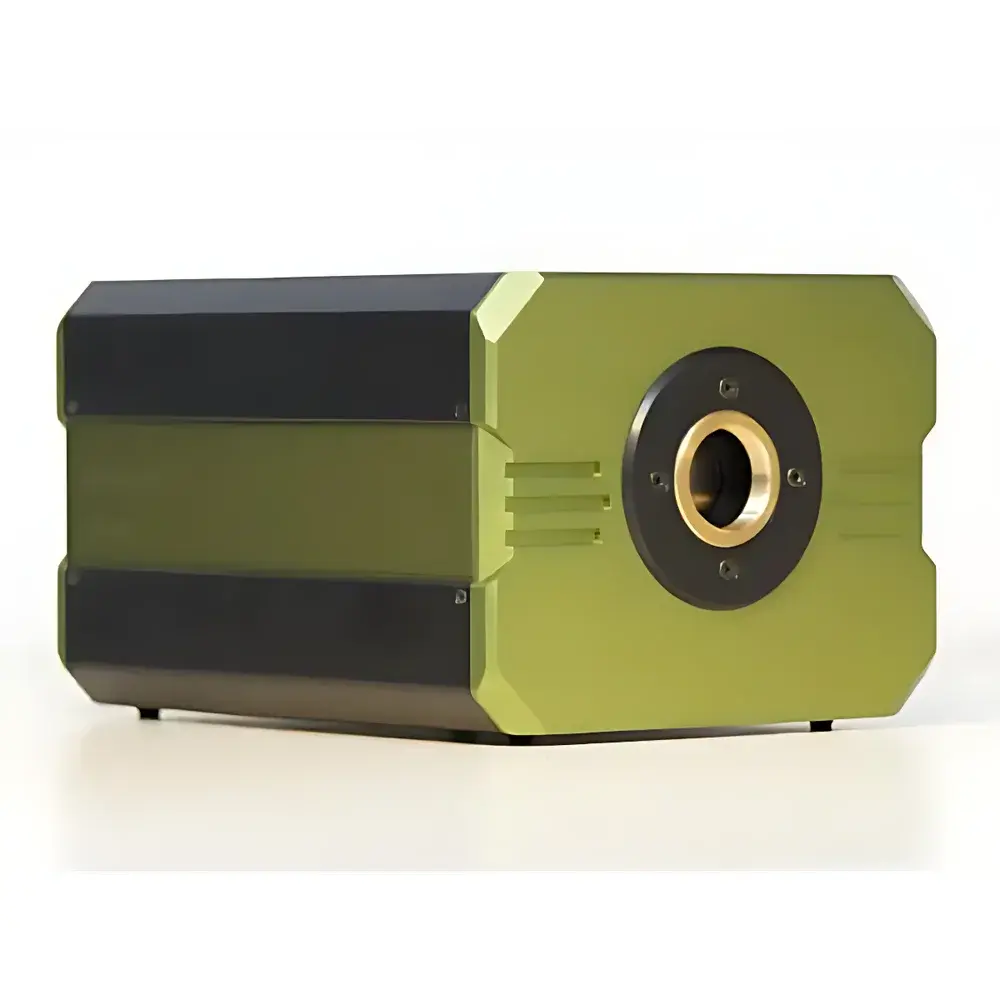
Auniontech TRiCAM Time-Resolved Intensified CMOS Camera
| Brand | Auniontech |
|---|---|
| Origin | Shanghai, China |
| Manufacturer Type | Authorized Distributor |
| Product Category | Domestic |
| Model | TRiCAM Series (G / M / GM) |
| Pixel Format | 1920 × 1200 |
| Readout Noise | 14 e⁻ |
| Integration Time Range | 5 µs – 3.2 s |
| Dynamic Range | 72 dB |
| Max Frame Rate | 162 fps (10-bit) / 128 fps (12-bit) |
| Pixel Size | 5.86 µm square |
| Digitization | 10-bit or 12-bit selectable |
| Trigger Interface | LVTTL input/output |
| Lens Mount | C-mount (F-mount optional) |
| Image Intensifier | Single-stage MCP Gen II or Gen III (filmless), 18 mm input diameter |
| Photon Gain (max) | 30,000–50,000 (photon/e⁻), dependent on phosphor |
| Equivalent Background Input | 0.006–0.024 photo-e⁻/pix/s |
| Spatial Resolution (bare intensifier) | up to 69 lp/mm (Gen II) |
| Phosphor Options | P20, P24, P43, P46 (TRiCAM G) |
| Gate Width (TRiCAM G) | <3 ns FWHM |
| Modulation Frequency (TRiCAM M) | up to 120 MHz (DDS-based, low phase noise) |
| Fiber Coupling | Tapered fiber optic (1.33:1) |
Overview
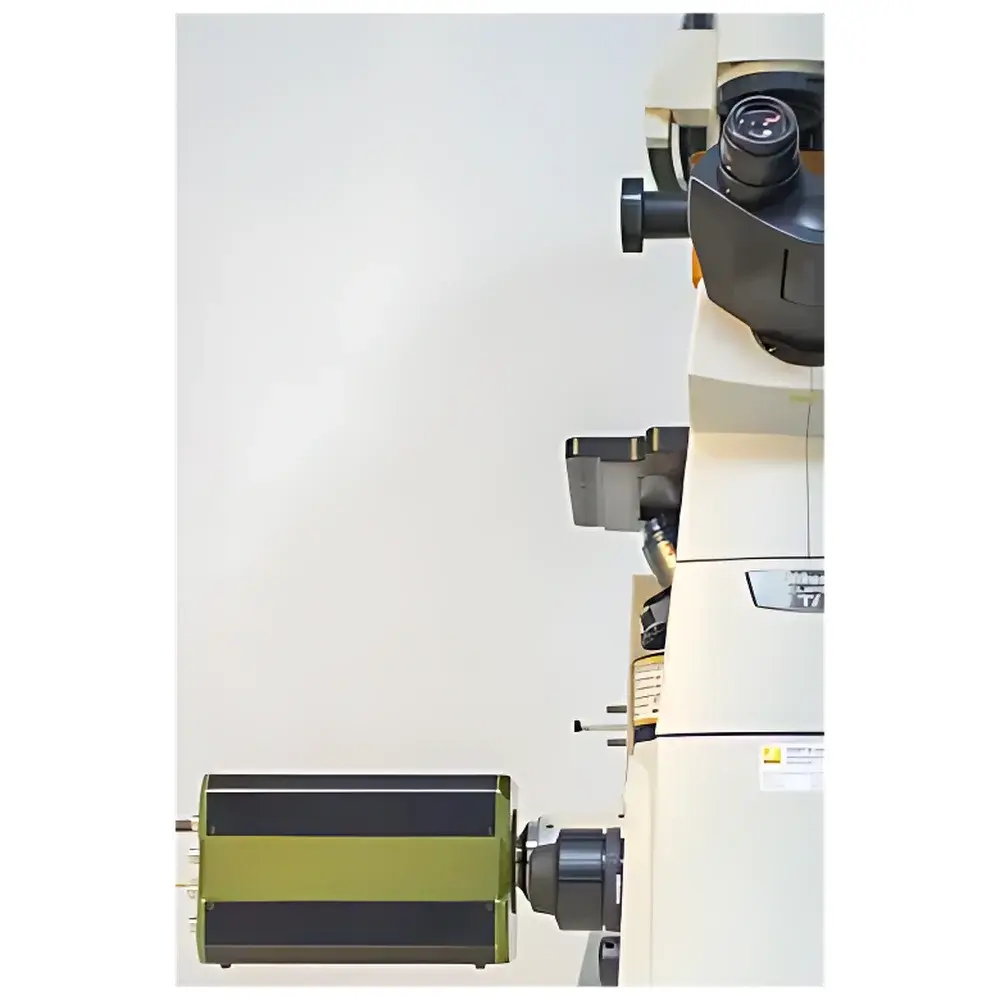
The Auniontech TRiCAM is a time-resolved intensified CMOS camera engineered for ultra-low-light, high-temporal-resolution imaging in scientific and industrial applications. It integrates a microchannel plate (MCP) image intensifier—either Gen II or filmless Gen III—with a high-speed, global-shutter CMOS sensor via a tapered fiber-optic coupler. This architecture enables photon amplification at the analog stage prior to digitization, delivering single-photon sensitivity while preserving spatial fidelity and temporal precision. The core operating principle relies on photocathode-to-electron conversion, electron multiplication within the MCP, and subsequent phosphor-based re-emission onto the CMOS sensor. As an electro-optical shutter, the intensifier supports sub-nanosecond gating (TRiCAM G) or high-frequency gain modulation (TRiCAM M), making it suitable for time-domain fluorescence lifetime imaging (FLIM), frequency-domain FLIM, laser-induced fluorescence (LIF), and time-gated ballistic imaging. Its compact, modular design allows seamless integration into inverted or confocal microscopes, spectrographs, and optical tomography platforms.
Key Features
- Sub-3 ns optical gate width (FWHM) with minimal timing jitter—enabling motion-free imaging of ultrafast phenomena
- Dual operational modes: time-gated (TRiCAM G) and gain-modulated (TRiCAM M), with hybrid TRiCAM GM supporting both simultaneously
- Integrated digital timing engine (TRiCAM G): programmable gate width, delay, repetition rate, and gain; two synchronized TTL outputs for external laser/LED triggering
- Onboard direct digital synthesizer (TRiCAM M): 120 MHz modulation capability with ultra-low phase noise—critical for high-fidelity frequency-domain FLIM
- Global-shutter 1920 × 1200 CMOS sensor with 5.86 µm pixels, 10-/12-bit digitization, and 72 dB dynamic range
- Tapered fiber-optic coupling (1.33:1) ensures >90% quantum-limited transmission efficiency between intensifier and sensor
- Configurable phosphor options (P43, P46, S20, GaAsP, etc.) and photocathode materials to optimize spectral response from UV to NIR (185–900 nm)
- LICapture software suite: full hardware control, ROI selection, real-time histogram analysis, and timestamped frame logging
- Software Development Kit (SDK) compliant with Windows/Linux; supports integration into LabVIEW, MATLAB, Python (PyTorch/TensorFlow pipelines), and custom acquisition frameworks
Sample Compatibility & Compliance
The TRiCAM is compatible with standard C-mount optical interfaces (F-mount adapters available upon request), facilitating drop-in replacement in existing microscope, endoscope, or spectrometer configurations. Its intensifier variants meet ISO 11341:2019 requirements for image intensifier performance characterization—including resolution, gain uniformity, and background-limited detection. For regulated environments, the camera’s firmware supports audit-trail-enabled acquisition logs and metadata stamping (timestamp, exposure, gate parameters, gain settings), aligning with GLP/GMP documentation workflows. While not FDA-cleared as a medical device, TRiCAM-derived data complies with ASTM E2717-20 standards for fluorescence lifetime measurement uncertainty estimation and supports validation per USP for analytical instrument qualification.
Software & Data Management
LICapture provides intuitive, parameter-driven control of all hardware functions—including gate timing, modulation waveform synthesis, pixel binning, and bit-depth selection. Acquired datasets are saved in vendor-neutral HDF5 or TIFF formats with embedded EXIF-style metadata (exposure, gain, phosphor type, intensifier voltage). Time-stamped frame sequences support post-acquisition alignment with external event markers (e.g., laser pulses, electrophysiology triggers). The SDK exposes low-level register access for deterministic synchronization in multi-camera or pump-probe setups. All software components comply with IEEE 1588-2019 Precision Time Protocol (PTP) for sub-microsecond inter-device timing alignment—essential for distributed FLIM or optical tomography arrays.
Applications
- Fluorescence Lifetime Imaging Microscopy (FLIM): Quantitative mapping of molecular interactions (e.g., FRET efficiency, protein conformational states) in live-cell assays
- Laser-Induced Fluorescence (LIF): Species-selective combustion diagnostics, plasma monitoring, and LIBS signal gating
- Diffuse Optical Tomography (DOT): Time-of-flight photon arrival distribution analysis for deep-tissue functional imaging
- Time-Gated Raman Spectroscopy: Suppression of fluorescence background in pharmaceutical crystallinity studies
- Ballistic and Snake-Light Imaging: Sub-ns gating to isolate unscattered photons in highly scattering media (e.g., biological tissue, fog, turbid liquids)
- Ultrafast Photodynamics: Tracking carrier recombination in perovskite solar cells or exciton diffusion in 2D materials
FAQ
What is the minimum achievable gate width in TRiCAM G mode?
The TRiCAM G achieves optical gate widths down to <3 ns FWHM, with timing jitter below 100 ps RMS.
Can TRiCAM M perform heterodyne detection?
Yes—its DDS-based 120 MHz modulation supports harmonic mixing and phase-sensitive demodulation for lock-in detection in frequency-domain FLIM.
Is fiber-optic coupling permanent or user-replaceable?
The tapered fiber-optic interface is factory-aligned and sealed; replacement requires recalibration and is performed only by authorized service centers.
Does TRiCAM support hardware-triggered burst acquisition?
Yes—external LVTTL trigger input enables externally synchronized burst capture at full frame rate, with programmable pre- and post-trigger frame buffering.
How is photon gain calibrated across intensifier types?
Gain calibration is performed using NIST-traceable photodiode reference measurements under controlled illumination; calibration files are loaded per intensifier module in LICapture.




