
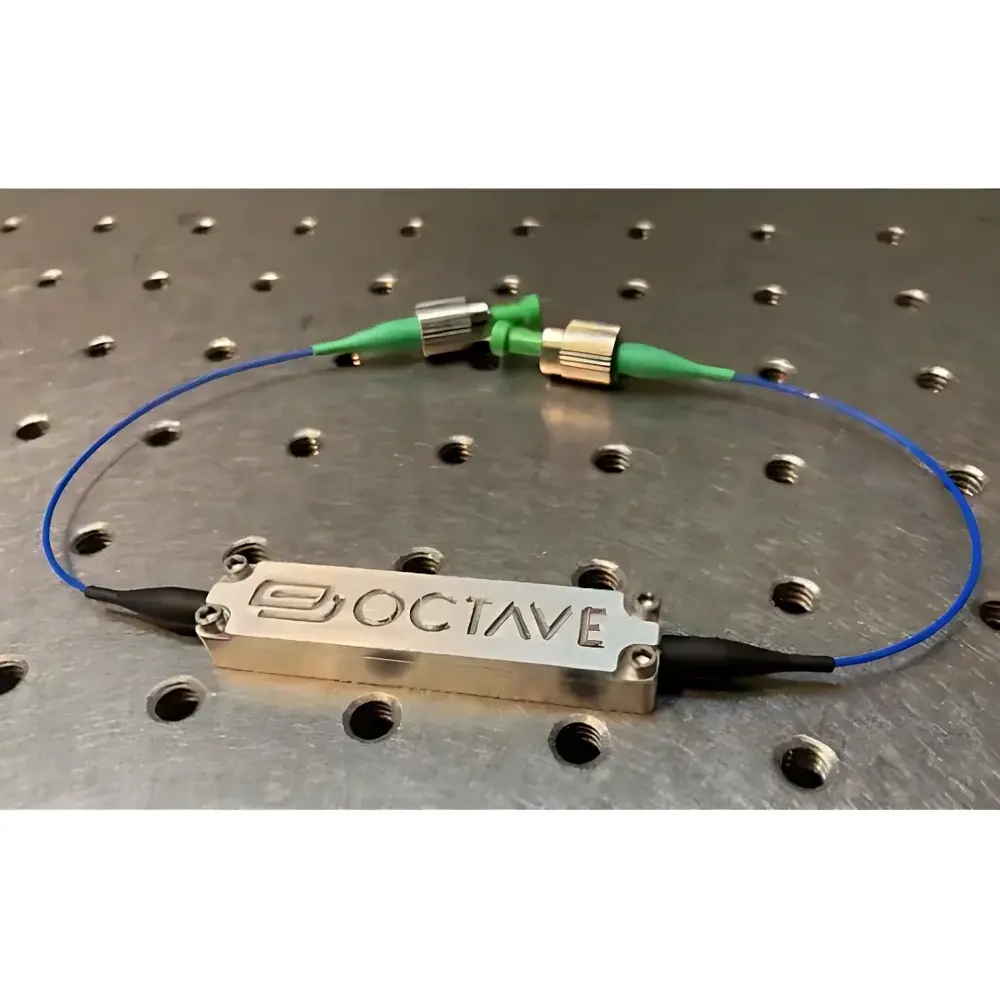
Auniontech SC-1560-780 Ultrafast Nonlinear Nanophotonic Supercontinuum Generation Module
| Brand | Auniontech |
|---|---|
| Origin | Shanghai, China |
| Model | SC-1560-780 (Standard) / SC-Custom (Customizable) |
| Input Wavelength | ~1560 nm (SC-1560-780) / 1000–2000 nm (SC-Custom) |
| Input Pulse Width | <200 fs (SC-1560-780) / <350 fs (SC-Custom) |
| Input Pulse Energy | 150 pJ (SC-1560-780) / >150 pJ (SC-Custom) |
| Output Spectrum Range | ~750–1300 nm (SC-1560-780) / Customizable (SC-Custom) |
| Average Output Power | 400 mW (SC-1560-780) / Up to 4 W with TEC cooling (SC-Custom) |
| Dispersion-Wave Power | >40 µW (SC-1560-780) / >100 µW (SC-Custom) |
| Output Coupling | FC/APC fiber or free-space lens option |
| Module Dimensions | ~57 × 13 × 9 mm (SC-1560-780) / Customizable (SC-Custom) |
| Operating Temperature | 15–30 °C (SC-1560-780) / –10 to +60 °C (SC-Custom) |
| Compliance | RoHS-compliant packaging, fiber-pigtailed for OEM integration |
Overview
The Auniontech SC-1560-780 Ultrafast Nonlinear Nanophotonic Supercontinuum Generation Module is a compact, fiber-coupled photonic device engineered for efficient supercontinuum generation (SCG) via highly confined nonlinear propagation in dispersion-engineered nanophotonic waveguides. Unlike bulk-fiber-based SC sources, this module leverages sub-micron silicon-nitride or chalcogenide-based integrated waveguides to achieve strong optical confinement and tailored anomalous dispersion—enabling octave-spanning spectral broadening at low pulse energies (<200 fs, ~150 pJ). The physical mechanism relies on soliton fission, dispersive wave radiation, and intrapulse Raman scattering under femtosecond excitation near the zero-dispersion wavelength (ZDW) of the waveguide. Its architecture supports direct integration into turnkey ultrafast laser systems, optical frequency comb stabilization setups, and portable spectroscopic platforms requiring stable, broadband coherent light between 750 nm and 1300 nm.
Key Features
- Femtosecond-pumped nanophotonic waveguide core enabling high nonlinearity at low pulse energy thresholds
- Standardized FC/APC fiber input/output interface compatible with polarization-maintaining (PM780) delivery fibers
- Hermetically sealed, thermally stabilized housing with optional TEC control for power scaling up to 4 W average output
- Dispersion-tailored design supporting both fundamental and dispersive-wave spectral components—critical for fceo detection in optical frequency combs
- OEM-optimized mechanical footprint (~57 × 13 × 9 mm) with alignment-free coupling and minimal mode mismatch loss
- Customization options include ZDW tuning, spectral bandwidth extension beyond 1300 nm, alternate output fiber types (e.g., SMF-28, HI1060), and free-space collimated output
Sample Compatibility & Compliance
The module accepts standard telecom-band femtosecond fiber lasers (e.g., Er-doped oscillators or amplifiers) operating at ~1560 nm with pulse widths <200 fs and repetition rates from 10 MHz to 100 MHz. Input pulse energy must exceed 150 pJ to initiate robust spectral broadening; below this threshold, output remains narrowband and dominated by self-phase modulation. For compliance, the device meets IEC 61340-5-1 ESD handling requirements and is RoHS 3 compliant. All fiber pigtails are certified to Telcordia GR-326-CORE specifications. When deployed in regulated environments—including ISO/IEC 17025-accredited metrology labs or GLP-compliant biophotonics workflows—the module supports traceable calibration documentation and can be integrated into systems compliant with FDA 21 CFR Part 11 when paired with validated data acquisition software.
Software & Data Management
While the SC-1560-780 operates as a passive photonic component without embedded firmware, it is fully compatible with industry-standard optical characterization platforms including Thorlabs’ OSA20xC series optical spectrum analyzers, Yokogawa AQ6370D, and Keysight N77xx tunable laser sources for spectral validation. For automated spectral monitoring and long-term stability logging, users commonly integrate the module with Python-based control frameworks (e.g., PyVISA + NumPy + Matplotlib) or LabVIEW via USB-connected spectrometers. Audit trails, timestamped spectral snapshots, and power drift logs can be exported in HDF5 or CSV format—ensuring full traceability required under ISO/IEC 17025 Clause 7.7 and GMP Annex 11 principles.
Applications
- Optical Frequency Comb Stabilization: Generation of dispersive waves at ~780 nm enables precise fceo detection via f–2f interferometry when seeded by PM780-coupled 1560 nm oscillators
- Broadband Coherent Anti-Stokes Raman Scattering (CARS) Microscopy: Simultaneous excitation across visible–NIR bands improves molecular contrast and reduces photodamage in live-cell imaging
- Dense Wavelength Division Multiplexing (DWDM) Component Testing: Provides calibrated, multi-channel reference spectra for insertion loss and polarization-dependent loss (PDL) measurements
- Time-Domain Optical Coherence Tomography (TD-OCT): Delivers high-brightness, low-coherence illumination with axial resolution <3 µm in biological tissue
- Gas Sensing & Hyperspectral Absorption Spectroscopy: Covers key fingerprint regions for H2O, CH4, CO2, and NOx between 750–1300 nm with SNR >50 dB over 1 s integration
FAQ
What input laser specifications are mandatory for reliable SCG operation?
A femtosecond fiber laser centered at ~1560 nm, with pulse width 500 pJ) may induce waveguide damage if not thermally managed.
Can the output spectrum be extended beyond 1300 nm?
Yes—custom waveguide dispersion profiles and alternative output fibers (e.g., SMF-28 or fluoride fibers) are available through the SC-Custom configuration path. This enables coverage up to 2200 nm depending on pump wavelength and waveguide material platform.
Is polarization maintenance supported throughout the module?
The standard configuration uses PM780 input/output fiber with extinction ratio >20 dB. Internal waveguide birefringence is minimized via symmetric cross-section design, preserving input polarization state within ±0.5 dB PDL across the full output band.
How does ambient temperature affect spectral stability?
The SC-1560-780 is rated for 15–30 °C operation; spectral centroid drift is <0.1 nm/°C. For wider thermal ranges (–10 to +60 °C), the SC-Custom variant includes active TEC control and thermistor feedback to maintain ZDW alignment within ±0.3 nm.
What documentation is provided for regulatory compliance in EU or US markets?
CE Declaration of Conformity (RoHS, EMC Directive 2014/30/EU), RoHS 3 Certificate of Compliance, and fiber safety classification report (IEC 60825-1:2014 Class 1M) are supplied with each unit. Additional ISO 17025 traceable spectral calibration reports are available upon request.




