
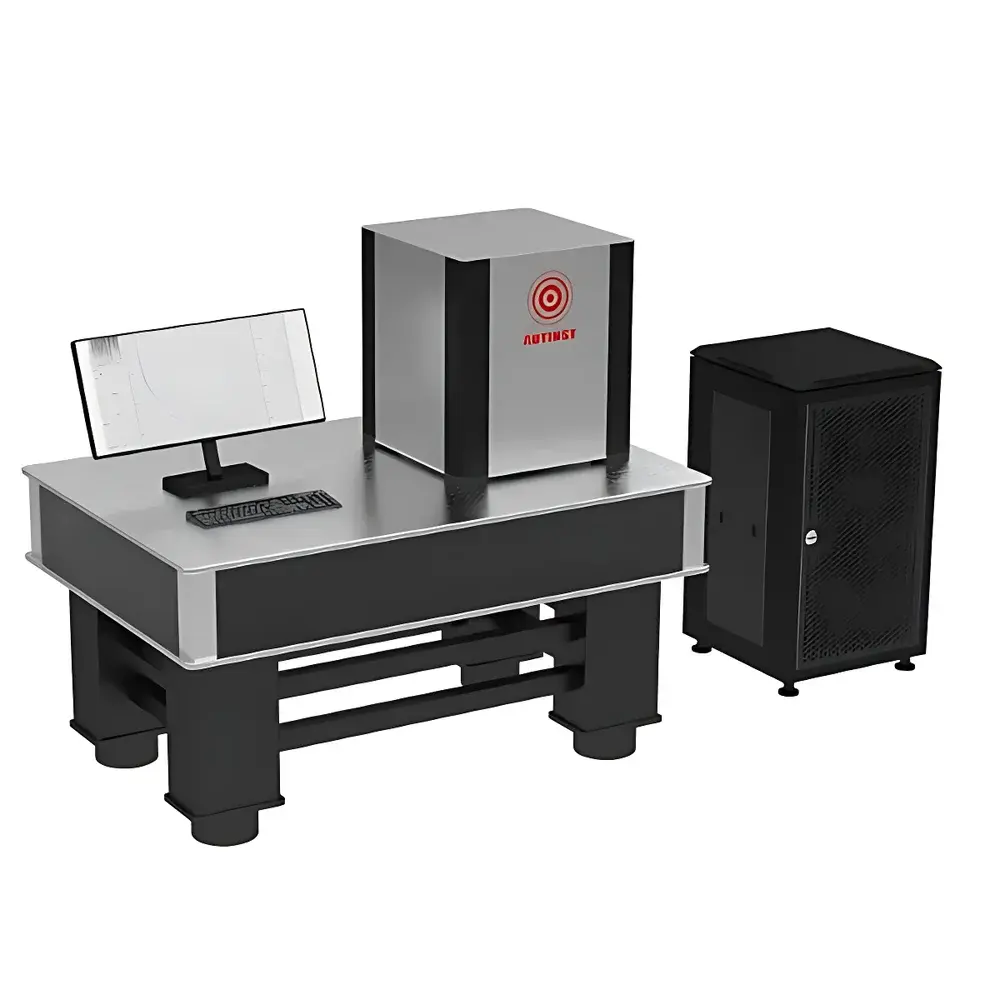
English Product Name
| Brand | Auniontech |
|---|---|
| Origin | Shanghai, China |
| Manufacturer Type | Authorized Distributor |
| Country of Origin | China |
| Model | Pioneer-ONE TDTR System |
| Pricing | Available Upon Request |
Overview
The Auniontech Pioneer-ONE Femtosecond Laser Time-Domain Thermoreflectance (TDTR) System is a precision metrology platform engineered for non-contact, ultrafast thermal property characterization at the nanoscale. It implements the pump-probe time-domain thermoreflectance principle—where a femtosecond laser pulse (“pump”) induces transient heating in a nanoscale metal transducer layer, and a time-delayed probe pulse monitors the resulting reflectivity change correlated with surface temperature evolution. This enables quantitative extraction of thermal conductivity (κ), thermal diffusivity (α), volumetric heat capacity (ρcp), interfacial thermal conductance (G), and cross-plane thermal resistance in multilayer thin-film architectures. Designed for rigorous academic and industrial R&D environments, the system operates across extreme conditions—including cryogenic temperatures down to 4 K and high-pressure regimes up to 10 GPa—and supports validation of non-Fourier heat transport models under ultrafast, high-frequency excitation.
Key Features
- Femtosecond time resolution (≤100 fs) for direct observation of ballistic-to-diffusive thermal transport transitions
- Multi-parameter fitting engine supporting simultaneous inversion of κ, α, G, and ρcp from single-set time-domain reflectance decay data
- Multi-frequency modulation capability for enhanced signal-to-noise ratio and decoupling of overlapping thermal responses
- Sensitivity analysis module quantifying parameter identifiability and correlation structure within physical models
- Uncertainty propagation framework compliant with ISO/IEC Guide 98-3 (GUM) for traceable uncertainty estimation in derived thermal properties
- Modular optical path design accommodating vacuum cryostats, diamond anvil cells (DAC), and custom sample stages
Sample Compatibility & Compliance
The Pioneer-ONE TDTR system accommodates a broad spectrum of material systems: continuous or patterned metallic transducer layers (e.g., Al, Au, Cu, ~50–150 nm thick); dielectric and semiconductor thin films (SiO2, SiNx, AlN, GaN, MoS2); liquid-solid interfaces; epitaxial heterostructures; and thermoelectric or phase-change materials. Sample substrates include sapphire, silicon, quartz, SrTiO3, and bulk metals. All measurement protocols adhere to ASTM E2585–22 (Standard Guide for Thermal Property Measurements Using Ultrafast Optical Techniques) and support GLP-compliant documentation workflows. Data acquisition and processing modules are structured to meet audit requirements under FDA 21 CFR Part 11 when integrated with validated electronic lab notebooks (ELN).
Software & Data Management
The proprietary TDTR Control & Analysis Suite provides a deterministic, scriptable environment for experiment orchestration, real-time signal averaging, and physics-based model fitting. Built-in thermal diffusion solvers implement 1D–3D multi-layer Green’s function solutions with finite-element boundary condition handling. Raw temporal reflectance traces are stored in HDF5 format with embedded metadata (laser fluence, delay stage position, ambient temperature, vacuum pressure). Version-controlled fitting templates allow reproducible parameter extraction across laboratories. Export options include CSV, MATLAB .mat, and JSON-LD for interoperability with FAIR-aligned data repositories. Audit trails log all user actions, parameter edits, and calibration events—enabling full traceability per ISO/IEC 17025:2017 Clause 7.7.
Applications
- Thermal interface optimization in advanced packaging (e.g., Cu–SiO2, Ni–AlN, graphene–Si interfaces)
- Validation of ab initio phonon transport simulations for low-dimensional materials
- Thermal stability assessment of thermoelectric thin films under cyclic thermal loading
- Interfacial thermal conductance mapping in atomic-layer-deposited (ALD) dielectric stacks
- Non-equilibrium energy relaxation dynamics in plasmonic nanostructures
- Thermal property benchmarking for next-generation thermal barrier coatings (TBCs) in gas turbine applications
FAQ
What sample preparation is required for TDTR measurements?
A uniform, optically reflective transducer layer (~80–120 nm Al or Au) must be deposited onto the test sample via e-beam evaporation or sputtering. Surface roughness should remain below λ/10 of the probe wavelength (typically <5 nm RMS) to minimize scattering artifacts.
Can the system measure liquids or soft matter?
Yes—when paired with a sealed microfluidic cell or inert gas purged chamber, the system characterizes solid–liquid interfacial thermal conductance (e.g., metal–water, graphene–ionic liquid) using identical pump–probe geometry and fitting formalism.
Is calibration traceable to national standards?
While TDTR is a relative technique, absolute calibration is achieved via reference samples with certified thermal properties (e.g., fused silica, sapphire) measured under identical environmental conditions and validated against NIST-traceable flash diffusivity data.
Does the software support custom thermal models?
Yes—the analysis suite accepts user-defined C++ or Python-based thermal kernels via its plugin architecture, enabling integration of non-local, two-temperature, or phonon hydrodynamic models.
What environmental controls are supported?
The system interfaces with commercial cryostats (4–300 K), closed-cycle refrigerators, and diamond anvil cells. Vibration isolation, acoustic shielding, and active temperature stabilization (±0.01 °C) are standard for long-duration acquisitions.
Related Products



