
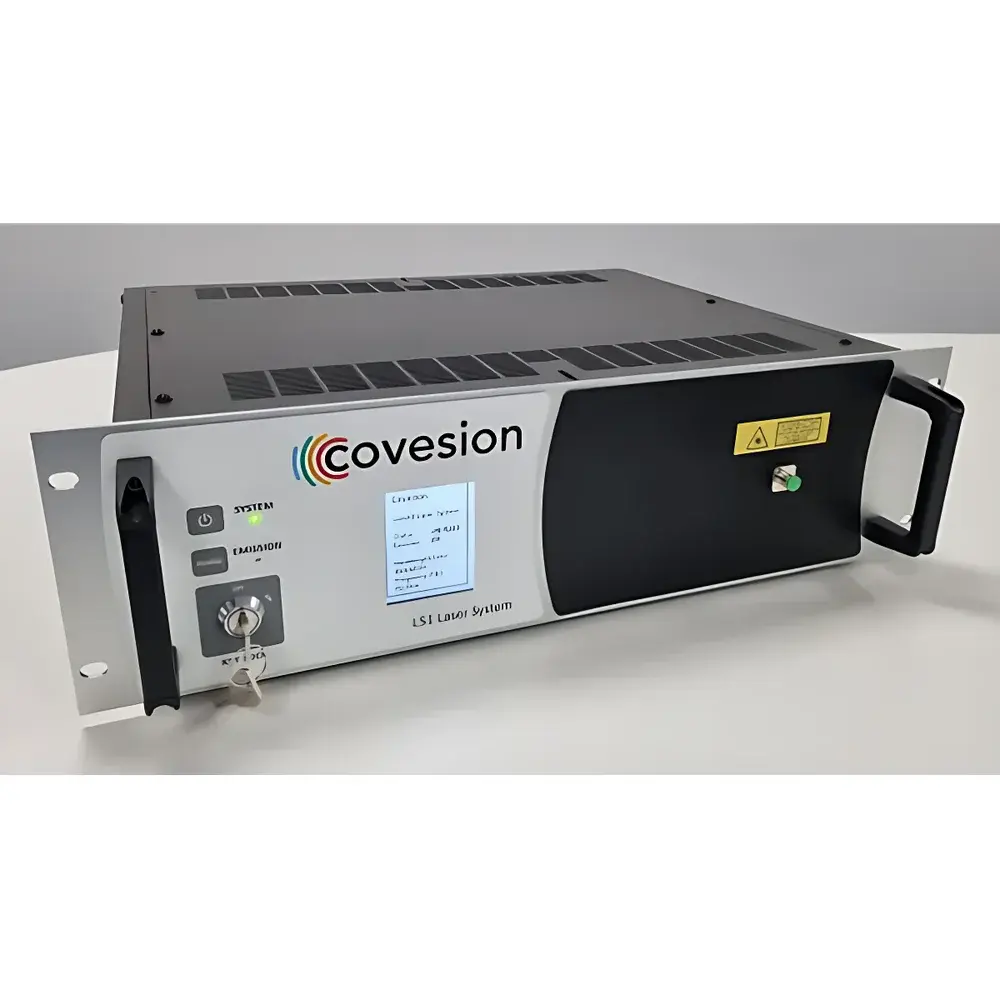
Covesion Locked Laser System V1.0 Dual-Frequency Narrow-Linewidth Stabilized Laser (1560 nm / 780 nm)
| Brand | Covesion |
|---|---|
| Wavelengths | 1560 nm and 780 nm (dual-frequency, dual-output) |
| Output Power | up to 1 W (wavelength-dependent) |
| Linewidth (RMS) | < 50 kHz (at 780 nm, ≥100 ms integration) |
| Frequency Stability (RMS) | < 250 kHz (at 780 nm, over 24 h) |
| Power Stability (RMS) | < 10% (over 1 h) |
| Frequency Locking Range | ±24 kHz to 12.8 GHz |
| Reference Standard | 87Rb D2 transition (F=2 → F′=2/3, 384.22799 THz) |
| Form Factor | 19-inch rack-mountable, 3U or 4U height |
| Compliance | Designed for GLP/GMP-aligned lab environments |
Overview
The Covesion Locked Laser System V1.0 is a dual-wavelength, dual-frequency narrow-linewidth stabilized laser engineered for high-precision applications in quantum science, optical metrology, and atomic physics. Operating simultaneously at 1560 nm and 780 nm, the system leverages proprietary fiber-pigtailed waveguide technology to deliver two spectrally isolated, independently controllable outputs—each actively locked to an absolute frequency reference. The 780 nm channel is stabilized to the hyperfine-resolved 87Rb D2 transition (F = 2 → F′ = 2/3, 384.22799 THz), serving as a primary frequency standard traceable to SI-defined atomic transitions. The 1560 nm output is phase-coherently derived or separately referenced, enabling heterodyne beat-note generation with sub-kHz resolution. This architecture eliminates reliance on external cavities or free-space optics, significantly improving long-term robustness and reducing alignment sensitivity. The system operates on the principle of Pound–Drever–Hall (PDH) locking combined with saturated absorption spectroscopy in an integrated Rb vapor cell, ensuring sub-Doppler spectral discrimination and low-drift frequency control. It is designed for continuous unattended operation in research laboratories requiring compliance with ISO/IEC 17025 traceability frameworks and compatibility with time-domain quantum control sequences.
Key Features
- Dual-wavelength, dual-frequency output: simultaneous 1560 nm and 780 nm beams with independent amplitude and frequency control
- Narrow intrinsic linewidth: <50 kHz RMS (measured via delayed self-heterodyne interferometry, ≥100 ms integration at 780 nm)
- Atomic-referenced stabilization: integrated 87Rb vapor cell provides absolute frequency anchor with ≤250 kHz RMS drift over 24 hours
- Wide electronic tuning range: ±24 kHz coarse offset adjustment and up to 12.8 GHz fine tuning via piezo-actuated cavity or current modulation
- High output power: up to 1 W per wavelength (dependent on configuration and thermal management)
- Rack-mount form factor: 19-inch, 3U or 4U chassis optimized for integration into multi-instrument quantum control racks
- Power stability: <10% RMS fluctuation over 1 hour under constant ambient conditions (23 ± 1 °C, no airflow disturbances)
- Self-contained design: no external reference lasers, vacuum cells, or optical tables required for initial commissioning
Sample Compatibility & Compliance
The system is compatible with standard polarization-maintaining (PM) fiber interfaces (FC/APC or FC/PC) and integrates seamlessly with commercial quantum experiment platforms—including MOT control systems, optical lattice setups, and trapped-ion RF/DC electrode drivers. Its frequency reference adheres to the internationally recognized 87Rb hyperfine transition defined in ITU-R Recommendation TF.2042 and NIST Special Publication 1065. All internal electronics comply with IEC 61326-1 (EMC for laboratory equipment) and IEC 61010-1 (safety requirements). The sealed Rb reference cell meets ASTM E2918-13 standards for alkali metal vapor cell longevity and hermeticity. While not certified for FDA 21 CFR Part 11 out-of-the-box, the system supports third-party validation protocols for GxP environments when paired with compliant data acquisition software.
Software & Data Management
The laser includes embedded firmware with USB 2.0 and Ethernet (TCP/IP) interfaces for remote monitoring and control via SCPI-compliant commands. A Windows/Linux-compatible GUI enables real-time display of lock status, error signals, photodiode traces, and Allan deviation plots. All frequency and power logs are timestamped with UTC-synchronized hardware clocks and exported in HDF5 format for interoperability with Python (NumPy, SciPy), MATLAB, and LabVIEW. Audit trails record user-initiated parameter changes, lock acquisition events, and thermal drift compensation actions—supporting GLP documentation requirements. Optional API modules allow integration into Quantum Orchestration Platforms (e.g., QOP by Quantum Machines) for synchronized pulse sequencing.
Applications
- Rubidium magneto-optical trap (MOT) loading and sub-Doppler cooling
- Coherent manipulation of neutral atom qubits in optical tweezers and lattices
- Primary frequency standard development and chip-scale atomic clock (CSAC) calibration
- Dual-comb spectroscopy requiring phase-stable mid-IR difference-frequency generation (DFG) pump sources
- Optical frequency synthesis chains for attosecond science and precision interferometry
- Testing of photonic integrated circuits (PICs) requiring stable, narrowband inputs at telecom and atomic wavelengths
FAQ
Is the 1560 nm output also locked to an atomic reference?
The 780 nm channel is directly locked to the 87Rb transition. The 1560 nm output may be either harmonically related (via intracavity doubling) or independently stabilized using an auxiliary reference; configuration depends on the ordered variant.
What is the typical warm-up time to achieve full frequency stability?
Full thermal equilibrium and lock acquisition require ≤45 minutes after cold start, with RMS frequency error dropping below specification within 20 minutes.
Can the system operate in continuous-wave (CW) mode only, or does it support modulation?
It supports analog current modulation (up to 10 MHz bandwidth) and digital TTL-triggered on/off switching, but does not include built-in pulse shaping or arbitrary waveform generation.
Are replacement Rb vapor cells available as service parts?
Yes—certified lifetime-rated Rb cells (≥5-year operational guarantee) are available under part number CLS-RB-87-REF-01, with factory recalibration included.
Does the system meet MIL-STD-810G for vibration and shock resistance?
While not formally certified, the 3U/4U chassis passes internal shock testing per IEC 60068-2-27 (25 g, 11 ms half-sine pulse) and operates reliably on optical tables with active damping.





