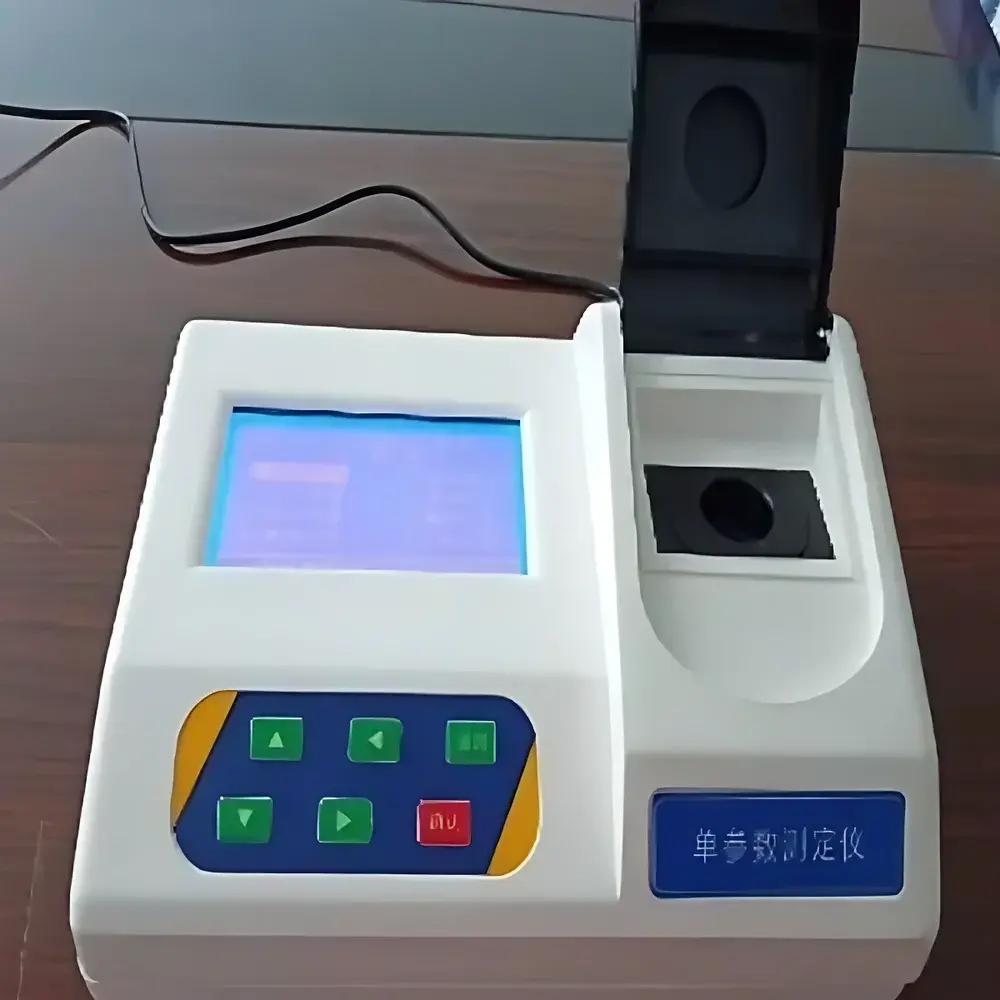
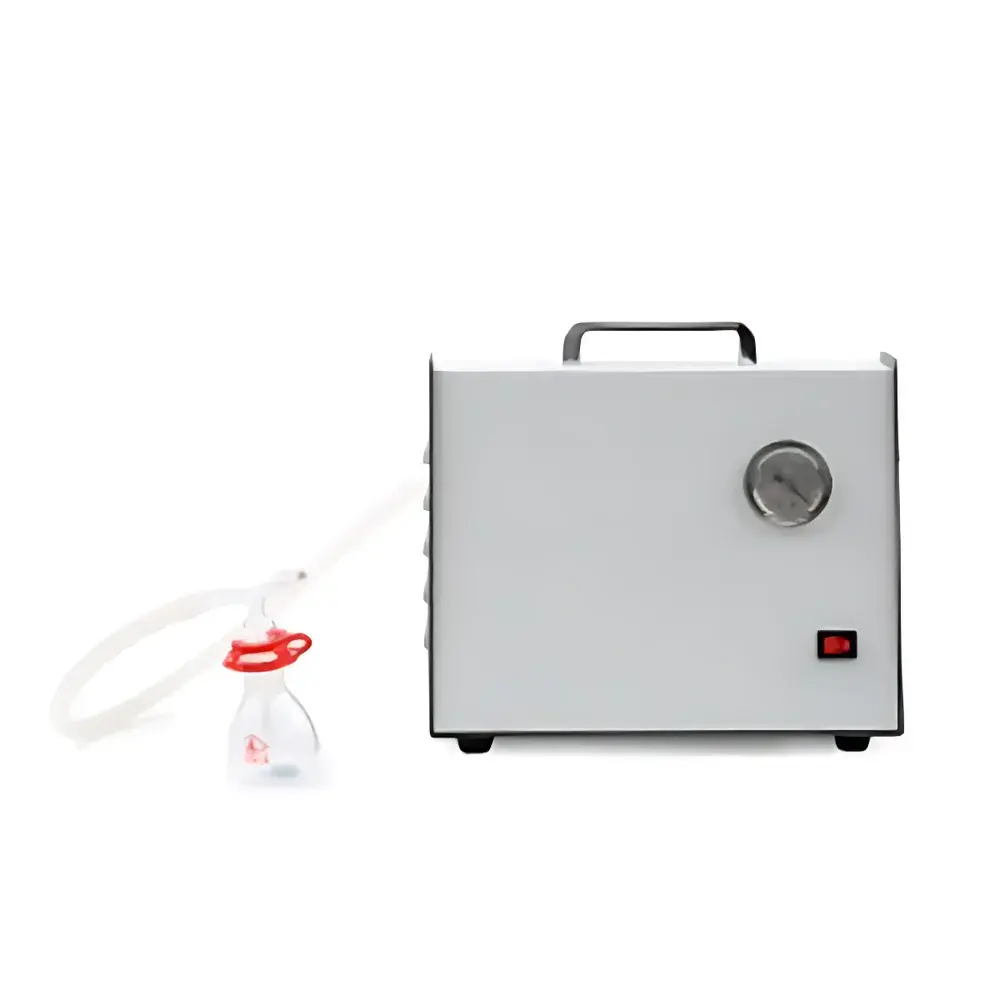
HengaoDe CryoStarI Milk Cryoscopic Analyzer with Thermistor Probe for Adulteration Detection
| Brand | HengaoDe |
|---|---|
| Origin | Beijing, China |
| Manufacturer Type | Authorized Distributor |
| Country of Origin | China |
| Model | CryoStarI |
| Price | USD 138 |
| Measurement Range | 0.000 °C to −1.500 °C |
| Sample Volume | 2.2 mL |
| Accuracy | ±0.0001 °C |
| Repeatability | ±0.002 °C |
| Cooling Time | ≤15 min |
| Throughput | Up to 40 samples/hour |
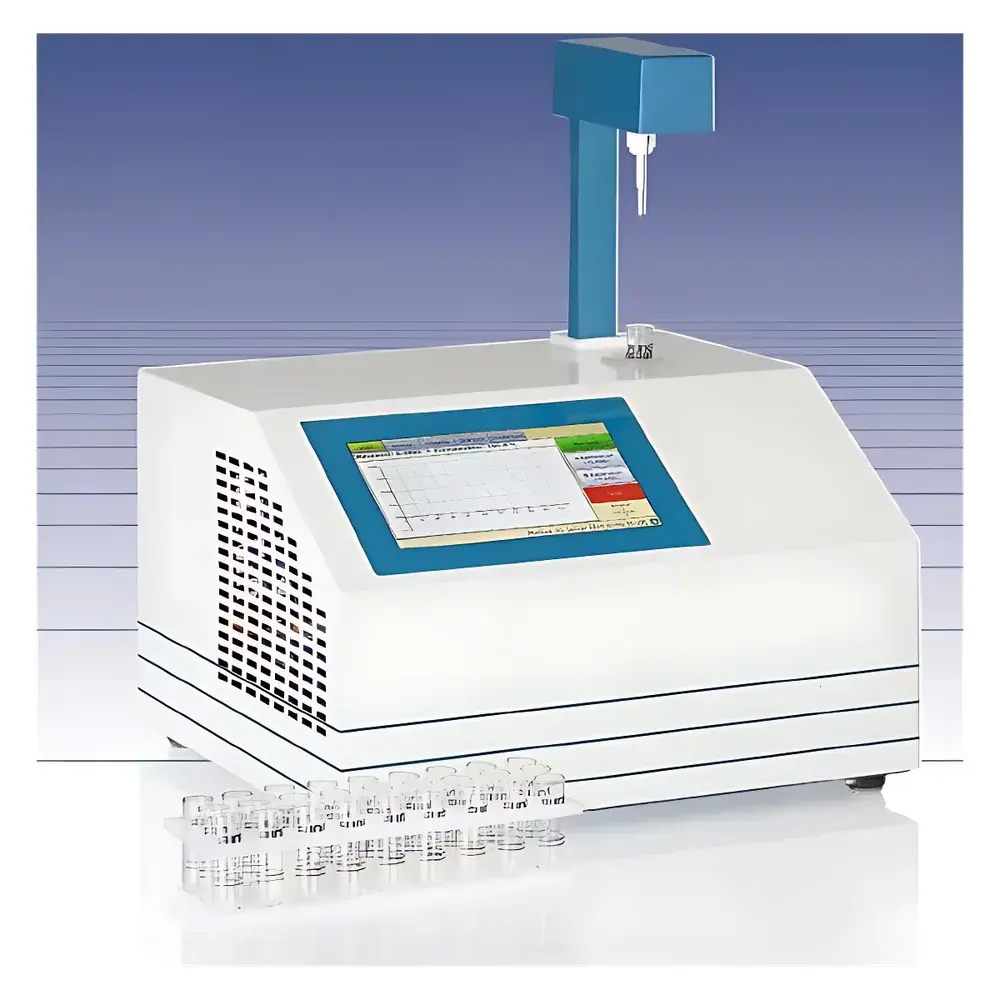
| Display | 7-inch capacitive touchscreen with real-time freezing curve, temperature (°C), water adulteration (%), timestamp, and status indicator |
| Interface | 2× parallel ports, 2× RS-232 serial ports, 1× 6 V thermal printer port, USB host for data export via USB flash drive |
| Power Supply | 230 V/115 V AC, 50–60 Hz |
| DC Option | 12 V DC |
| Dimensions (W×H×D) | 340×330×290 mm |
| Weight | 8.7 kg |
| Operating Environment | Continuous operation ≥6 h |
Overview
The HengaoDe CryoStarI Milk Cryoscopic Analyzer is a precision laboratory instrument engineered for the quantitative detection of water adulteration in raw and processed bovine milk using the thermistor-based cryoscopic method. It operates on the fundamental colligative property that dissolved solutes—primarily lactose, casein, whey proteins, and milk fat—depress the freezing point of aqueous solutions. Pure water freezes at 0.000 °C; undiluted, unadulterated milk exhibits a characteristic cryoscopic depression averaging −0.530 °C (±0.005 °C). When exogenous water is added, the solute concentration decreases proportionally, resulting in a measurable elevation of the freezing point. The CryoStarI employs a calibrated glass-encapsulated thermistor probe to detect the precise temperature at which ice nucleation initiates during controlled sample cooling. Internal firmware applies a linear calibration algorithm (ΔT = k × % water) derived from empirical validation against reference standards per ISO 5725 and IDF Standard 141, enabling direct readout of water adulteration percentage with traceable metrological confidence.
Key Features
- High-resolution thermistor sensing with ±0.0001 °C absolute accuracy and ±0.002 °C repeatability across repeated measurements under identical conditions.
- Integrated Peltier-based cooling system achieving full thermal stabilization within ≤15 minutes, maintaining stable sub-zero operation even at ambient temperatures up to 34 °C.
- 7-inch capacitive touchscreen interface displaying real-time freezing curves, final cryoscopic temperature (°C), calculated water adulteration (%), test timestamp, and system status—eliminating manual interpretation errors.
- Automated self-calibration routine with non-volatile memory storage of calibration constants, user-defined parameters, and historical settings compliant with GLP documentation requirements.
- Dual-mode operation: fixed-cycle analysis for routine QC or customizable timing for research-grade protocol development.
- Robust mechanical architecture with vibration-damped base and sealed probe housing to ensure measurement integrity during high-throughput lab workflows.
Sample Compatibility & Compliance
The CryoStarI is validated for use with raw cow’s milk, pasteurized whole milk, skimmed milk, and reconstituted powdered milk. It accommodates standard 2.2 mL aliquots delivered via calibrated pipettes or automated dispensers. All wetted components—including the thermistor probe, stirrer shaft, and crystallization chamber—are constructed from borosilicate glass and food-grade stainless steel, meeting FDA 21 CFR Part 110 and EC No. 1935/2004 material safety requirements. Instrument performance adheres to ISO 9622:2013 (Milk — Determination of freezing point) and AOAC Official Method 978.07. Data integrity is supported by audit-trail-capable firmware, time-stamped result logs, and optional thermal printer output for hard-copy traceability in regulated dairy quality assurance programs.
Software & Data Management
The CryoStarI embeds a deterministic real-time operating system with persistent flash memory capable of storing ≥10,000 test records locally. Data export is enabled via USB mass-storage mode—allowing direct transfer of CSV-formatted results (including sample ID, date/time, °C value, % water, operator ID, and instrument serial number) to external PCs without proprietary drivers. Optional PC software provides statistical trend analysis, SPC charting (X-bar/R), batch reporting, and integration with LIMS platforms via RS-232 or USB virtual COM port. All data handling complies with EU Annex 11 and FDA 21 CFR Part 11 electronic record/electronic signature (ER/ES) principles when deployed with appropriate administrative controls.
Applications
- Routine incoming raw milk inspection at dairy collection centers to enforce contractual solids-not-fat (SNF) specifications.
- Regulatory compliance testing for national dairy standards (e.g., GB 19301–2010, IS 1479–1961, Codex Alimentarius STAN 206–1999).
- QC release testing of UHT and ESL milk products prior to distribution.
- Research into seasonal variation in natural freezing point depression linked to lactation stage or feed composition.
- Validation of membrane filtration or ultrafiltration process efficiency in whey protein concentration.
FAQ
What is the theoretical basis for detecting water adulteration via freezing point depression?
Freezing point depression is a colligative property dependent solely on the molal concentration of dissolved solutes. Milk’s native solutes depress its freezing point to approximately −0.530 °C; dilution with water reduces solute concentration linearly, elevating the measured freezing point in proportion to added volume.
Does the CryoStarI require daily recalibration?
No. The instrument performs an internal zero-point verification at startup using a built-in reference junction. Full calibration is recommended quarterly or after probe replacement, using certified −0.530 °C and −0.265 °C standard solutions traceable to NIST SRM 1990.
Can the CryoStarI analyze non-bovine milks (e.g., goat, buffalo)?
Yes—with user-defined calibration offsets. While default algorithms assume bovine composition, the device supports custom slope/intercept entry for alternative species based on published cryoscopic baselines (e.g., −0.525 °C for goat milk).
Is the thermistor probe susceptible to fouling from milk fat or protein residues?
The glass-encapsulated thermistor is chemically inert and easily cleaned with warm deionized water followed by ethanol rinse and air drying—validated per ISO 5725-2 repeatability protocols after 500+ cleaning cycles.
How does the CryoStarI handle samples with high somatic cell count or bacterial load?
Microbial metabolism may cause minor pre-freezing exotherms. The instrument’s dynamic curve-fitting algorithm identifies the true nucleation inflection point, rejecting spurious thermal artifacts—confirmed in interlaboratory trials with spiked mastitic milk samples (IDF Report 221:2017).