
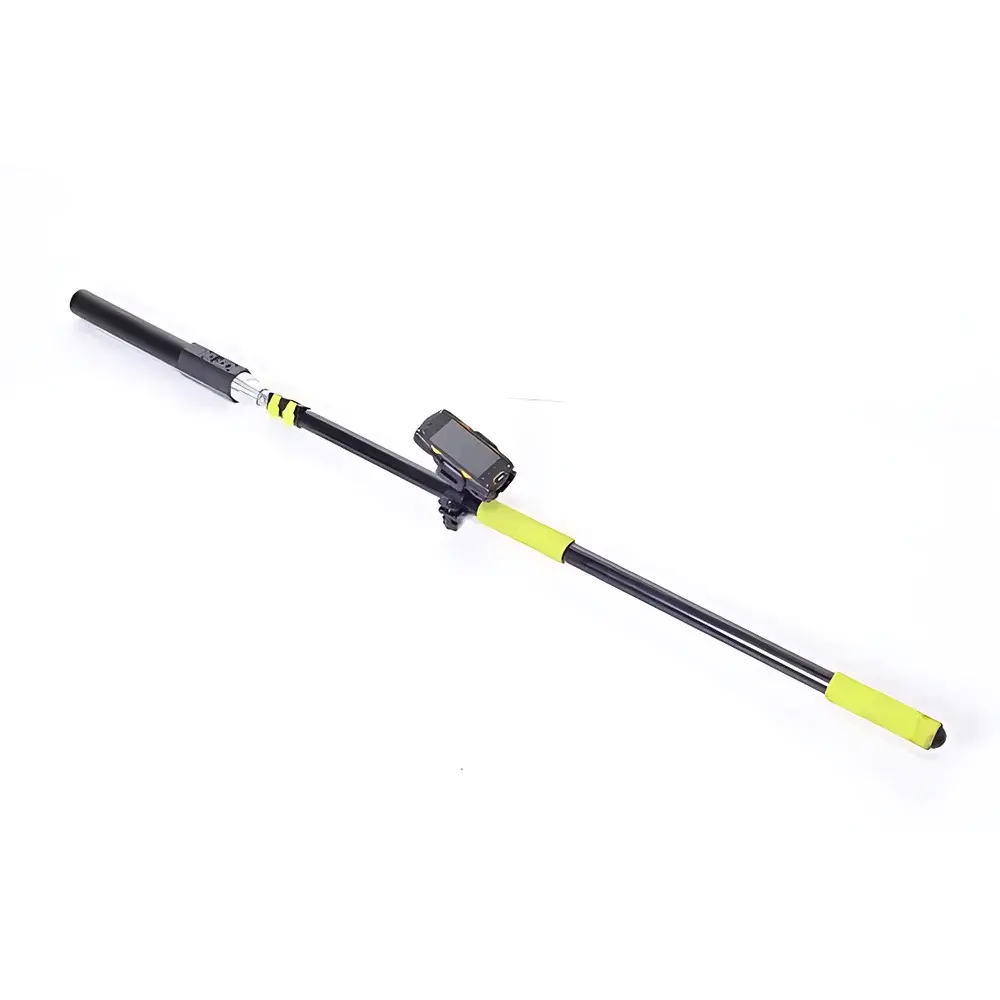
SMACH RE3000 Telescopic-Handle X- and γ-Ray Radiation Survey Meter
| Brand | SMACH |
|---|---|
| Origin | Fujian, China |
| Model | RE3000 |
| Instrument Type | Portable Dose Rate Meter |
| Detector | Ø30×25 mm NaI(Tl) Scintillation Crystal |
| Measurement Range | Dose Rate: 0.01–200.00 µSv/h |
| Cumulative Dose | 0.00 µSv–9.99 Sv |
| Sensitivity | ≥350 CPS/µSv/h |
| Energy Range | 38 keV–3 MeV |
| Relative Error | ≤±8% (at 200.00 µSv/h) |
| Measurement Time | Adjustable from 1–60 s |
| Alarm Thresholds | User-Configurable for Dose Rate & Cumulative Dose |
| Power | Rechargeable Li-ion Battery |
| Weight | 1.85 kg (total system) |
| Dimensions (Host) | 420×180×88 mm |
| Maximum Telescopic Rod Length | 3.5 m |
| Bluetooth Communication Range | Up to 15 m |
| IP Rating | IP68 |
| Data Storage | Local 4 GB + microSD card expansion |
| Display | Capacitive Touchscreen with Dual-Language (EN/CN) UI |
Overview
The SMACH RE3000 Telescopic-Handle X- and γ-Ray Radiation Survey Meter is a field-deployable, high-sensitivity scintillation-based radiation monitoring instrument engineered for real-time environmental and occupational dose rate assessment. It operates on the principle of gamma-ray photon interaction with thallium-doped sodium iodide (NaI(Tl)) scintillation crystal, where incident photons generate light pulses proportional to deposited energy; these pulses are converted into electrical signals via a photomultiplier tube (PMT) or silicon photomultiplier (SiPM), digitized, and processed to yield dose rate (µSv/h) and cumulative dose (µSv/Sv) values. Designed for compliance with IEC 60846-1:2014 (Radiation protection instrumentation — Ambient and/or directional dose equivalent (rate) meters and/or monitors for beta, X and gamma radiation), the RE3000 delivers stable response across a broad energy range (38 keV–3 MeV), making it suitable for mixed-field environments including medical isotope handling, NORM/TENORM screening, nuclear facility perimeter surveys, and post-incident radiological reconnaissance.
Key Features
- Telescopic carbon-fiber-reinforced aluminum alloy handle extending up to 3.5 m—enabling remote measurement while minimizing operator exposure in high-dose-rate zones.
- High-efficiency Ø30×25 mm NaI(Tl) scintillation detector with sensitivity ≥350 counts per second per µSv/h (CPS/µSv/h), optimized for low-dose-rate detection and rapid transient event capture.
- Bluetooth 5.0 wireless interface supporting bidirectional communication up to 15 m line-of-sight—enabling real-time telemetry without physical tethering between probe and host unit.
- Capacitive touchscreen host with dual-language (English/Chinese) graphical user interface, configurable alarm thresholds, and intuitive menu navigation.
- Dual-mode operation: continuous real-time monitoring and programmable timed acquisition (1–60 s integration intervals) for statistical optimization in low-flux conditions.
- Comprehensive self-diagnostic suite—including battery voltage monitoring, detector fault detection, dose-rate overload warning, and low-power alerts—with audible and visual indicators.
- Robust mechanical design rated IP68 (dust-tight and submersible to 1.5 m for 30 min), validated for extended outdoor deployment in rain, dust, and temperature extremes (−10 °C to +50 °C).
- Onboard 4 GB internal flash memory plus microSD slot (up to 128 GB)—supporting timestamped dose logging, alarm event tagging, and export-ready CSV/BIN data formats.
Sample Compatibility & Compliance
The RE3000 is calibrated for ambient dose equivalent rate H*(10) in accordance with ICRU Report 57 and IEC 61526:2010. Its NaI(Tl) detector provides adequate energy compensation across the specified 38 keV–3 MeV range, ensuring acceptable angular and spectral response for common gamma emitters (e.g., 137Cs, 60Co, 241Am, 192Ir) and diagnostic X-ray spectra (e.g., 60–150 kVp). The instrument meets requirements for routine area monitoring under ISO 4037-3:2019 (X- and gamma-reference radiations) and supports ALARA (As Low As Reasonably Achievable) implementation in accordance with national radiation safety regulations (e.g., NRC 10 CFR Part 20, IAEA Safety Standards Series No. GSR Part 3). While not certified for primary standard calibration, it is appropriate for secondary-level verification, leak testing, and operational health physics screening.
Software & Data Management
The RE3000 integrates with proprietary PC-based data analysis software (Windows/macOS compatible) that enables full traceability of measurement sessions—including GPS-tagged survey routes (when paired with external GNSS module), dose history visualization, statistical summary reports (mean, max, SD), and customizable threshold-triggered export. All logged data include audit-trail metadata: operator ID, device serial number, firmware version, UTC timestamps, and sensor status flags. Optional mobile application (iOS/Android) provides live streaming, push notifications for threshold breaches, and offline map overlay functionality. Data files conform to ANSI N42.42-2019 format for interoperability with laboratory information management systems (LIMS) and regulatory reporting platforms. Firmware updates are delivered via secure HTTPS channel with SHA-256 signature validation.
Applications
- Radiation safety surveys in nuclear medicine departments, radiotherapy bunkers, and industrial radiography facilities.
- Decommissioning support—hot spot localization, contamination mapping, and clearance verification prior to release of materials or structures.
- Environmental monitoring around uranium mining sites, phosphate processing plants, and legacy waste disposal areas.
- Emergency response—rapid identification and quantification of orphan sources, lost gauges, or illicit radioactive material during border control or hazmat incidents.
- Education and training—hands-on demonstration of inverse-square law, shielding effectiveness, and background variability in undergraduate and technician-level courses.
- Regulatory compliance audits—documentation of workplace dose rates per OSHA 1910.1096 or equivalent jurisdictional requirements.
FAQ
What is the energy compensation method used in the RE3000?
The detector employs passive energy compensation via graded aluminum/copper filter layers bonded directly to the NaI(Tl) crystal housing, achieving flat H*(10) response within ±15% across 60 keV–1.3 MeV per IEC 60846-1 Annex B.
Can the RE3000 be used for alpha or beta radiation detection?
No—the instrument is specifically optimized for X- and gamma-ray photons. It lacks a thin entrance window or Z-sensitive configuration required for charged particle detection.
Is firmware upgrade capability available in the field?
Yes—updates are delivered via USB-C connection or over-the-air (OTA) through the companion mobile app, with rollback support and version-controlled changelogs.
Does the device support GLP/GMP-compliant data integrity requirements?
It provides time-stamped, non-erasable logs with tamper-evident file hashing; however, full 21 CFR Part 11 compliance requires integration with validated third-party LIMS or electronic lab notebook (ELN) systems.
What is the typical battery life under continuous operation?
With Bluetooth enabled and screen brightness set to 60%, average runtime exceeds 18 hours at 10-second averaging intervals; standby current draw is <50 µA.
Related Products







