
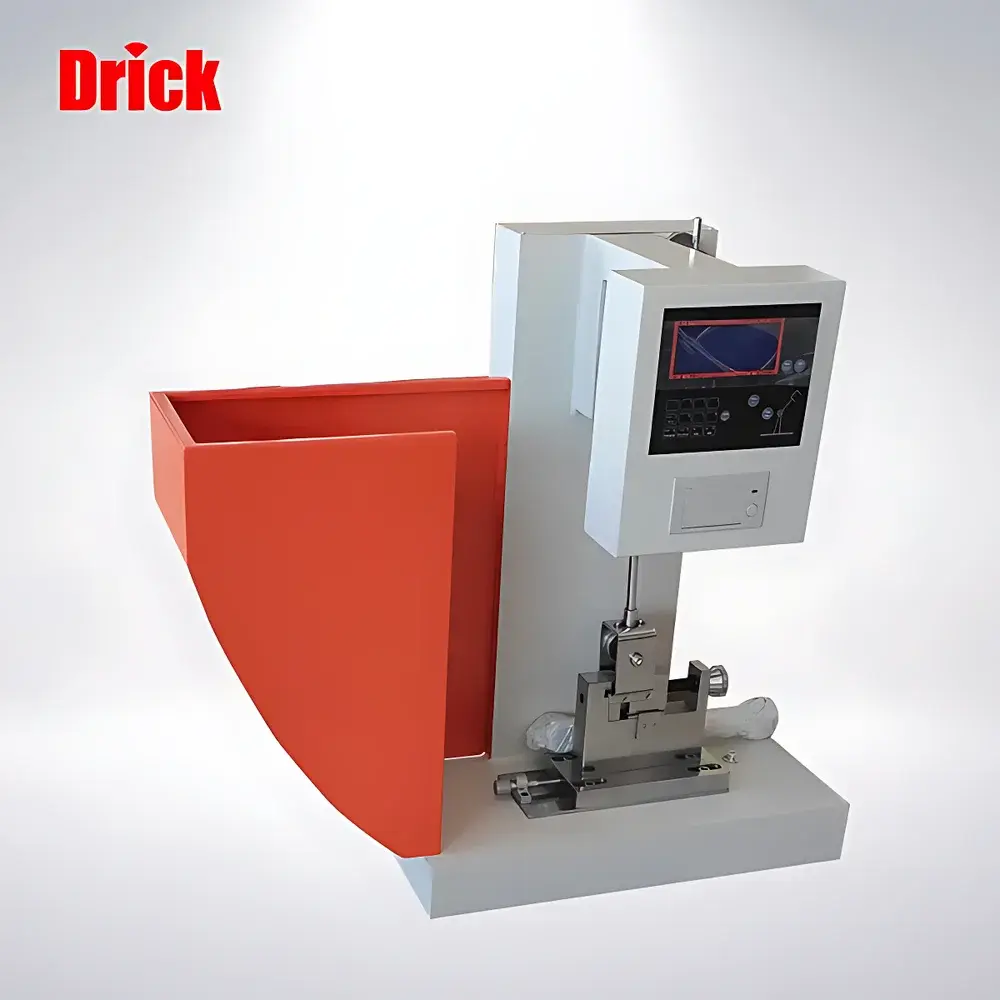
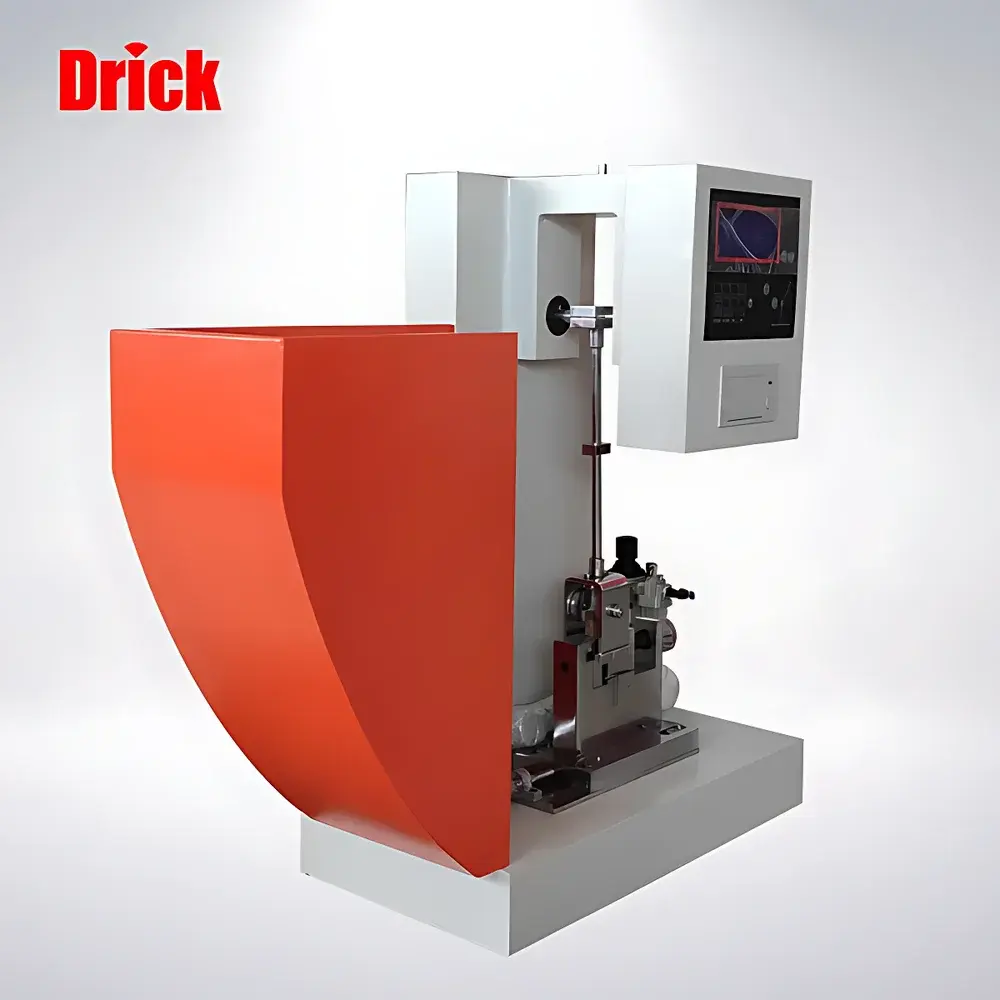
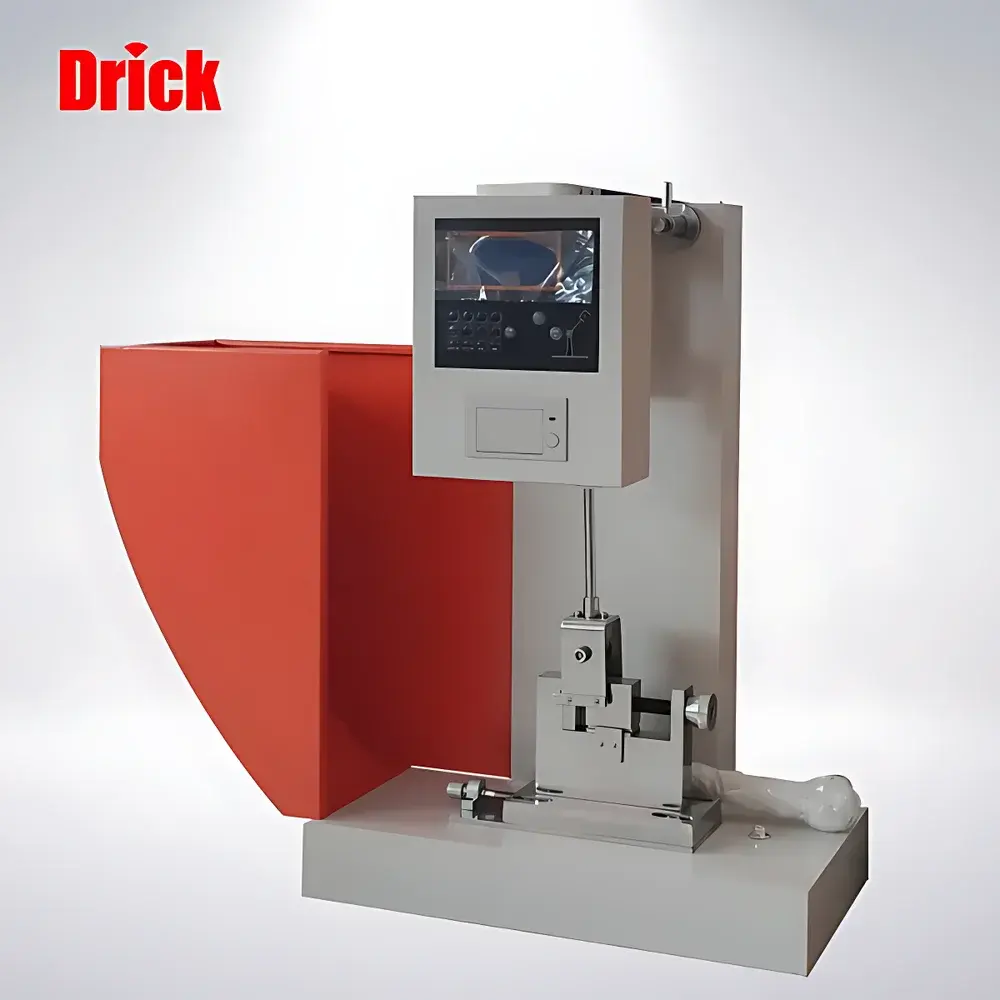
Drick XJC-25D Combined Charpy & Izod Impact Testing Machine (EN ISO 179 / ISO 180 Compliant)
| Key | Brand: Drick |
|---|---|
| Origin | Shandong, China |
| Manufacturer Type | Direct Manufacturer |
| Model | XJC-25D |
| Impact Energy (Charpy) | 1 J, 2 J, 4 J, 5 J |
| Impact Energy (Izod) | 1 J, 2.75 J, 5.5 J, 11 J, 22 J |
| Impact Velocity (Charpy) | 2.9 m/s |
| Impact Velocity (Izod) | 3.5 m/s |
| Support Span (Charpy) | 40 mm, 60 mm, 62 mm, 70 mm |
| Support Span (Izod) | 22 mm |
| Pre-lift Angle | 150° |
| Dimensions (L×W×H) | 500 mm × 350 mm × 780 mm |
| Weight | 130 kg (including accessory case) |
| Power Supply | AC 220 V ±10%, 50 Hz |
| Operating Environment | 10–35 °C, RH ≤80%, vibration-free, non-corrosive atmosphere |
Overview
The Drick XJC-25D Combined Charpy & Izod Impact Testing Machine is a precision-engineered physical property testing instrument designed for standardized determination of impact resistance in rigid and semi-rigid non-metallic materials. It operates on the classical pendulum impact principle—where a calibrated pendulum strikes a notched or unnotched specimen supported in either Charpy (three-point bending, simply supported beam) or Izod (cantilever beam) configuration—and measures the energy absorbed during fracture. This dual-mode architecture enables full compliance with EN ISO 179 (Charpy), EN ISO 180 (Izod), ASTM D256, GB/T 1043, GB/T 1843, ISO 9854, and other internationally recognized standards governing plastic and composite material qualification. The machine’s mechanical robustness, angular repeatability, and low-energy-loss pendulum system ensure high reproducibility across test series—critical for quality control laboratories, R&D centers, and third-party certification bodies operating under GLP or ISO/IEC 17025 frameworks.
Key Features
- Dual-standard configuration: Simultaneous support for both Charpy (simply supported beam) and Izod (vertical cantilever) impact test geometries per EN ISO 179 and EN ISO 180 requirements.
- Multi-range pendulum system: Interchangeable hammers providing discrete impact energies—Charpy: 1 J, 2 J, 4 J, 5 J; Izod: 1 J, 2.75 J, 5.5 J, 11 J, 22 J—enabling precise selection based on material stiffness and expected fracture energy.
- High-fidelity angular measurement: Optical rotary encoder (circular grating) ensures traceable, digital resolution of pre-lift angle (150° nominal), swing angle, and residual angle—eliminating parallax error inherent in analog dial systems.
- Energy loss compensation algorithm: Automatically corrects for frictional and aerodynamic losses using calibrated pendulum constants and real-time angular kinematics—improving accuracy to ±0.5% of full scale per ISO 13802 Annex B.
- Modular specimen fixture set: Includes interchangeable anvil bases and clamping jaws for Charpy spans of 40 mm, 60 mm, 62 mm, and 70 mm; Izod support span fixed at 22 mm per ISO 180-1.
- Stable mechanical architecture: Cast-iron base frame with vibration-damped mounting, precision-machined pivot shaft, and hardened steel impact blade—designed for long-term dimensional stability and minimal hysteresis.
Sample Compatibility & Compliance
The XJC-25D accommodates standard test specimens defined in EN ISO 179-1 (Charpy) and EN ISO 180-1 (Izod), including Type 1A (80 × 10 × 4 mm), Type 1B (80 × 10 × 3 mm), and Type 2 (63.5 × 12.7 × 3.2 mm) bars. It is validated for use with thermoplastics (e.g., ABS, PC, PP), thermosets (e.g., epoxy-glass laminates), fiber-reinforced composites, engineering ceramics, and electrical insulating materials. All mechanical components—including pendulum arm, striker, anvils, and clamps—conform to dimensional tolerances specified in ISO 13802:2017. The instrument meets essential safety and metrological requirements outlined in EN 61000-6-2 (EMC immunity) and EN 61000-6-4 (EMC emissions), and supports audit-ready documentation for ISO/IEC 17025 accreditation and FDA-regulated material release protocols where impact data informs biocompatibility or device housing validation.
Software & Data Management
The optional microprocessor-controlled variant integrates a dedicated embedded controller with RS-232/USB interface for bidirectional communication with Windows-based laboratory software. Test parameters (energy range, specimen dimensions, notch depth), raw angular displacement data, and calculated results—including absorbed energy (J), impact strength (kJ/m²), and coefficient of variation (%CV) for batch analysis—are stored with timestamp, operator ID, and instrument serial number. Data export complies with ASTM E1447 and ISO/IEC 17025 clause 7.7 requirements: CSV and PDF report formats include full metadata, calibration certificate references, and electronic signatures compatible with 21 CFR Part 11-compliant systems when deployed with validated software modules. Audit trails record all parameter modifications, result overrides, and user logins—ensuring full traceability for regulatory submissions.
Applications
- Quality assurance of injection-molded plastic components in automotive and consumer electronics supply chains.
- Comparative evaluation of polymer toughening agents (e.g., elastomer blends, nano-fillers) during formulation development.
- Batch release testing of glass-fiber-reinforced polyamide (PA66-GF30) and carbon-fiber composites per aerospace material specifications (e.g., AMS 3675).
- Failure analysis of brittle fracture in ceramic substrates used in semiconductor packaging.
- Validation of flame-retardant additives’ effect on impact performance without compromising UL94 V-0 rating.
- Teaching laboratories demonstrating fundamental fracture mechanics concepts—including strain-rate dependence, notch sensitivity, and ductile-to-brittle transition behavior.
FAQ
Does the XJC-25D comply with EN ISO 179 and EN ISO 180 simultaneously?
Yes—the instrument is mechanically configured to satisfy the specimen support geometry, pendulum energy calibration, and striker radius requirements of both standards without hardware modification.
Can it be used for unnotched impact testing?
Yes; the standard fixture set includes both notched and unnotched anvil configurations per EN ISO 179-1 Annex A and EN ISO 180-1 Clause 6.2.
Is calibration certification included with delivery?
Each unit ships with a factory calibration report traceable to NIM (National Institute of Metrology, China) for pendulum constant, energy scale, and angular encoder linearity.
What maintenance is required to maintain ISO 13802 compliance?
Annual verification of pivot friction torque, striker edge radius (measured via optical profilometry), and encoder linearity is recommended; full recalibration every 24 months or after major component replacement.
Are spare pendulum hammers available for extended energy ranges?
Drick supplies certified replacement hammers up to 22 J (Izod) and 5 J (Charpy); higher-energy variants (e.g., XJC-50D) require separate model procurement.
Related Products



