
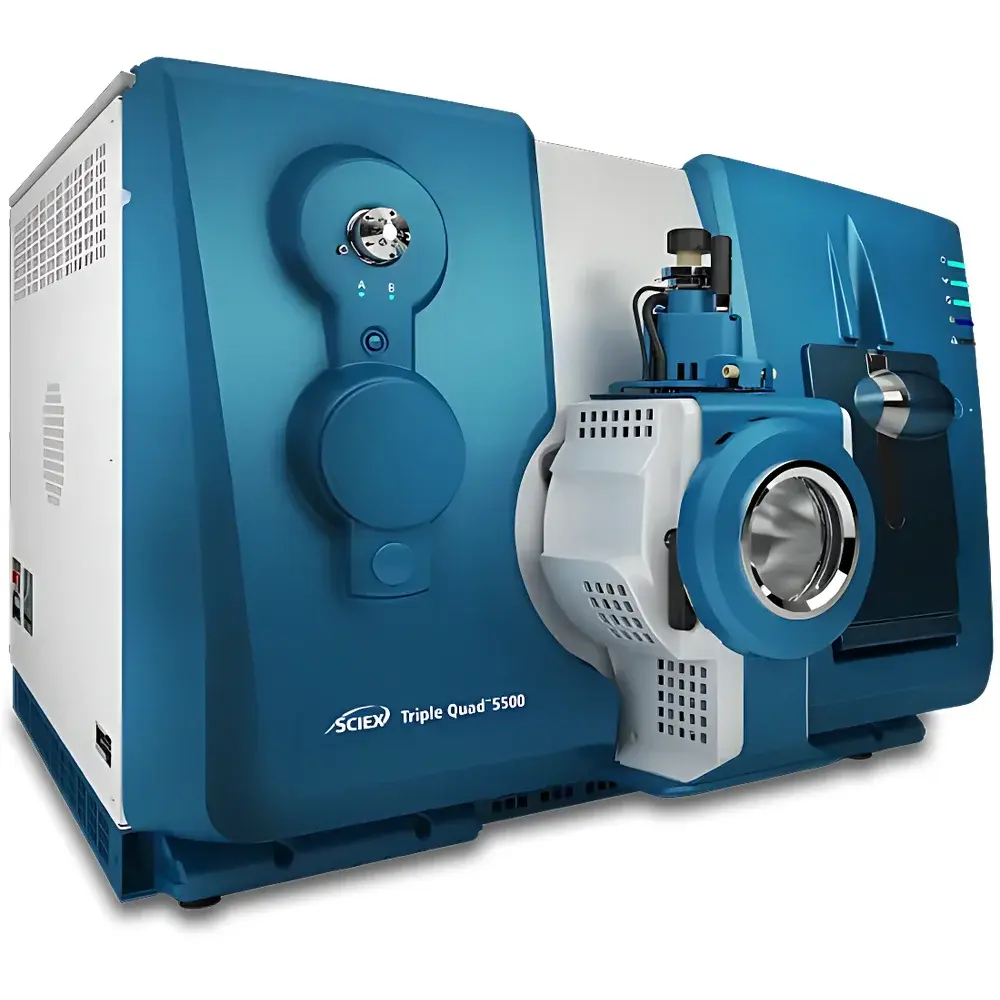
SCIEX Triple Quad™ 5500+ System with QTRAP® Ready Capability
| Brand | SCIEX |
|---|---|
| Origin | USA |
| Manufacturer Type | Authorized Distributor |
| Product Origin | Imported |
| Model | 5500+ System |
| Application Scope | General-Purpose Quantitative and Qualitative LC-MS/MS Analysis |
| Regulatory Status | Not Registered or Filed with NMPA for Clinical Diagnostics or Therapeutic Use |
Overview
The SCIEX Triple Quad™ 5500+ System is a high-performance, triple quadrupole liquid chromatography–tandem mass spectrometry (LC-MS/MS) platform engineered for demanding quantitative bioanalysis, environmental monitoring, food safety testing, and pharmaceutical research. Built upon SCIEX’s proven QTRAP® architecture, the 5500+ system operates in both conventional MRM (Multiple Reaction Monitoring) mode for ultra-sensitive quantitation and linear ion trap (LIT)-enabled MS3 mode for structural elucidation and compound identification. Its core measurement principle relies on electrospray ionization (ESI) or atmospheric pressure chemical ionization (APCI), followed by mass-selective filtering in Q1, collision-induced dissociation (CID) in a pressurized curved LINAC™ collision cell, and final mass analysis in Q3—enabling reproducible, high-duty-cycle detection of low-abundance analytes across complex matrices.
Key Features
- Curtain Gas™ Interface: A proprietary differential pumping design that separates the atmospheric-pressure ion source from the high-vacuum mass analyzer region, significantly reducing chemical noise and suppressing matrix-induced signal suppression while extending instrument uptime and data consistency over extended batch runs.
- Dual QJet™ Ion Guide: A dual-stage RF-only ion funnel system that enhances ion capture efficiency, improves collisional focusing in the first quadrupole region, and delivers superior transmission across broad m/z ranges—critical for maintaining sensitivity during rapid polarity switching and multi-analyte workflows.
- High-Energy Dynode (HED) Detector: Provides a dynamic linear range exceeding six orders of magnitude (106) with sub-femtogram-level detection limits, supporting robust quantitation across wide concentration gradients without manual gain adjustment.
- Linear Accelerator™ (LINAC™) Collision Cell: A curved, pressurized collision cell enabling near-100% duty cycle fragmentation at variable collision energies—producing rich, library-searchable MS/MS spectra with high spectral fidelity and minimal neutral loss bias.
- Q0 High-Pressure Collision Focusing: An optimized entrance region to the collision cell that increases ion density prior to fragmentation, directly contributing to enhanced signal-to-noise ratios and improved MRM sensitivity—particularly for low-ion-yield compounds.
- QTRAP® Ready Architecture: Native compatibility with QTRAP® functionality allows seamless transition between triple quadrupole quantitation and hybrid scan modes (e.g., Enhanced MS/MS, Information-Dependent Acquisition, and Scheduled MRMHR), delivering both quantitative rigor and qualitative confidence within a single acquisition method.
Sample Compatibility & Compliance
The 5500+ system interfaces natively with UHPLC systems operating up to 15,000 psi and supports reversed-phase, HILIC, and ion-pairing chromatographic methods. It accommodates diverse sample types—including plasma, serum, urine, tissue homogenates, environmental water extracts, and food digests—without requiring hardware modification. From a regulatory perspective, the system supports audit-trail-enabled data acquisition via SCIEX OS software, aligning with 21 CFR Part 11 requirements when deployed with appropriate IT controls and user access management. Method validation workflows are compatible with ICH Q2(R2), USP , and ISO/IEC 17025 frameworks. The instrument does not carry NMPA medical device registration and is explicitly intended for research-use-only (RUO) or non-clinical applications.
Software & Data Management
SCIEX OS software serves as the unified control and processing environment for the 5500+ system, offering integrated method development, real-time monitoring, automated calibration, and post-acquisition processing—including peak integration, isotopic correction, and internal standard normalization. The software supports secure, role-based user authentication, electronic signatures, and full audit trail logging for all critical events (e.g., parameter changes, data reprocessing, report generation). Raw data files comply with open-standard formats (e.g., .wiff), enabling interoperability with third-party quantitation platforms such as MultiQuant™ Software (v3.0.3+) and MasterView™ for cross-platform review. All data archives adhere to ALCOA+ principles (Attributable, Legible, Contemporaneous, Original, Accurate, Complete, Consistent, Enduring, Available) under validated laboratory information management system (LIMS) integration.
Applications
The 5500+ system is routinely deployed in regulated bioanalytical laboratories for PK/PD studies, clinical toxicology screening, doping control, pesticide residue analysis per EU SANTE/11312/2021 guidelines, mycotoxin quantification per AOAC Official Method 2012.01, and PFAS monitoring in drinking water per EPA Method 1633. Its dual-mode capability makes it especially valuable for metabolomics workflows requiring both targeted quantitation (e.g., acylcarnitines, bile acids) and untargeted MS3 confirmation. In pharmaceutical development, it supports forced degradation product identification, impurity profiling, and extractable/leachable studies compliant with ICH Q5, Q3B, and Q3D.
FAQ
Is the SCIEX 5500+ System compliant with 21 CFR Part 11?
Yes—when configured with SCIEX OS software v2.4 or later, enabled audit trails, electronic signatures, and appropriate procedural controls, the system meets technical requirements for Part 11 compliance.
Can the 5500+ perform both quantitative and qualitative analysis in a single run?
Yes—via Information-Dependent Acquisition (IDA) or Scheduled MRMHR methods, the system dynamically triggers MS/MS scans based on precursor intensity or retention time windows, enabling concurrent quantitation and structural confirmation.
What is the typical polarity switching speed?
The system achieves full polarity switching (positive to negative or vice versa) in ≤5 ms, maintaining >95% duty cycle for co-eluting analytes of opposite polarity.
Does the 5500+ require special infrastructure beyond standard LC-MS lab utilities?
It operates on standard 208–240 V AC, 50/60 Hz power; requires chilled recirculating coolant (15–25 °C) and dry, oil-free nitrogen gas (≥99.999% purity) for Curtain Gas and collision gas—no liquid nitrogen or specialized vacuum pumps are needed.
Is QTRAP® functionality included by default?
The 5500+ system is QTRAP® Ready—full QTRAP® capabilities (e.g., enhanced product ion scans, MS3) require activation via licensed software module and are subject to regional regulatory classification.




