
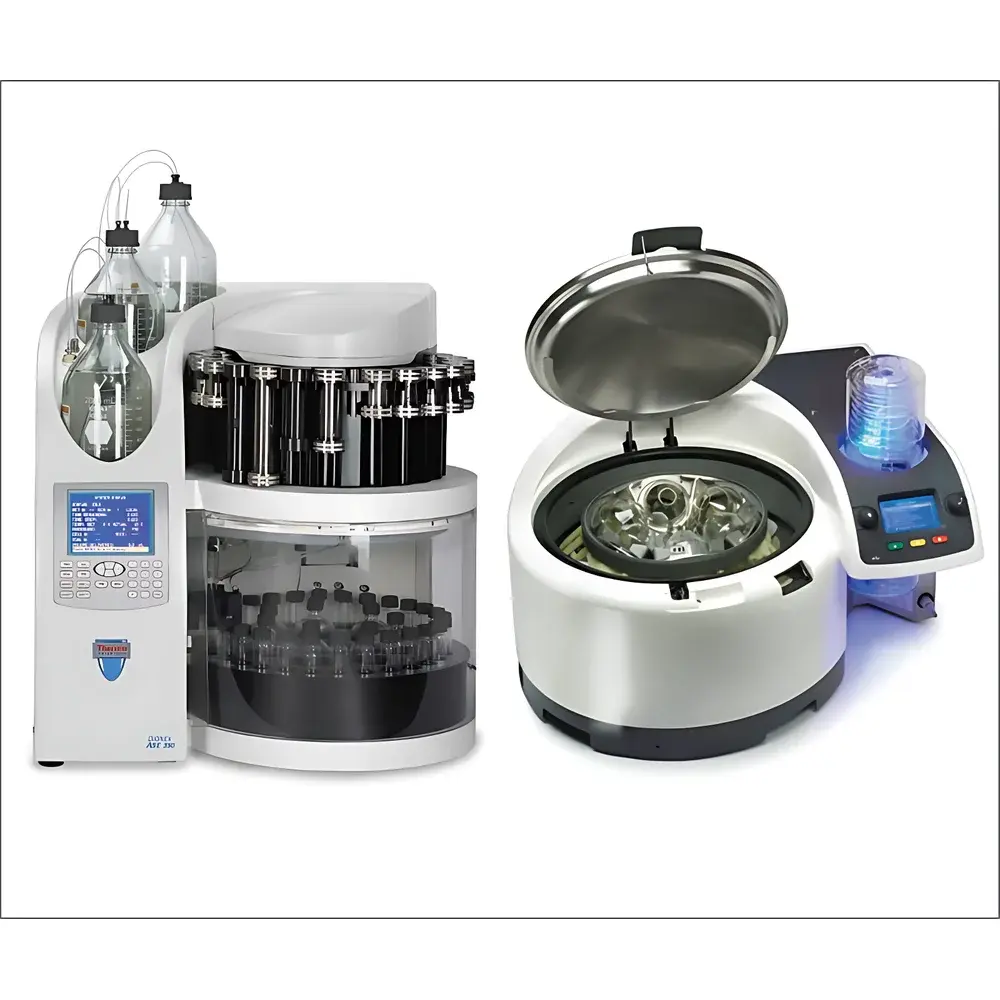
Thermo Fisher Dionex ASE+Rocket Automated Sample Preparation System
| Brand | Thermo Fisher |
|---|---|
| Origin | USA |
| Manufacturer | Thermo Fisher Scientific |
| Product Category | Imported Instrument |
| Model | ASE+Rocket |
| Instrument Type | Accelerated Solvent Extractor (ASE) with Integrated Rotary Evaporation |
| Price Range | USD 42,000 – 70,000 (FOB US Port) |
| Extraction Principle | High-Temperature/High-Pressure Static-Dynamic Solvent Extraction |
Overview
The Thermo Fisher Dionex ASE+Rocket Automated Sample Preparation System is an integrated, walk-away solution engineered for high-throughput, reproducible sample extraction and solvent removal in analytical laboratories. Built upon Thermo Fisher’s proprietary Accelerated Solvent Extraction (ASE®) technology — the industry-standard method since its commercial introduction in the 1990s — the system leverages controlled elevated temperature (up to 200 °C) and pressure (up to 20 MPa) to enhance solute solubility and mass transfer kinetics. Unlike conventional techniques such as Soxhlet extraction or ultrasonic-assisted extraction, ASE operates via static-dynamic extraction cycles: a defined volume of solvent is delivered under pressure to a sealed extraction cell containing solid or semi-solid matrix; after thermal equilibration, static extraction occurs, followed by dynamic flush and purge steps. This thermodynamically optimized process reduces typical extraction times from hours to minutes per sample while cutting solvent consumption by up to 90%. The ASE+Rocket configuration extends this workflow by directly coupling the ASE extractor to the Dionex Rocket™ evaporator — a nitrogen-purged, centrifugal rotary evaporation system designed for parallel concentration of up to 24 ASE extracts without manual intervention.
Key Features
- Full automation from extraction to solvent removal: ASE extractor initiates extraction, transfers eluate via programmable fluid path to Rocket evaporator, and triggers concentration without operator involvement.
- ASE module supports standardized 1–100 mL extraction cells (including 11 mL, 22 mL, and 33 mL formats), compatible with diverse matrices — soils, sediments, tissues, polymers, and food products.
- Rocket evaporator employs centrifugal force, heated nitrogen gas, and precise temperature control (30–80 °C) to achieve rapid, gentle solvent removal while minimizing analyte degradation or cross-contamination.
- Integrated method library compliant with EPA Methods 3545A, 3546, ASTM D7699, and ISO 14507, enabling out-of-the-box regulatory alignment.
- Robust architecture with stainless-steel fluid paths, leak-tight cell sealing, and real-time pressure/temperature monitoring ensures long-term operational reliability and method traceability.
Sample Compatibility & Compliance
The ASE+Rocket system accommodates heterogeneous solid and semi-solid samples across environmental, pharmaceutical, food safety, and forensic applications. It handles matrices with high fat content (e.g., fish tissue), complex organics (e.g., activated carbon), and moisture-sensitive materials (e.g., dried herbs) without pre-drying or extensive homogenization. All ASE extraction protocols are validated per GLP and GMP requirements. Data integrity is maintained through audit-trail-enabled software supporting 21 CFR Part 11 compliance — including electronic signatures, user access levels, and immutable method/version history. Instrument qualification documentation (IQ/OQ/PQ) templates are provided, aligned with ISO/IEC 17025 and ASTM E2500 standards.
Software & Data Management
The Thermo Fisher Chromeleon™ CDS (Chromatography Data System) v7.3 or later serves as the unified control and reporting platform. It enables end-to-end sequence definition — from cell loading and solvent selection to evaporation ramp profiles and final vial capping. All critical parameters (cell ID, solvent type, temperature ramp, pressure setpoint, flush volume, evaporation time/temperature) are logged with timestamps and user attribution. Raw data files are stored in vendor-neutral .cdf format, supporting third-party integration with LIMS and ELN systems. Batch reports include statistical summaries (RSD%, recovery %, carryover %) and customizable PDF certificates of analysis.
Applications
- Environmental analysis: PAHs, PCBs, pesticides, and dioxins in soil, sludge, and sediment per EPA SW-846 Methods.
- Food testing: Mycotoxins, veterinary drug residues, and lipid-soluble contaminants in cereals, meat, and dairy products.
- Pharmaceutical R&D: Active pharmaceutical ingredient (API) recovery from excipient blends and stability-indicating impurity profiling.
- Materials science: Additive leaching studies from plastics and polymer composites under simulated aging conditions.
- Clinical & forensic toxicology: Solid-phase microextraction (SPME) support and tissue homogenate cleanup prior to LC-MS/MS quantification.
FAQ
What extraction solvents are compatible with the ASE+Rocket system?
Commonly used solvents include acetone, dichloromethane, ethyl acetate, methanol, hexane, and mixtures thereof — all compatible with ASE’s pressure-rated cell design and Rocket’s inert nitrogen environment.
Can the system perform in-cell cleanup?
Yes — ASE cells can be packed with sorbents (e.g., silica, Florisil, PSA) upstream of the sample to enable simultaneous extraction and clean-up; this eliminates post-extraction SPE steps.
Is method transfer from legacy ASE systems supported?
All ASE+Rocket methods are backward-compatible with Thermo Fisher’s ASE 150, ASE 200, and ASE 350 platforms via Chromeleon method import/export functionality.
What maintenance intervals are recommended for routine operation?
Cell seals should be replaced every 200 extractions; nitrogen filters require quarterly replacement; and evaporator rotor bearings are rated for ≥10,000 cycles with scheduled lubrication every 6 months.
Does the system support unattended overnight operation?
Yes — fully automated sequences with up to 99 samples can be queued; built-in safety interlocks monitor pressure decay, temperature deviation, and solvent level to halt execution if thresholds are exceeded.



