
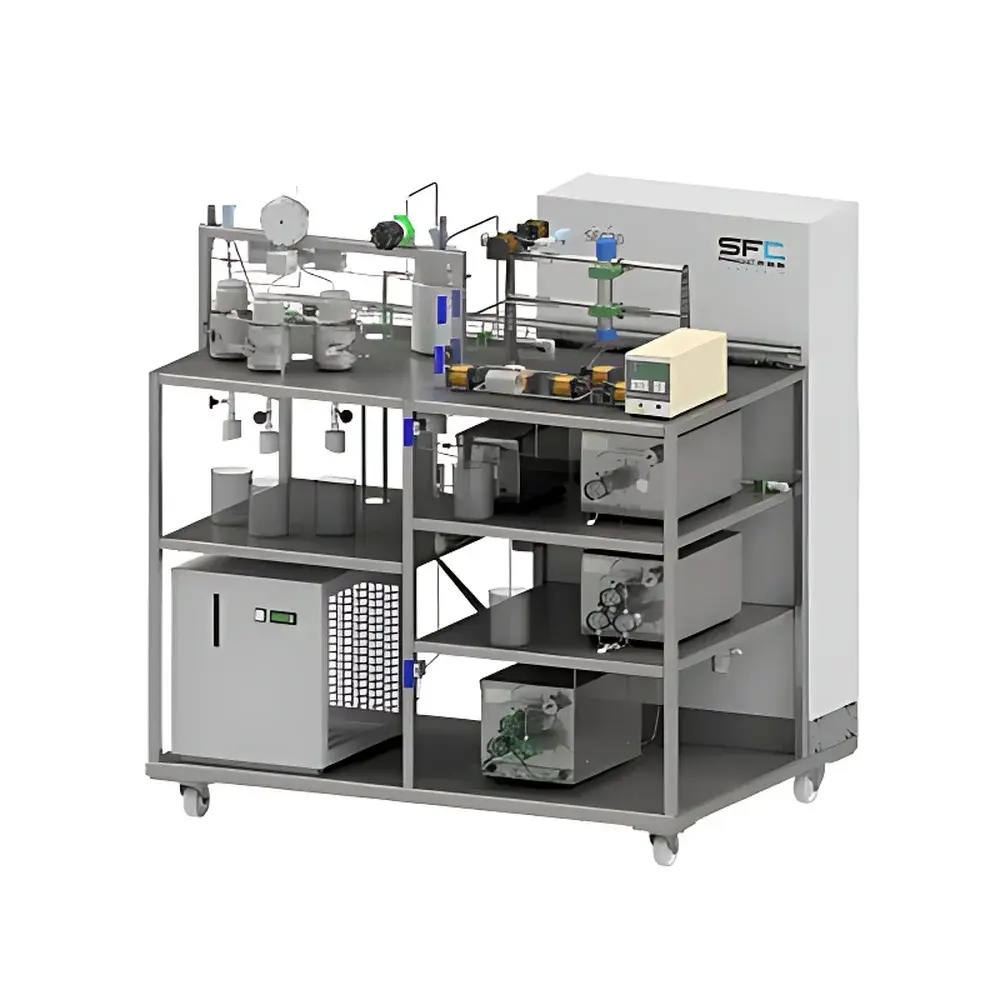
SFE PROCESS SFC30 Supercritical Fluid Chromatography (SFC) Preparative Purification System
| Brand | SFE PROCESS |
|---|---|
| Origin | France |
| Manufacturer Type | Authorized Distributor |
| Instrument Type | Preparative |
| Flow Rate | 150 g/min CO₂ |
| Maximum Operating Pressure | 14,500 psi |
| Detector | UV-Vis |
| Column ID | 30 mm |
| CO₂ Recovery Rate | >90% |
| Modifier Compatibility | Methanol, Acetonitrile, Isopropanol, Ethanol |
Overview
The SFE PROCESS SFC30 is a high-performance preparative supercritical fluid chromatography (SFC) purification system engineered for scalable, environmentally sustainable separation of chiral and achiral small molecules. It operates on the fundamental principle of supercritical fluid chromatography—utilizing carbon dioxide (CO₂) above its critical point (31.1 °C, 1,070 psi) as the primary mobile phase. In this thermodynamically distinct state, CO₂ exhibits gas-like diffusivity and low viscosity, coupled with liquid-like density and solvating power—enabling rapid mass transfer, high-resolution separations, and reduced analysis times compared to conventional liquid chromatography. The SFC30 integrates precisely controlled CO₂ delivery, modifier blending, back-pressure regulation, fraction collection, and real-time UV detection to support method development, analytical-to-preparative translation, and GMP-aligned purification workflows.
Key Features
- Robust stainless-steel fluidic architecture rated for continuous operation up to 14,500 psi, ensuring long-term stability under high-pressure supercritical conditions.
- Precision mass-flow-controlled CO₂ delivery at up to 150 g/min, with integrated thermal management to maintain consistent fluid density and elution strength.
- Automated modifier pump supporting binary gradient composition (e.g., CO₂/methanol or CO₂/ethanol), enabling fine-tuned polarity modulation for complex mixture resolution.
- UV-Vis detector with variable wavelength (190–400 nm), 10 mm pathlength flow cell, and <1.5 AU full-scale linearity—optimized for trace-level detection in preparative fractions.
- Intelligent back-pressure regulator (BPR) with active pressure feedback control, minimizing retention time drift and improving inter-run reproducibility.
- Onboard CO₂ recovery subsystem achieving >90% solvent recapture efficiency—reducing operational cost, environmental footprint, and regulatory burden associated with VOC handling.
- Modular column oven accommodating 30 mm ID preparative columns (standard length 150–250 mm), with temperature control from ambient +5 °C to 80 °C (±0.5 °C).
Sample Compatibility & Compliance
The SFC30 is routinely deployed for the purification of thermally labile, non-volatile, and chiral compounds—including pharmaceutical intermediates, enantiomeric APIs, natural product isolates, synthetic peptides, and process impurities. Its compatibility with common SFC stationary phases (e.g., polysaccharide-based chiral columns such as Chiralpak AD-H, AS-H, OD-H; as well as silica, diol, and amino-bonded phases) supports broad method development flexibility. From a regulatory standpoint, the system’s architecture aligns with key quality frameworks: pressure, flow, temperature, and UV signal data are timestamped and logged with audit-trail capability compliant with FDA 21 CFR Part 11 requirements when operated with validated software. Method parameters meet ASTM D7096 (Standard Practice for SFC Analysis) and ICH Q5A/Q5C guidelines for biopharmaceutical purity assessment. The absence of chlorinated or high-boiling organic solvents further facilitates compliance with ICH Q3C residual solvent limits and EPA-recommended green chemistry principles.
Software & Data Management
Controlled via SFE PROCESS’s proprietary SFC Navigator™ software (Windows-based), the SFC30 provides intuitive sequence programming, real-time chromatogram visualization, automated fraction triggering based on UV threshold or time windows, and post-run peak integration using tangent skim baseline correction. All raw data—including pressure transients, modifier % ramp profiles, detector absorbance, and fraction metadata—are stored in vendor-neutral .csv and .cdf formats. Software supports electronic signature workflows, user role-based access control (admin/operator/auditor), and export-ready reports conforming to GLP/GMP documentation standards. Optional integration with LIMS platforms is available via OPC UA or RESTful API interfaces.
Applications
- Chiral resolution of racemic drug candidates during preclinical development—achieving >99.5% ee with single-pass purification at gram-scale.
- Removal of genotoxic impurities (GTIs) and stereoisomeric by-products from API synthesis streams without thermal degradation.
- Isolation of bioactive flavonoids, alkaloids, and terpenoids from crude plant extracts—preserving oxidation-sensitive functional groups.
- Desalting and buffer exchange of synthetic peptides prior to lyophilization, leveraging CO₂’s immiscibility with aqueous media.
- Method scouting and transfer between analytical SFC (e.g., Waters UPC²) and preparative scale—minimizing re-optimization effort through linear scalability modeling.
FAQ
What is the maximum column internal diameter supported by the SFC30?
The SFC30 is configured for 30 mm ID preparative columns as standard; optional column ovens and flow-path adaptations support larger-diameter hardware upon request.
Does the system support automated fraction collection?
Yes—the SFC30 includes a programmable 24-position fraction collector with UV-triggered or time-based fractionation logic and vial identification tagging.
Can the SFC30 operate with modifiers other than methanol and acetonitrile?
Absolutely—it accepts polar protic (e.g., ethanol, isopropanol) and aprotic modifiers, as well as additive systems (e.g., 0.1% diethylamine for basic compounds) via auxiliary solvent modules.
Is CO₂ recovery mandatory, or can the system vent to atmosphere?
Recovery is strongly recommended for cost, safety, and sustainability reasons; however, the system allows configurable venting paths for method development or low-throughput screening.
How is system suitability verified prior to GMP runs?
Built-in performance tests include pressure decay checks, flow accuracy verification per ISO 11696, UV lamp energy calibration, and BPR response latency measurement—all documented within the electronic batch record.





