
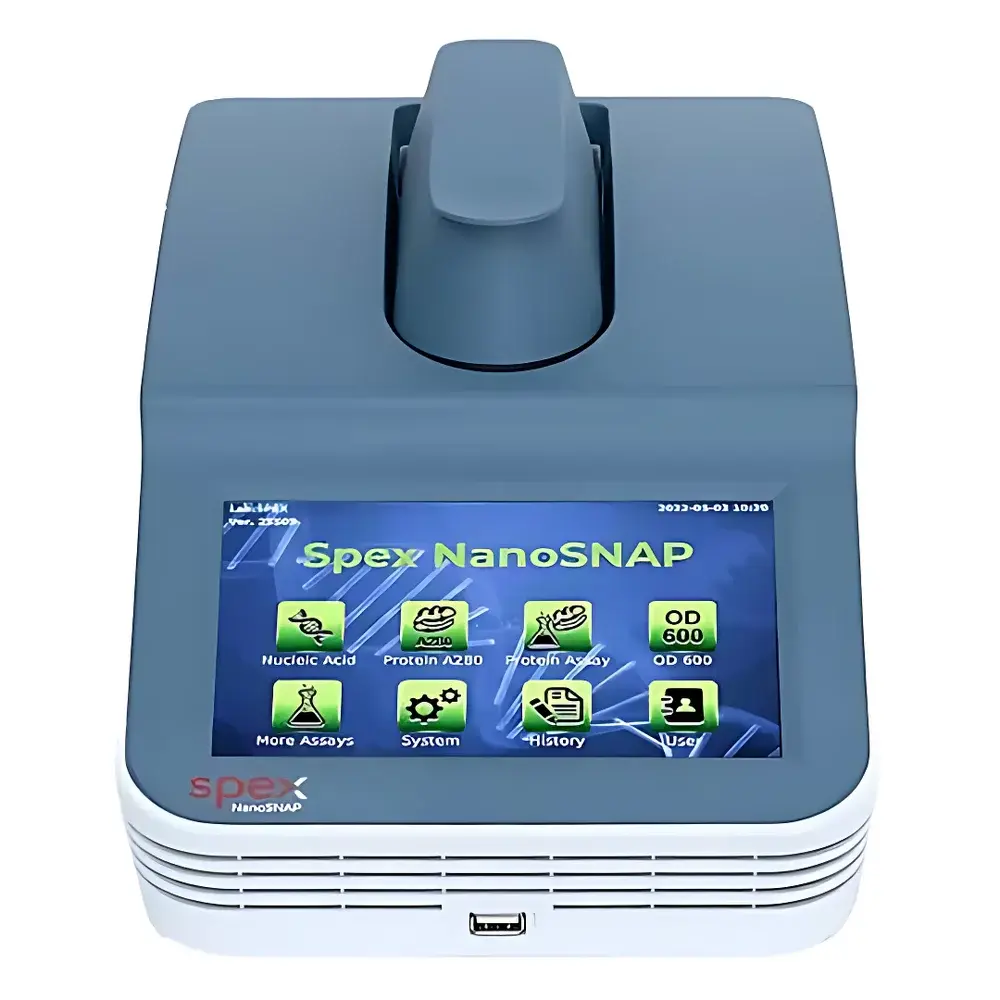
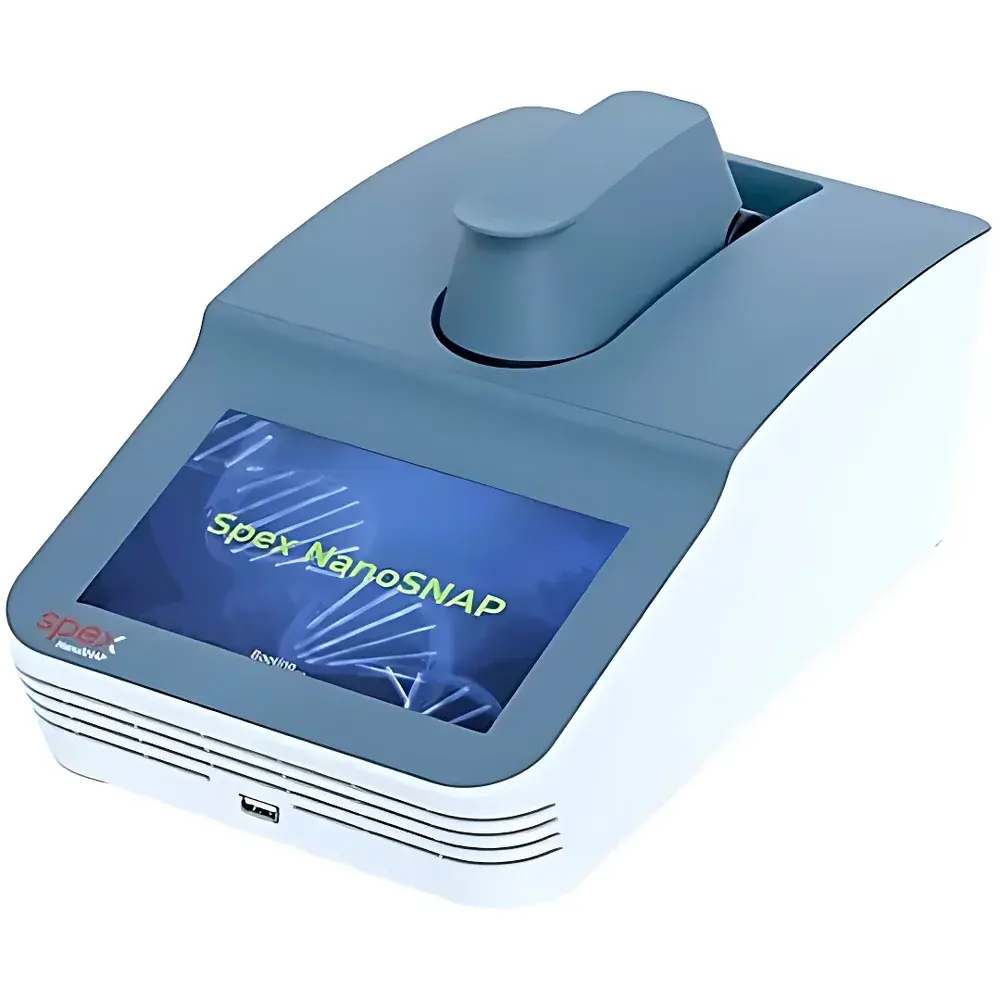
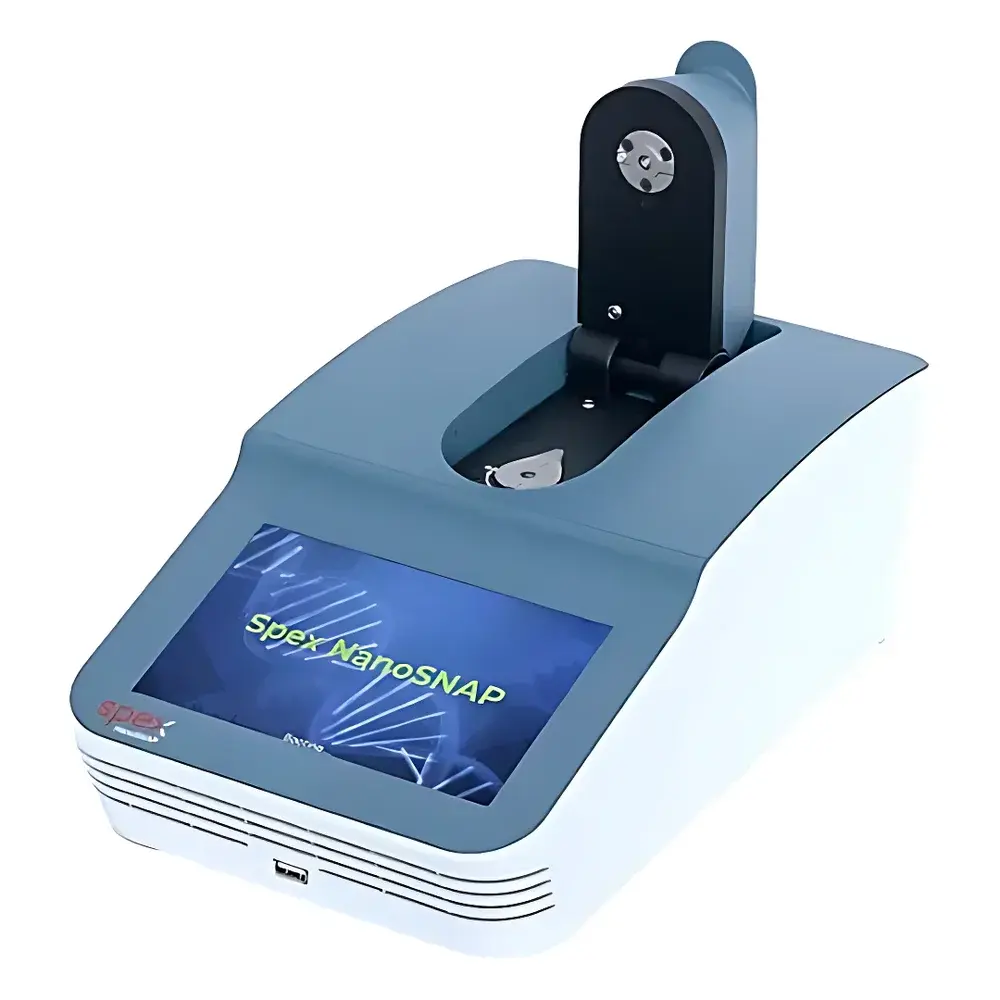
Spex NanoSNAP UV-Vis Spectrophotometer
| Brand | SPEX SamplePrep |
|---|---|
| Origin | USA |
| Model | 83057-02 |
| Spectral Bandwidth | 1.5 nm (FWHM at Hg 253.7 nm) |
| Wavelength Range | 190–1000 nm |
Overview
The Spex NanoSNAP UV-Vis Spectrophotometer is an ultra-microvolume, high-precision absorbance-based analytical instrument engineered for rapid, reliable quantification and purity assessment of nucleic acids and proteins in life science laboratories. It operates on the fundamental principle of ultraviolet-visible absorption spectroscopy, measuring sample absorbance across a continuous wavelength range from 190 nm to 1000 nm with a fixed spectral bandwidth of 1.5 nm (FWHM, calibrated at the mercury emission line at 253.7 nm). Its optical architecture employs a high-stability xenon flash lamp source and a precision monochromator system optimized for low-stray-light performance and photometric accuracy. Designed specifically for microvolume applications, the NanoSNAP requires only 1 µL of undiluted sample—eliminating time-consuming dilution steps and minimizing sample consumption—while maintaining linear dynamic range across concentrations spanning from sub-nanogram to milligram per microliter levels. The instrument’s integrated nanoscale hydrophobic coating on the sample pedestal ensures consistent droplet formation, minimal carryover, and reproducible pathlength definition without mechanical adjustment.
Key Features
- Ultra-microvolume capability: 1 µL sample volume requirement, no cuvettes or capillaries needed
- Full-spectrum scanning (190–1000 nm) with 1.5 nm spectral resolution (FWHM)
- Integrated 7-inch capacitive touchscreen interface with intuitive, role-based life science workflow navigation
- Nanostructured hydrophobic sample pedestal surface enabling stable liquid column formation and automatic pathlength calibration
- Dedicated LED alignment illumination and shock-absorbing detection arm for enhanced operational robustness and user ergonomics
- Onboard data storage with USB 2.0 front-panel port for direct export of reports, spectra, and method files
- Multi-mode measurement engine supporting nucleic acid quantification (dsDNA, ssDNA, RNA), protein A280 (BSA, IgG, lysozyme), colorimetric assays (BCA, Bradford, Modified Lowry), OD600 bacterial density, and custom UV-Vis methods
Sample Compatibility & Compliance
The NanoSNAP accommodates a broad range of biological sample types—including purified genomic DNA, plasmid preparations, total RNA isolates, crude lysates, recombinant and native proteins, and bacterial suspensions—without requiring dilution or filtration under standard operating conditions. Its optical design minimizes scattering artifacts in turbid or particulate samples through optimized beam geometry and background subtraction algorithms. From a regulatory perspective, the instrument supports GLP- and GMP-aligned workflows: all measurements include timestamped audit trails, user authentication logs, and method versioning. Data export formats (CSV, PDF, XML) are compatible with LIMS integration and satisfy documentation requirements under FDA 21 CFR Part 11 when deployed with appropriate institutional IT controls. While not certified as a medical device, the NanoSNAP conforms to IEC 61010-1 for laboratory electrical safety and meets ISO/IEC 17025 traceability recommendations for absorbance measurement when used with NIST-traceable DNA and protein reference standards (e.g., Spex DNACON 260/280 Reference, Cat. No. 99959-77).
Software & Data Management
The embedded firmware provides a dedicated Life Science User Interface (LSUI) with preconfigured assay templates, real-time spectral visualization, and automated purity ratio calculation (A260/A280, A260/A230). Custom method development is supported via editable parameters including wavelength selection, integration time, number of scans, and calibration curve configuration (linear, quadratic, or user-defined). All measurement metadata—including instrument ID, operator login, date/time stamp, sample ID, and raw absorbance values at key wavelengths—is automatically embedded in exported files. Internal memory retains ≥10,000 measurement records with searchable indexing by date, assay type, or sample ID. USB export preserves full spectral datasets (wavelength vs. absorbance) alongside summary reports, enabling offline reprocessing and cross-platform validation using third-party analysis tools such as Python-based spectrophotometry libraries or MATLAB-based spectral deconvolution scripts.
Applications
- Quantitative analysis of dsDNA, ssDNA, and RNA in next-generation sequencing library preparation and CRISPR editing workflows
- Routine QC of protein expression and purification batches via A280 and colorimetric assays
- High-throughput screening of bacterial growth kinetics using OD600 monitoring
- Verification of oligonucleotide synthesis yield and desalting efficiency
- Assessment of nucleic acid integrity in FFPE tissue extracts and plant genomic isolates
- Method transfer and cross-platform validation studies between microvolume and conventional cuvette-based spectrophotometers
FAQ
What is the minimum detectable concentration for double-stranded DNA?
The NanoSNAP achieves a lower limit of quantitation (LLOQ) of approximately 2.4 ng/µL for dsDNA using the standard 1 µL measurement protocol, validated against serial dilutions of ultra-pure salmon sperm DNA (10 mg/mL stock).
Does the instrument require routine recalibration?
No routine recalibration is required. The hydrophobic pedestal and optical path are factory-aligned and thermally stabilized. Optional annual verification using the Spex DNACON 260/280 Reference (Cat. No. 99959-77) is recommended for labs operating under ISO/IEC 17025 or internal QA protocols.
Can custom wavelength pairs be defined for kinetic assays?
Yes—users may define up to five independent wavelength sets per method, with configurable scan intervals and dwell times, enabling basic kinetic monitoring of enzymatic reactions or ligand-binding events.
Is the software compatible with Windows-based laboratory networks?
Data export is OS-agnostic (USB mass-storage class). The instrument does not require host PC software for operation, but exported CSV and XML files are fully compatible with Microsoft Excel, GraphPad Prism, and common LIMS platforms running on Windows, macOS, or Linux environments.
Related Products





