
TDR-MUX Multi-Parameter Soil Monitoring System
| Origin | Poland |
|---|---|
| Manufacturer Type | Authorized Distributor |
| Origin Category | Imported |
| Model | TDR-MUX |
| Instrument Type | Multi-Parameter Soil Analyzer |
| Price Range | USD 13,500–40,500 (FOB) |
Overview
The TDR-MUX Multi-Parameter Soil Monitoring System is a modular, research-grade instrumentation platform engineered for high-fidelity, long-term in situ and laboratory-based characterization of unsaturated soil hydraulic and thermal properties. At its core, the system leverages Time-Domain Reflectometry (TDR) as the primary physical principle for volumetric water content (θv) measurement—based on the dielectric permittivity contrast between water (εr ≈ 80) and dry soil matrix (εr ≈ 3–5). Complementary sensing modalities include four-wire conductivity measurement for bulk electrical conductivity (σb, reported in S/m), thermistor-based temperature monitoring (±0.5 °C accuracy), and ceramic-cup tensiometric measurement of soil matric potential (ψ, in kPa or mbar). The architecture supports both field-deployable configurations—using ruggedized FP-series probes—and controlled-laboratory setups—employing LP-series miniaturized sensors embedded in standardized soil columns. This dual-environment capability enables rigorous validation of hydrological models (e.g., HYDRUS-1D), calibration of pedotransfer functions, and experimental determination of soil water retention curves (pF curves), unsaturated hydraulic conductivity (Ku), and diffusivity (D(θ)).
Key Features
- Modular 8-channel TDR/MUX/mpts data logger with independent per-channel TDR calibration—ensuring traceable accuracy across heterogeneous soil profiles.
- Expandable sensor interface: 8 dedicated TDR channels + 1 auxiliary port supporting up to 16 low-power LP-series sensors (LP/ms, LP/p, LP/t) via daisy-chained RS-485.
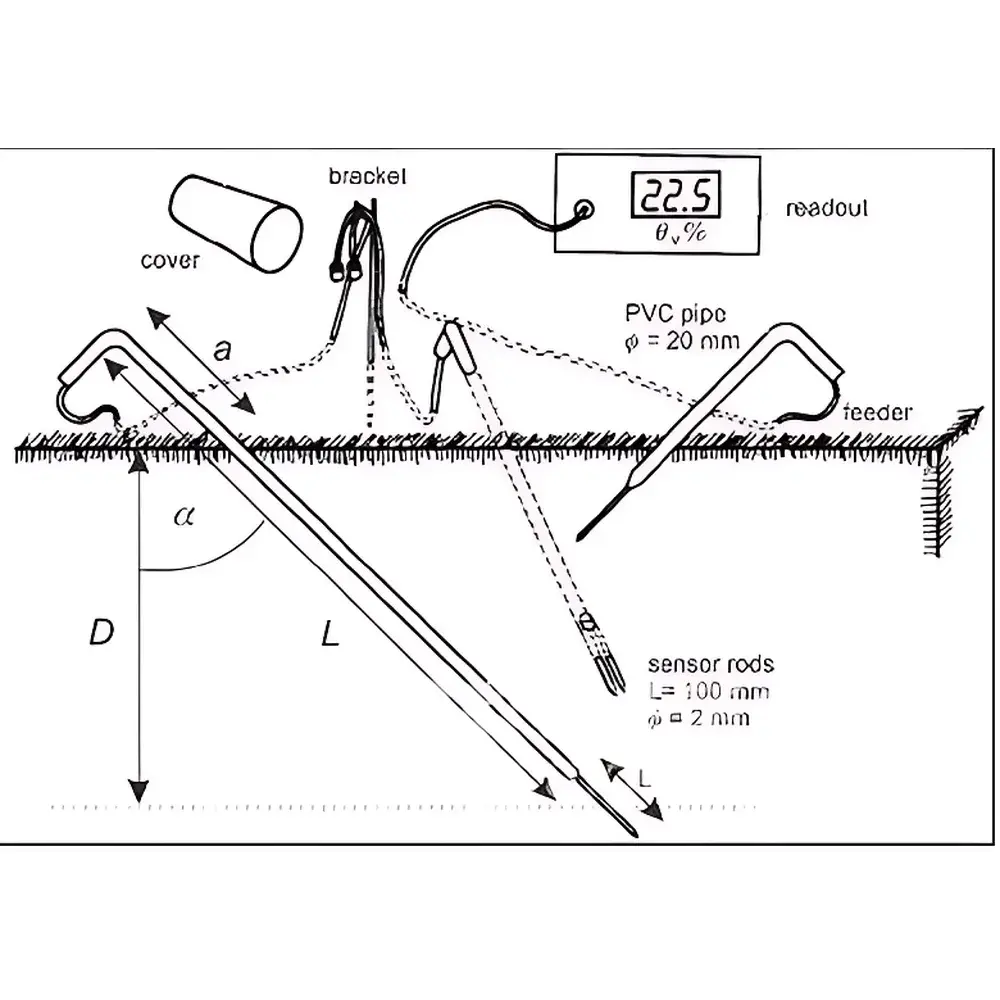
- Field-proven FP/mts probe: Integrated TDR moisture, thermistor temperature, and four-electrode EC measurement in a single 20-mm-diameter PVC housing; minimizes thermal bridging via thin-wall geometry and stainless-steel 3-mm-diameter rods.
- Lab-optimized LP-series mini-sensors: LP/ms (moisture + salinity), LP/p (tensiometric matric potential, ±15% relative error, 1 mbar resolution), and LP/t (high-resolution temperature, 0.01 °C resolution, −20 to +60 °C range) — all designed for 8-mm installation bores in standardized metal soil columns (55-mm ID, 100-mm height).
- Onboard non-volatile memory storing >10,000 timestamped records; real-time USB 2.0 interface with open-format CSV export; built-in RTC and internal temperature reference.
- Optional MIDL-2 GPRS telemetry module: Enables remote data retrieval, configuration updates (sampling interval, clock sync, channel activation), and secure FTP upload to user-defined or IA PAS-hosted servers; supports up to 16 concurrent TDR/MUX loggers via shared cellular infrastructure.
Sample Compatibility & Compliance
The TDR-MUX system is compatible with mineral soils ranging from coarse sand to clay loam (texture classes per USDA classification), including structured and organic-rich substrates where probe insertion integrity is maintained. All FP-series probes are rated IP68 for continuous burial; LP-series sensors require controlled column environments with stable mechanical confinement. The system adheres to ASTM D5084–22 (in situ hydraulic conductivity), ISO 11276:2020 (soil water retention), and USP guidelines for analytical instrument qualification—particularly relevant for environmental fate studies supporting regulatory submissions (e.g., EPA OPPTS 835.1200). Data integrity meets GLP audit requirements through immutable timestamping, configurable measurement metadata tagging, and optional MIDL-2 audit logs (user login, parameter changes, firmware version).
Software & Data Management
The system ships with free, Windows-compatible acquisition software featuring real-time visualization, multi-sensor overlay plots, and automated TDR waveform analysis (including cable loss compensation and reflection peak detection). Export formats include CSV, Excel (.xlsx), and MATLAB (.mat) for downstream modeling. Raw TDR waveforms are retained for post-hoc reprocessing using custom algorithms (e.g., CTD calibration, complex permittivity inversion). When integrated with MIDL-2, data streams comply with HTTP RESTful API conventions and support TLS 1.2 encryption. Audit trails—including operator ID, timestamped configuration changes, and storage buffer status—are exportable as PDF reports for regulatory review. No cloud dependency: local server deployment (Linux/Windows) is fully supported via open TCP/IP protocols.
Applications
- Determination of soil water retention curves (pF curves) and hysteresis loops via controlled drainage/imbibition experiments in laboratory columns.
- Quantification of unsaturated hydraulic conductivity (Ku) using transient outflow/inflow methods coupled with simultaneous θv and ψ profiling.
- Monitoring solute transport dynamics (e.g., nitrate leaching, salt accumulation) via co-located LP/ms and LP/p arrays under variable irrigation regimes.
- Field-scale validation of vadose zone models (e.g., SWAP, STANMOD) using long-term FP/mts deployments across climatic gradients.
- Thermal-hydraulic coupling studies: synchronized LP/t and LP/ms measurements enable estimation of thermal conductivity and latent heat flux under non-isothermal conditions.
- Calibration and intercomparison of proximal sensing platforms (e.g., cosmic-ray neutron probes, capacitance sensors) against TDR-derived ground truth.
FAQ
What is the maximum recommended depth for FP/mts probe installation in field soils?
For optimal signal integrity and mechanical stability, FP/mts probes are validated for vertical insertion up to 150 cm; custom lengths up to 400 cm are available but require site-specific validation of cable attenuation and rod bending resistance.
Can LP/ms and LP/p sensors be installed in the same soil column without cross-interference?
Yes—the metal column features helically distributed 8-mm bores to minimize spatial interference; empirical testing confirms negligible crosstalk when sensors are spaced ≥20 mm apart along the column axis.
Does the TDR/MUX/mpts logger support external power sources beyond 6–15 VDC?
No—it is strictly regulated to 6–15 VDC input; operation outside this range may damage the internal DC-DC converters and void calibration traceability.
Is MIDL-2 GPRS module compatible with LTE-M or NB-IoT networks?
MIDL-2 operates exclusively on legacy 2G/3G GPRS networks; for LTE-M/NB-IoT deployments, a third-party gateway with Modbus RTU-to-MQTT translation is required.
How frequently should LP/p tensiometers be recalibrated in long-term lab experiments?
Ceramic cup equilibration drift is characterized at ≤20 mbar/month; we recommend quarterly zero-point verification against saturated salt solutions and annual full-range calibration using pressure standards traceable to NIST.







