
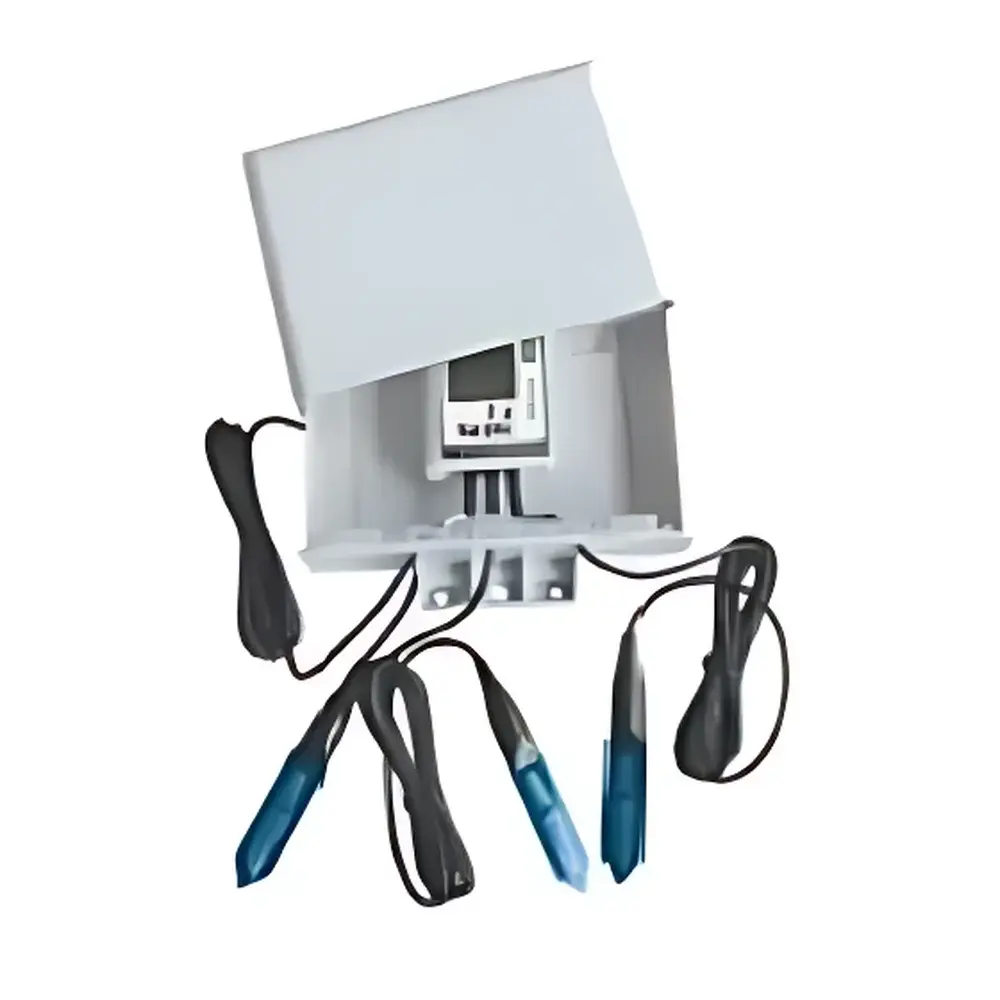
Spectrum Technologies WatchDog 1400 Soil Moisture and Temperature Monitoring Station
| Brand | Spectrum Technologies |
|---|---|
| Origin | USA |
| Model | WatchDog 1400 |
| Instrument Type | Multi-parameter Soil Monitoring System |
| Sensor Capacity | 4 channels |
| Data Storage | 10,080 records |
| Sampling Interval | 1–60 minutes (user-configurable) |
| Display | Built-in LCD screen |
| Power | CR2032 battery (12-month typical life) |
| Soil Moisture Sensor Range | 0% to saturation (Volumetric Water Content, VWC) |
| Resolution | 0.1% VWC |
| Accuracy | ±3% VWC (at EC < 8 mS/cm) |
| Sensor Dimensions | 6 cm × 2 cm × 0.3 cm |
| Oscillation Frequency | 80 MHz |
| Output Signal | Analog voltage (0.5–1.5 V at 3 V excitation |
| Cable Length | Standard 1.8 m (optional 6 m |
| Operating Voltage | 3–5 V DC @ 6–10 mA |
Overview
The Spectrum Technologies WatchDog 1400 Soil Moisture and Temperature Monitoring Station is a field-deployable, low-power environmental data logging system engineered for long-term, unattended monitoring of soil volumetric water content (VWC) and temperature across up to four discrete locations. It operates on the principle of frequency-domain reflectometry (FDR), utilizing an 80 MHz oscillator to measure the dielectric permittivity of soil—directly correlated to water content—while compensating for salinity effects within typical agricultural and ecological ranges (EC < 8 mS/cm). Designed for integration into irrigation scheduling, drought assessment, agronomic research, and ecological monitoring networks, the WatchDog 1400 delivers high reproducibility in variable field conditions without requiring continuous external power or network connectivity.
Key Features
- Four-channel analog input architecture supporting simultaneous connection of up to four FDR-based soil moisture and temperature sensors
- Integrated LCD display enabling real-time viewing of current sensor readings, battery status, and sampling interval settings—no external device required for field verification
- Onboard non-volatile memory storing up to 10,080 timestamped records (e.g., ~209 days at 30-minute intervals)
- CR2032 lithium battery powering the system for approximately 12 months under standard sampling conditions (30-min interval, ambient temperatures 0–40°C)
- User-configurable sampling intervals from 1 to 60 minutes via simple button interface
- Robust sensor design with compact 6 cm × 2 cm × 0.3 cm sensing volume, minimizing soil disturbance during installation
- Standard 1.8 m sensor cable (extendable to 15 m using shielded, low-capacitance cabling to preserve signal integrity)
Sample Compatibility & Compliance
The WatchDog 1400 is validated for use in mineral soils, loams, sandy, and clay-rich substrates where bulk electrical conductivity remains below 8 mS/cm—a threshold aligned with ASTM D5725-19 (Standard Test Method for Determining Volumetric Water Content of Unsaturated Rock and Soil Using Electromagnetic Methods). While not certified for regulated GLP/GMP environments, its measurement traceability supports QA/QC protocols in USDA-NRCS, FAO, and CIMMYT-affiliated field trials. Sensor calibration is factory-established using gravimetric reference methods per ISO 11272:2017 (Soil quality — Determination of dry matter and water content on a mass basis). No firmware or hardware modifications are required for deployment in USDA Plant Hardiness Zones 3–11.
Software & Data Management
Data retrieval is performed via USB-to-serial cable using Spectrum Technologies’ proprietary WatchDog Software (Windows-compatible, v5.0+). The software enables batch download, time-series visualization, export to CSV/Excel, and basic statistical analysis (min/max/mean/stdev per channel). All logged entries include UTC timestamps, sensor ID tags, and battery voltage metadata. While the system does not support wireless transmission or cloud synchronization natively, exported datasets are compatible with third-party platforms including RStudio, Python (pandas), and MATLAB for advanced modeling (e.g., SWAP, HYDRUS-1D). Audit trails are maintained locally in the software’s project log files, though the device itself does not implement FDA 21 CFR Part 11-compliant electronic signatures or user-role access controls.
Applications
- Irrigation optimization in precision agriculture and horticultural greenhouses
- Long-term soil water balance studies in watershed hydrology and climate change impact assessments
- Root-zone moisture profiling for crop phenotyping and drought-tolerance screening
- Validation of satellite-derived soil moisture products (e.g., SMAP, Sentinel-1 SAR)
- Environmental education and citizen science deployments requiring rugged, low-maintenance instrumentation
- Baseline monitoring for land reclamation, mine site rehabilitation, and landfill cover performance evaluation
FAQ
What is the recommended installation depth for the soil moisture sensors?
Sensors should be installed at agronomically relevant depths (e.g., 15 cm, 30 cm, 60 cm) depending on root zone requirements; ensure full contact between sensor surface and undisturbed soil.
Can the WatchDog 1400 operate in frozen soil conditions?
No—FDR-based measurements become unreliable below 0°C due to phase transition effects on dielectric response; data logging may continue, but VWC values are not valid in frozen matrixes.
Is sensor recalibration required after extended field deployment?
Factory calibration remains stable for ≥2 years under normal exposure; however, users conducting high-accuracy research should verify against gravimetric samples annually or after major soil amendments.
Does the system support external power input?
Yes—the terminal block accepts regulated 3–5 V DC input, enabling solar-battery hybrid operation when paired with appropriate charge controllers and low-dropout regulators.
How is temperature compensation applied to VWC readings?
Each connected sensor includes an integrated thermistor; the logger applies empirically derived temperature coefficients during analog-to-digital conversion to minimize thermal drift in permittivity-derived VWC calculations.
Related Products







